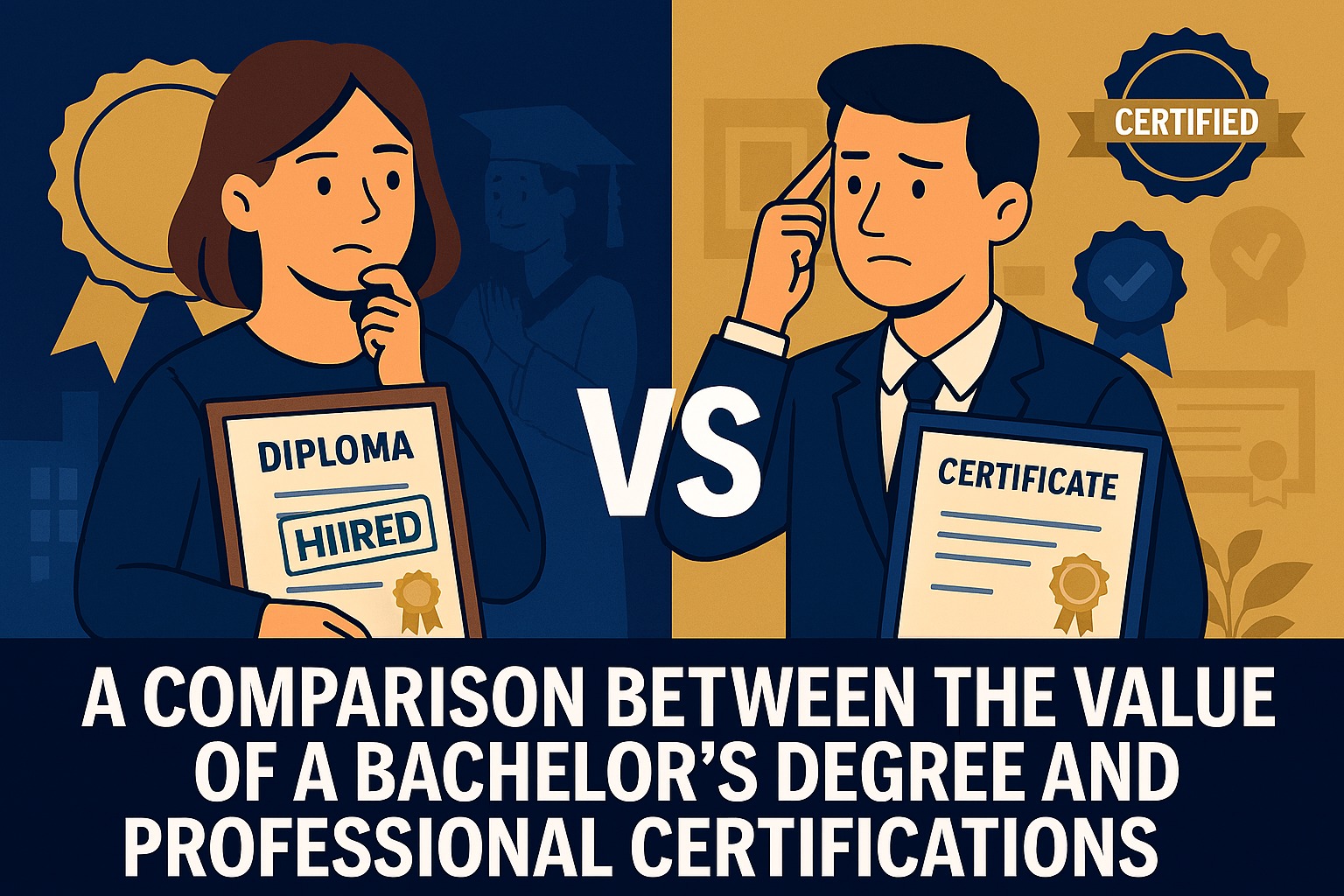
In today’s fast-changing employment landscape, professionals are constantly evaluating the best path to career success. As industries evolve due to digital transformation, automation, and globalization, both traditional academic qualifications and specialized credentials are being reassessed. This has sparked an important debate: what holds greater value in the modern workforce—a bachelor’s degree or professional certifications? While both pathways aim to enhance employability and expertise, they differ significantly in structure, purpose, duration, and long-term impact. Understanding these differences is essential for students, early-career professionals, and even experienced workers seeking advancement.
UNDERSTANDING A BACHELOR’S DEGREE
A bachelor’s degree is a formal academic qualification awarded by universities after completing a structured multi-year program, typically lasting three to four years. It provides comprehensive theoretical knowledge within a specific discipline, such as engineering, business, computer science, healthcare, or social sciences.
The core value of a bachelor’s degree lies in its depth and breadth. Students gain foundational knowledge, analytical reasoning abilities, research skills, and critical thinking competencies. In addition to subject-specific expertise, higher education cultivates transferable skills such as communication, teamwork, and strategic problem-solving.
Many industries continue to regard a bachelor’s degree as a baseline requirement for entry-level roles. In regulated professions—such as law, medicine, accounting, and education—formal academic credentials are mandatory. Furthermore, a bachelor’s degree often serves as a prerequisite for postgraduate studies and leadership positions.
UNDERSTANDING PROFESSIONAL CERTIFICATIONS
Professional certifications, on the other hand, are specialized credentials designed to validate specific skills or competencies. They are typically shorter in duration and more focused than a traditional degree. Certifications are commonly offered in fields such as information technology, project management, digital marketing, cybersecurity, finance, and data analytics.
The primary strength of professional certifications lies in their practicality and industry relevance. They are often developed in collaboration with industry experts and aligned with current market demands. This ensures that certified individuals possess job-ready skills applicable to real-world scenarios.
Certifications can also be earned more quickly and at a lower cost compared to a bachelor’s degree. For individuals seeking immediate career transitions or skill upgrades, certifications offer a flexible and targeted learning pathway.
COMPARING LONG-TERM CAREER IMPACT
When comparing the long-term impact of a bachelor’s degree and professional certifications, it is important to consider career stage and professional goals.
A bachelor’s degree tends to provide stronger long-term stability and career mobility. It establishes a broad academic foundation that allows individuals to shift roles, industries, or pursue advanced education. Many organizations consider formal degrees when evaluating candidates for managerial or executive positions.
Professional certifications, however, offer immediate competitive advantages in technical or specialized roles. They signal up-to-date expertise and commitment to professional development. In rapidly evolving industries such as technology, certifications can significantly enhance employability.
However, certifications alone may not always substitute for a degree in sectors where formal education remains a standard requirement. Conversely, a degree without updated skills may limit competitiveness in highly technical environments.
COST, TIME, AND RETURN ON INVESTMENT
Cost and time investment are critical factors in evaluating both options. A bachelor’s degree requires several years of study and often involves substantial tuition expenses. The return on investment is typically realized over the long term through higher earning potential and expanded career opportunities.
Professional certifications usually demand shorter preparation periods and lower financial commitments. They can provide quicker entry into specific roles and may yield immediate salary improvements. However, certifications often require renewal or continuous updates to remain valid, especially in technology-related fields.
Therefore, the financial and time-related value of each pathway depends largely on individual circumstances, industry demands, and long-term career aspirations.
THE POWER OF COMBINATION
Rather than viewing a bachelor’s degree and professional certifications as competing credentials, many experts emphasize their complementary nature. A degree offers intellectual depth and academic credibility, while certifications demonstrate specialized and current expertise.
For example, a business graduate who earns certifications in data analytics or project management significantly enhances their marketability. Similarly, an IT professional with a computer science degree and advanced cybersecurity certifications stands out in a competitive hiring environment.
Employers increasingly favor candidates who combine strong educational backgrounds with practical, industry-recognized credentials. This blended approach reflects adaptability and lifelong learning—qualities that are essential in the modern workforce.
INDUSTRY-SPECIFIC CONSIDERATIONS
The relative value of a bachelor’s degree versus certifications varies by industry. In healthcare, education, engineering, and legal professions, academic degrees remain indispensable. In contrast, technology, digital marketing, and creative industries may prioritize hands-on skills and recognized certifications.
Global companies also consider regional standards and accreditation systems when evaluating qualifications. In multinational environments, having both a degree and relevant certifications can enhance international mobility and professional credibility.
Understanding industry expectations is therefore crucial when deciding which path to prioritize.
CONCLUSION
A comparison between the value of a bachelor’s degree and professional certifications reveals that both play significant roles in shaping career success. A bachelor’s degree provides comprehensive knowledge, intellectual growth, and long-term career mobility. Professional certifications deliver specialized expertise, practical relevance, and immediate market competitiveness.
The modern job market does not necessarily require choosing one over the other. Instead, professionals who integrate formal education with targeted certifications position themselves for sustainable growth and adaptability. As industries continue to evolve, the combination of academic foundation and specialized skill validation offers the strongest pathway to long-term professional success.
Tentang Penulis
Gusti Ayu Tita
Penulis — Universitas STEKOM
Penulis aktif yang berfokus pada isu-isu akademik, teknologi pendidikan, dan pengembangan sumber daya manusia di lingkungan kampus.