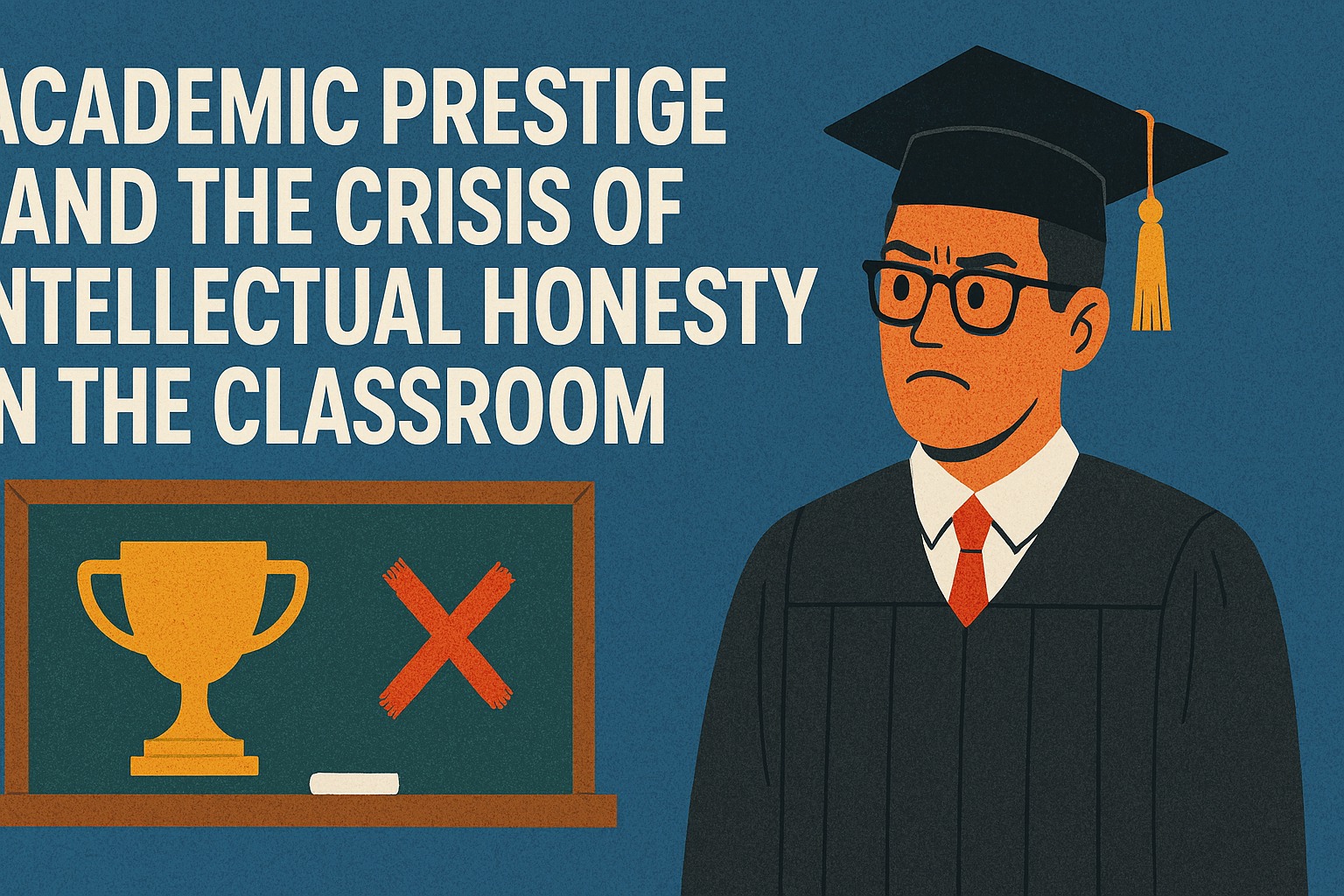
In many universities, academic prestige is treated as a symbol of intellectual superiority. Students compete not only for grades but also for recognition, reputation, and validation. While prestige can motivate excellence, it may also create unintended consequences. One of the most concerning is the gradual decline of intellectual honesty in classroom discussions.Intellectual honesty requires students to admit what they do not know, question assumptions, and engage in authentic dialogue. However, in competitive academic environments, acknowledging confusion can feel like admitting weakness. As a result, some students choose to perform understanding rather than genuinely seek clarity. This phenomenon reflects a deeper cultural issue within higher education.
THE RISE OF ACADEMIC PRESTIGE CULTURE
Prestige in academic settings often manifests through visible indicators: high GPA, eloquent speech, complex vocabulary, and active participation. Students who appear confident and articulate are frequently perceived as more competent, even when their understanding may be superficial.
Over time, this dynamic fosters a performance-oriented classroom culture. Students become more focused on appearing knowledgeable than on developing real comprehension. Academic discussions shift from collaborative learning spaces into stages for intellectual display.
INTELLECTUAL HONESTY UNDER PRESSURE
When prestige becomes the primary currency, intellectual honesty is at risk. Students may avoid asking basic questions out of fear of being judged. Some may paraphrase others’ ideas without fully understanding them, while others offer vague comments that sound sophisticated but lack depth.
This behavior does not necessarily involve plagiarism or cheating in the traditional sense. Instead, it reflects a subtle form of academic dishonesty—misrepresenting one’s level of understanding. Over time, this practice weakens critical thinking and authentic engagement.
THE IMPACT ON CLASSROOM DYNAMICS
A classroom where intellectual vulnerability is discouraged becomes intellectually stagnant. Students hesitate to challenge ideas or admit confusion. Discussions remain surface-level because no one wants to risk appearing uninformed.
In such environments, genuine learning is replaced by impression management. Students may leave the classroom with high grades but limited conceptual clarity. The long-term consequence is a generation of graduates who excel in presentation but struggle with independent critical analysis.
TOWARD A CULTURE OF AUTHENTIC LEARNING
Addressing this crisis requires redefining what academic prestige means. Instead of rewarding flawless performance, institutions should value curiosity, humility, and thoughtful questioning. Educators play a crucial role in modeling intellectual honesty by openly acknowledging complexity and uncertainty.
When students feel safe admitting gaps in their knowledge, classrooms transform into spaces of genuine exploration. Intellectual honesty then becomes a strength rather than a liability.
CONCLUSION
Academic prestige can inspire excellence, but when it prioritizes appearance over authenticity, it undermines the very purpose of education. Reclaiming intellectual honesty is essential for restoring meaningful academic discourse. Universities must cultivate environments where vulnerability is respected and curiosity is celebrated. Only then can academic prestige align with true intellectual growth.
Tentang Penulis
Gusti Ayu Tita
Penulis — Universitas STEKOM
Penulis aktif yang berfokus pada isu-isu akademik, teknologi pendidikan, dan pengembangan sumber daya manusia di lingkungan kampus.