
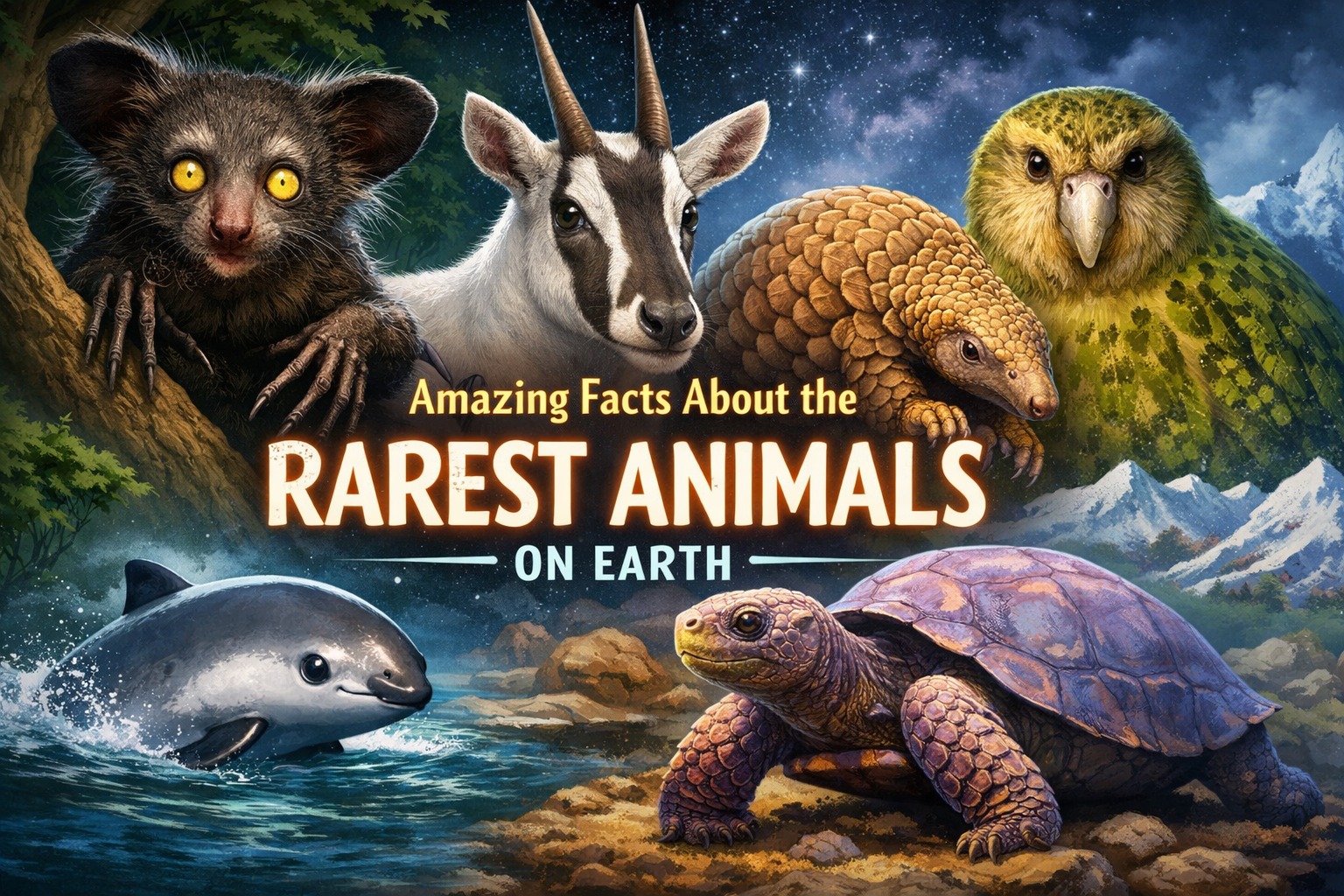
The world is home to millions of animal species, but some are so rare that only a few individuals remain in the wild. These extraordinary creatures are often found in isolated habitats and face serious threats such as climate change, habitat destruction, illegal hunting, and pollution. Learning about the rarest animals on Earth can inspire people to protect wildlife and preserve biodiversity for future generations.
WHY RARE ANIMALS ARE IMPORTANT
Rare animals play a major role in maintaining ecological balance. Every species has a unique function in nature, whether it is pollinating plants, controlling pests, or supporting food chains. When a species disappears, ecosystems can become unstable.
In addition, rare animals are valuable for scientific research, education, and environmental awareness. Protecting endangered species also helps preserve forests, oceans, and other natural habitats that humans rely on.
THE VAQUITA: THE WORLD’S RAREST MARINE MAMMAL
The vaquita is a small porpoise that lives only in the northern part of the Gulf of California in Mexico. Scientists estimate that fewer than 20 vaquitas remain in the wild, making it one of the rarest animals on Earth.
This shy marine mammal is threatened mainly by illegal fishing nets. Despite international conservation efforts, the vaquita remains critically endangered. Its small size, dark eye patches, and gentle behavior make it one of the most unique sea creatures in the world.
THE JAVAN RHINOCEROS: A GIANT ON THE EDGE OF EXTINCTION
The Javan rhinoceros is among the rarest large mammals alive today. It can only be found in a protected national park in Indonesia. Experts believe that fewer than 80 individuals survive in the wild.
Unlike other rhino species, the Javan rhino is extremely difficult to study because it avoids human contact. Habitat loss and poaching nearly caused its extinction. Conservation programs are now focused on protecting its forest habitat and increasing population numbers.
THE SAOLA: THE “ASIAN UNICORN”
Discovered only in 1992, the saola is one of the rarest mammals in the world. It lives in the dense forests of Laos and Vietnam. Because it is rarely seen, scientists still know very little about its behavior and lifestyle.
The saola is often called the “Asian unicorn” due to its mysterious nature and long, straight horns. Hunting and habitat destruction are the biggest threats to this remarkable animal.
THE AMUR LEOPARD: A BEAUTIFUL BIG CAT
The Amur leopard is known for its thick fur and stunning spotted coat. It survives in the cold forests of eastern Russia and parts of China. This rare leopard is critically endangered because of illegal hunting and deforestation.
Although conservation efforts have helped increase its population slightly, the Amur leopard remains one of the rarest big cats on Earth. Its ability to survive harsh winters makes it a truly extraordinary predator.
THE KAKAPO: THE FLIGHTLESS PARROT
The kakapo is a unique parrot native to New Zealand. Unlike most parrots, it cannot fly and is active mainly at night. The bird has a friendly personality and a distinctive owl-like face.
Introduced predators such as cats and rats nearly wiped out the kakapo population. Today, conservationists carefully monitor and protect every remaining bird. Thanks to these efforts, the kakapo population has slowly increased over the years.
HOW HUMAN ACTIVITIES THREATEN RARE SPECIES
Human activities are the biggest reason many animals are becoming rare. Deforestation destroys habitats, while pollution damages rivers and oceans. Illegal wildlife trade also pushes many species closer to extinction.
Climate change creates additional challenges by altering temperatures and weather patterns. Animals that cannot adapt quickly enough may struggle to survive in changing environments.
CONSERVATION EFFORTS TO SAVE ENDANGERED ANIMALS
Many organizations and governments are working together to protect rare species. Wildlife reserves, anti-poaching laws, breeding programs, and environmental education campaigns are helping endangered animals recover.
People can also contribute by supporting conservation groups, reducing plastic waste, and avoiding products linked to habitat destruction. Even small actions can make a significant difference in protecting Earth’s biodiversity.
CONCLUSION
The rarest animals on Earth remind us how precious and fragile wildlife can be. From the mysterious saola to the critically endangered vaquita, these species highlight the importance of global conservation efforts. Protecting rare animals is not only about saving wildlife but also about preserving the balance of nature for future generations.
Tentang Penulis
Gusti Ayu Tita
Penulis — Universitas STEKOM
Penulis aktif yang berfokus pada isu-isu akademik, teknologi pendidikan, dan pengembangan sumber daya manusia di lingkungan kampus.



