
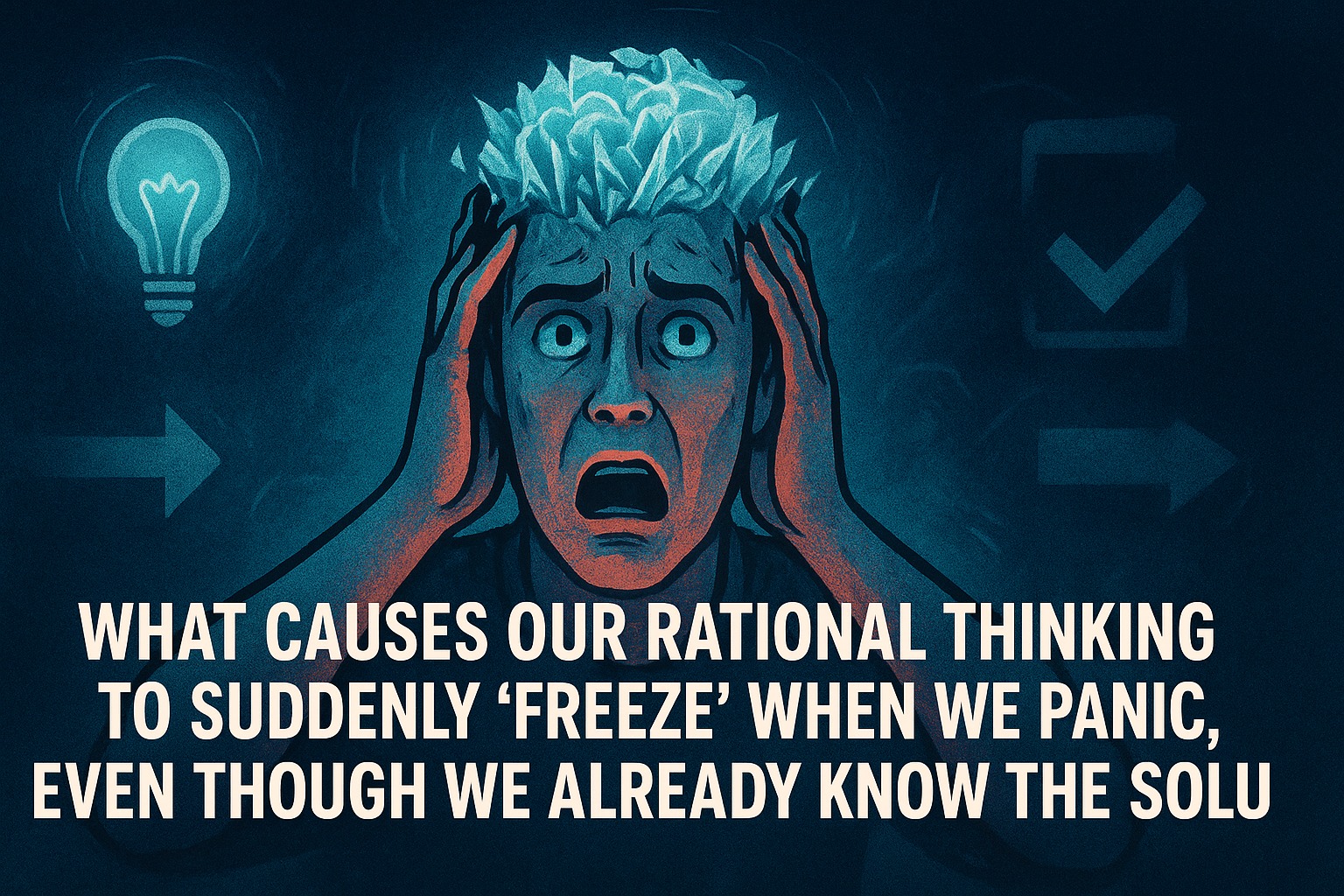
Many people have experienced moments when rational thinking seems to stop working exactly when it’s needed most. Even though the solution is clear, familiar, and something we’ve done many times, everything suddenly disappears the moment panic strikes. This phenomenon isn’t just a “blank moment,” but a biological and psychological response that happens automatically. This article explains the main causes and how we can anticipate them.
WHAT HAPPENS IN THE BRAIN WHEN WE PANIC?
When panic occurs, the brain activates an emergency system that deprioritizes the logical center. The prefrontal cortex—the part responsible for rational decision-making—suddenly receives less energy. Instead, the amygdala, the fear center, takes full control.
As a result, even though we know the correct steps, the brain becomes unable to access that information. It’s as if a “door” closes right when we need it.
WHY DOES MEMORY BECOME HARD TO ACCESS DURING PANIC?
Memory works optimally when the body is calm. But during panic, stress hormones like adrenaline and cortisol spike dramatically. This surge disrupts the brain’s ability to retrieve information from long-term memory.
Several reasons why memory doesn’t function well during panic:
Narrowed focus
The brain pays attention only to potential threats, not stored information.
Weakened memory access
Stress hormones disrupt connections between emotional and memory centers.
The brain chooses automatic responses
Instead of searching for the solution, the brain prefers impulsive actions that feel quick.
This is why someone can forget simple procedures they have mastered.
THE IMPACT OF INTENSE EMOTIONS ON LOGIC
Strong emotions can overshadow rational thinking. When fear or anxiety increases, we tend to interpret situations as more dangerous than they really are. This creates a “cognitive fog”—a condition in which rational information cannot be processed normally.
In this state, the body and mind no longer work in harmony. Emotions push a person to act quickly, while logic struggles to catch up. As a result, solutions that usually seem obvious become difficult to remember or apply.
WHY DO CLEAR, MEMORIZED SOLUTIONS STILL FEEL HARD TO ACCESS?
There are several reasons why known solutions don’t show up when panic hits:
- We’ve never practiced them under real pressure
Theoretical knowledge doesn’t automatically become an automatic response.
- Daily habits influence panic reactions
If you’re used to overreacting, the brain will repeat that pattern.
- Lack of self-regulation practice
Without habits that calm the mind, panic takes over easily.
Thoughts are filled with worst-case scenarios
This leaves even less room for rational solutions.
Solutions require calmness, but panic pulls us in the opposite direction.
PHYSICAL FACTORS THAT CAUSE THE MIND TO “FREEZE”
It’s not just mental factors—physical conditions play a big role too:
- Lack of sleep impairs cognitive function.
- Fatigue slows down brain processes.
- Low blood sugar reduces energy for thinking.
- Chronic stress puts the body in constant alert mode.
When the body isn’t in optimal condition, panic becomes stronger and rational thinking “shuts down” more easily.
HOW TO REACTIVATE RATIONAL THINKING DURING PANIC
The good news is that rational thinking can be brought back with simple steps practiced consistently:
Pause and take slow breaths
This stabilizes the nervous system and reduces amygdala activity.
Use grounding techniques
Focusing on objects or physical sensations pulls the mind back to reality.
Practice simulated situations
Repeating responses in a calm state helps them become automatic in panic.
Create short commands
Phrases like “slow down,” “look around,” or “focus on one thing” help the brain regain control.
Improve daily routines
Adequate sleep, exercise, and stress limits strengthen self-regulation.
CONCLUSION
Rational thinking can suddenly “freeze” during panic because the brain prioritizes emergency responses over logical thinking. Stress hormones, intense emotions, physical conditions, and daily habits all play a role in blocking our ability to access solutions we actually know. By training ourselves and building healthier habits, we can significantly improve our ability to think clearly during moments of panic.
Tentang Penulis
Gusti Ayu Tita
Penulis — Universitas STEKOM
Penulis aktif yang berfokus pada isu-isu akademik, teknologi pendidikan, dan pengembangan sumber daya manusia di lingkungan kampus.



