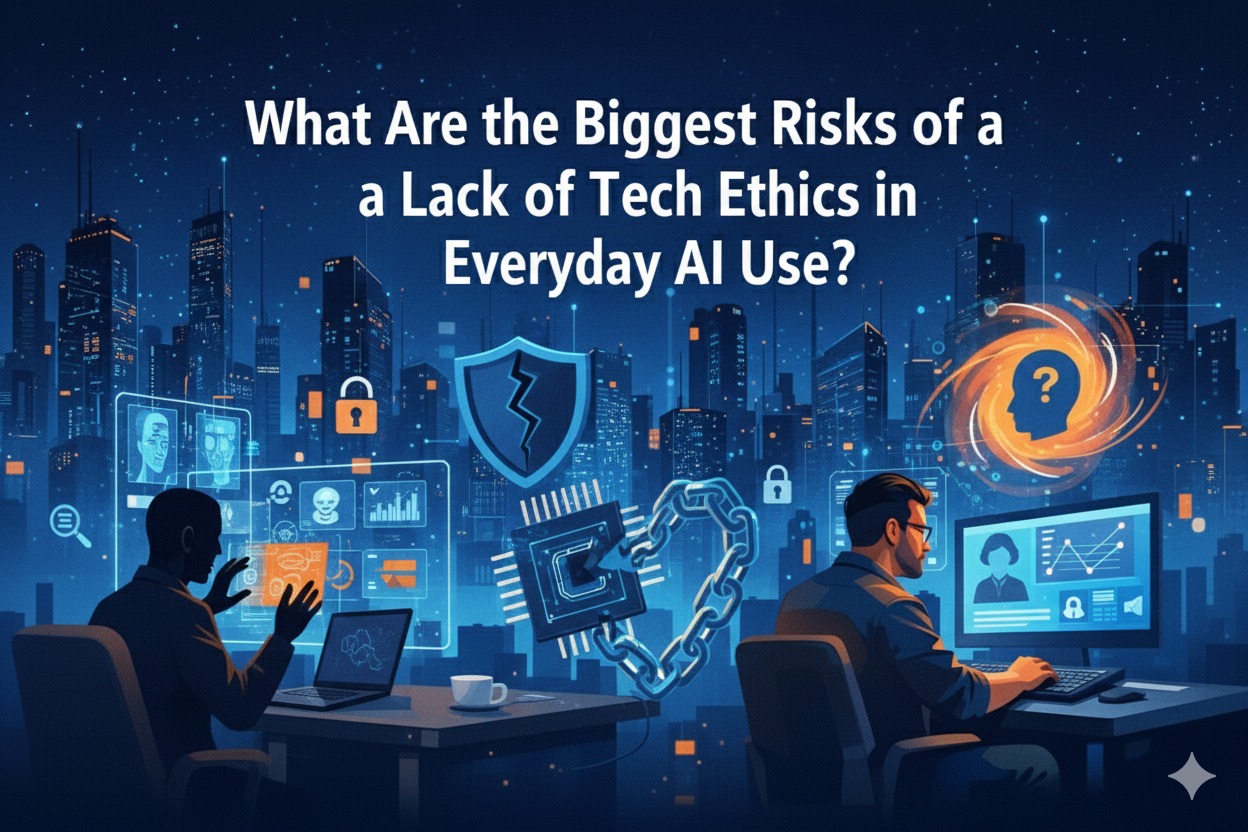
The Biggest Risks of Using AI Without Ethical Awareness
Artificial intelligence (AI) is now present in almost every aspect of daily life—from shopping recommendations, social media filters, chatbots, and smartphone cameras to workplace decision-making. However, as the benefits of AI continue to grow, so do the risks when users lack proper technological ethics.
So, what are the biggest risks of using AI without understanding ethical principles?
1. THE SPREAD OF MISINFORMATION (DISINFORMATION & DEEPFAKES)
When users lack technological ethics, they may easily spread false information or even create fake content using AI.
The risks include:
Deepfakes damaging a person’s reputation.
False information triggering public panic.
Fake content spreading faster than factual clarification.
With AI’s ability to generate highly realistic images, videos, and voices, this has become one of the most dangerous risks.
2. PRIVACY VIOLATIONS AND DATA MISUSE
A lack of ethical awareness often leads users to ignore privacy boundaries, such as uploading someone else’s photos to AI tools without consent or misusing personal data.
The risks include:
Personal data leaks and misuse.
Identity theft and digital fraud.
Individuals being harmed without knowing their data was used.
Privacy is a fundamental right, and AI can easily violate it when ethics are ignored.
3. UNFAIR DECISION-MAKING (AI BIAS)
AI systems rely on data. Without ethical understanding from users or developers, biased data can result in unfair decisions.
The risks include:
Unfair recruitment due to gender or racial bias.
Loan applications being rejected because of algorithmic bias.
Academic or work performance evaluations becoming subjective.
Poor technological ethics can amplify existing inequalities in society.
4. UNHEALTHY DEPENDENCE ON TECHNOLOGY
Using AI without ethical boundaries can lead to overdependence, reducing critical thinking and creativity.
The risks include:
Decreased productivity when technology is unavailable.
Loss of basic human skills such as writing, evaluating information, and logical reasoning.
Younger generations becoming passive users instead of technology creators.
Technological ethics help define the boundary between being assisted by AI and fully depending on it.
5. MISUSE OF AI FOR HARMFUL PURPOSES
Without ethical guidance, AI can be used for negative or harmful activities.
The risks include:
Creating spam, phishing, and digital scams.
Manipulating public opinion.
Producing harmful content such as automated cyberbullying or harassment.
This is why digital literacy and technological ethics must go hand in hand.
HOW CAN THESE RISKS BE REDUCED?
To minimize these risks, several practical steps can be taken:
Verify information before sharing it.
Use AI while respecting privacy and consent.
Understand basic AI mechanisms, especially regarding bias.
Set boundaries to avoid overreliance on AI.
Use AI only for positive and constructive purposes.
Using AI is not just about technology—it is also about responsibility.
CONCLUSION
The greatest risk of lacking technological ethics in everyday AI use is widespread misuse, ranging from misinformation and privacy violations to unfair decision-making.
By understanding technological ethics and strengthening digital literacy, we can maximize the benefits of AI while minimizing its negative impacts.
Tentang Penulis
Gusti Ayu Tita
Penulis — Universitas STEKOM
Penulis aktif yang berfokus pada isu-isu akademik, teknologi pendidikan, dan pengembangan sumber daya manusia di lingkungan kampus.