
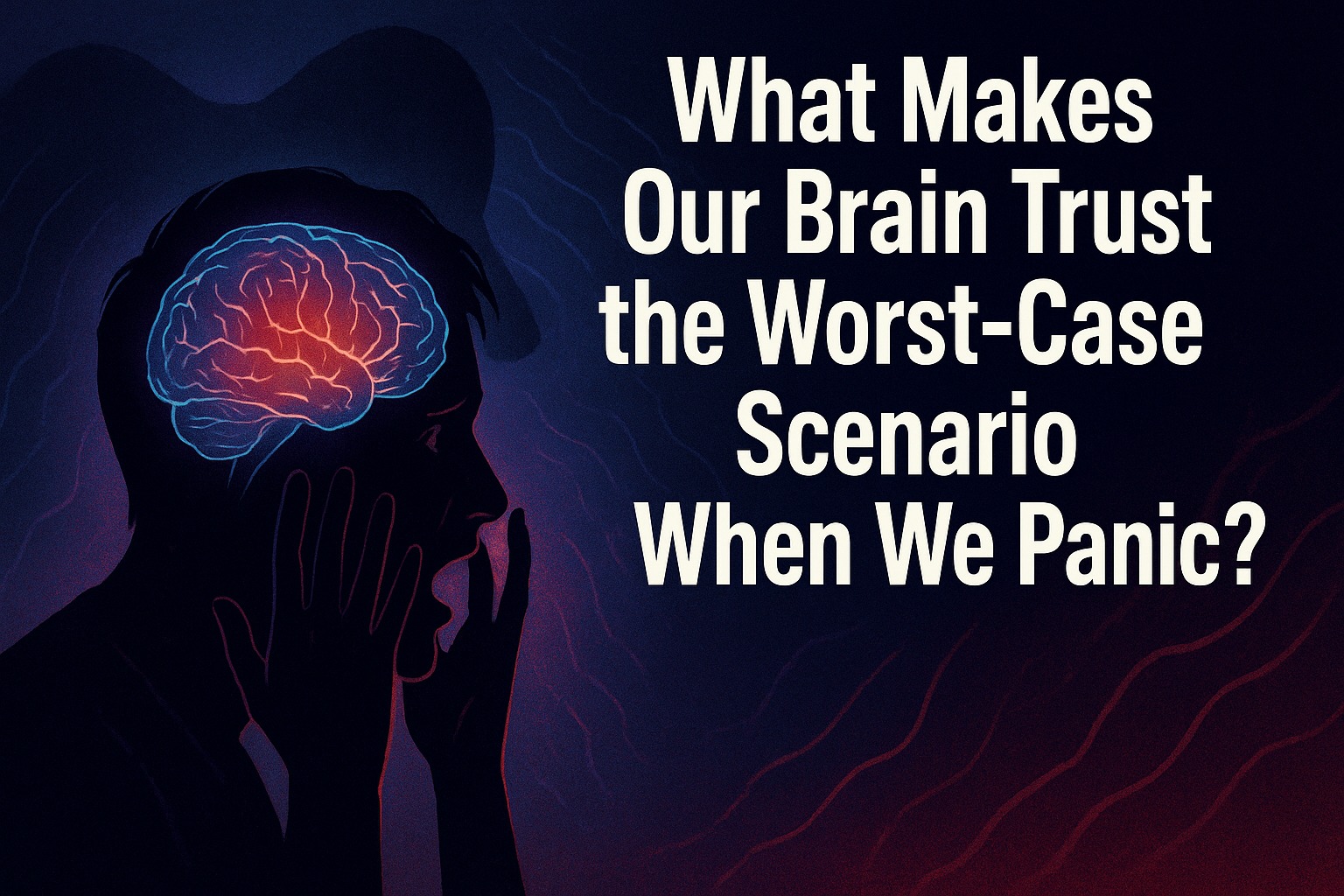
In high-pressure situations, many people instantly imagine the worst possible outcome. This reaction often appears automatically and feels uncontrollable. But why does the brain choose the most negative scenario, even when reality may not be as bad? This article explores the psychological and biological factors that make our minds more likely to believe the worst-case scenario when panic arises.
HOW DOES THE BRAIN RESPOND TO EMERGENCIES?
When panic strikes, the brain works faster in a defensive pattern. The amygdala— the part of the brain responsible for processing fear—takes control before logical reasoning has a chance to assess the situation. This is why the mind jumps to negative conclusions without going through a proper analytical process.
This system is actually evolutionary. In the past, humans needed to react quickly to real threats, such as predators or physical danger. That mechanism remains today, even though modern threats often tend to be mental rather than physical.
WHY DOES THE WORST-CASE SCENARIO SEEM MORE BELIEVABLE?
Several factors make “the worst possible outcome” easier to believe during panic:
1.Increased negative bias
The brain is naturally more sensitive to potential danger than potential safety. This makes negative thoughts feel more realistic.
2.Reduced logical capacity
When stress hormones rise, the activity of the prefrontal cortex decreases. This part of the brain is responsible for rational decision-making.
3.The brain prioritizes speed
In moments of panic, speed is considered more important than accuracy. This causes the brain to choose extreme conclusions even when they’re not supported by facts.
4.Stronger negative memories
Negative experiences usually leave clearer memory traces. During panic, the brain recalls these memories and reinforces worst-case thinking.
THE ROLE OF EMOTIONS IN SHAPING NEGATIVE THOUGHTS
Intense emotions make it difficult for someone to evaluate a situation objectively. Fear, anxiety, and a sense of losing control create a “cognitive fog” that blocks the brain from filtering information accurately. As a result, extreme predictions feel far more convincing.
When emotions dominate, the body responds by increasing heart rate, accelerating breathing, and tightening muscles. These physical signals reinforce the perception that the situation is genuinely dangerous—even when the threat may not be real.
WHY DO WE ASSUME THE WORST EVEN BEFORE IT HAPPENS?
Panic pushes the brain into predictive thinking—preparing itself for the worst possible outcome. Although its primary purpose is self-protection, the side effect is dramatic and unbalanced thoughts.
Some reasons include:
- the brain wants to avoid pain or loss,
- the body interprets threats as bigger than they are,
- the mind tries to control uncertainty,
- overinterpretation feels like a “safe” approach.
This explains why the mind trusts negative assumptions more easily than it trusts actual facts.
HOW TO REDUCE WORST-CASE THINKING DURING PANIC
Here are several strategies to reduce this tendency:
1.Focus on breathing
Slow breathing helps reduce amygdala activity and reactivates logical thinking.
2.Question the truth of negative thoughts
Train yourself to ask: “What evidence do I have?” to weaken extreme assumptions.
3.Shift attention to something concrete
Observing your surroundings helps stabilize the mind and pull it away from imagined threats.
4.Write down the thoughts
Writing allows you to separate facts from assumptions, making worst-case scenarios appear less realistic.
With consistent practice, the brain becomes better at returning to rational thinking—even in moments of panic.
CONCLUSION
The brain is more likely to believe the worst-case scenario during panic due to the influence of the amygdala, negative bias, and reduced logical function. This reaction is part of the body’s natural survival mechanism. However, understanding how the brain works and learning emotional regulation techniques can help us control negative thoughts and think more clearly in high-pressure situations.
Tentang Penulis
Gusti Ayu Tita
Penulis — Universitas STEKOM
Penulis aktif yang berfokus pada isu-isu akademik, teknologi pendidikan, dan pengembangan sumber daya manusia di lingkungan kampus.



