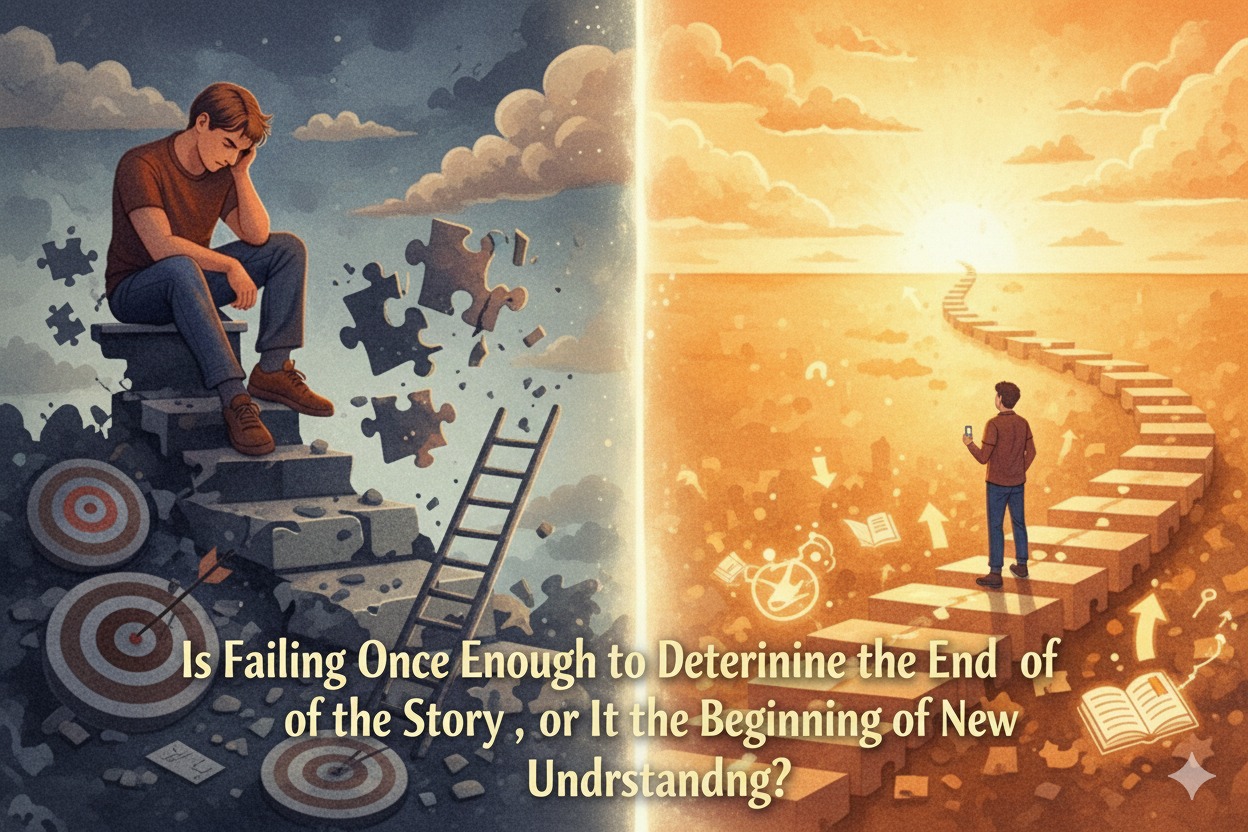
Failure often feels like the final hammer striking down hope. Many people see a single failure as proof that their efforts are no longer worth continuing. But is failing once truly enough to determine the end of the story? Or is it, instead, the beginning of a deeper understanding of oneself, one’s direction, and the process being lived?
Failure and the Meaning We Give It
The meaning of failure is largely shaped by how we interpret it. When failure is viewed as a permanent verdict, self-confidence easily collapses. On the other hand, when failure is understood as information, it transforms into a powerful source of learning.
In many cases, failure is not a sign of incompetence, but an indication that strategy, timing, or approach needs adjustment. With the right perspective, a single failure does not close the story—it opens a new chapter.
One Event Does Not Represent the Entire Journey
Life is made up of long processes, not single moments. Judging oneself based on one failure is like judging a book by a single page. All previous efforts still hold value, even if the outcome has not met expectations.
Many people quit too early because they treat their first failure as a prediction of the future. In reality, consistency and reflection play a far greater role in shaping final outcomes than one disappointing result.
Failure as a Mirror for Self-Understanding
Failure often forces us to pause and reflect. It is in these moments that new insights emerge—about personal limits, habitual patterns, and unrealistic expectations. Without failure, this kind of reflection rarely happens.
The self-awareness that grows from failure makes the next steps more conscious and intentional. We move forward not just by acting, but by understanding the reasons behind each decision.
The Difference Between Giving Up and Ending One Approach
Not every pause means giving up. Sometimes, what needs to end is not the goal, but the way we are trying to reach it. Failure signals that an old approach may need to be revised, not completely abandoned.
By separating goals from methods, failure becomes a tool for evaluation rather than a reason to bury dreams. This is where a new understanding truly begins.
Building Mental Resilience Through Failure
Every failure faced with openness strengthens mental resilience. We learn that disappointment can be endured, fear can be confronted, and progress can continue—even imperfectly.
This resilience does not grow from effortless success, but from failures that are processed into meaningful experiences.
Closing an Old Chapter, Opening a New Direction
Failing once is never enough to define the end of the story—unless we decide it is. More often, failure marks the beginning of new understanding about ourselves, our processes, and more suitable directions.
When failure is seen as part of the journey rather than its conclusion, we give ourselves the chance to grow wiser and move forward with greater awareness.
Tentang Penulis
Gusti Ayu Tita
Penulis — Universitas STEKOM
Penulis aktif yang berfokus pada isu-isu akademik, teknologi pendidikan, dan pengembangan sumber daya manusia di lingkungan kampus.