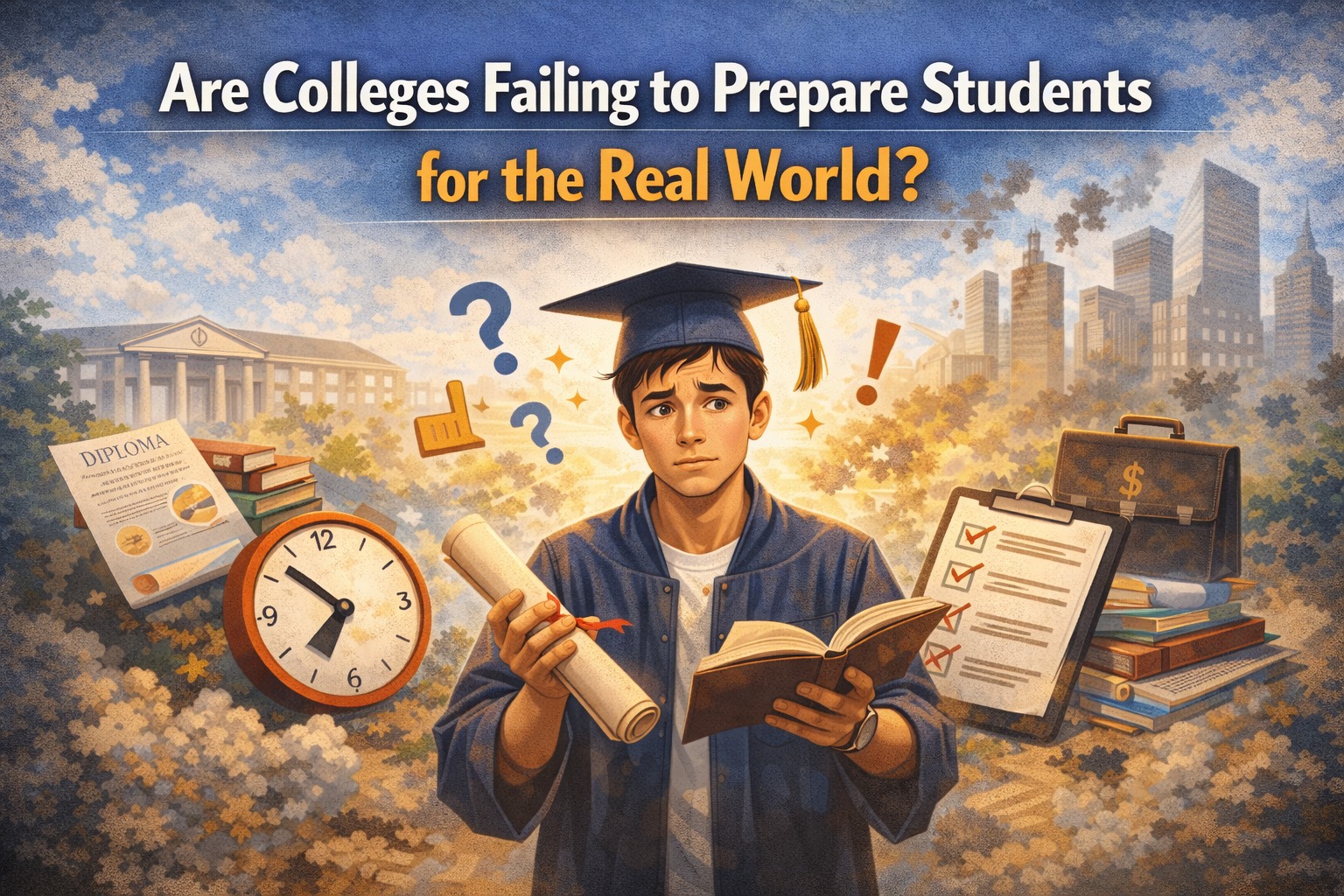
Higher education is often positioned as a bridge to professional life and social maturity. However, the reality faced by many graduates appears to contradict this ideal. Not a few students graduate with academic degrees yet feel unprepared when confronted with the demands of the workforce and the realities of life beyond campus. This condition raises an increasingly relevant question: has higher education truly succeeded in preparing students for the real world?
The Gap Between Campus Life and Real-World Reality
During college, students live within a relatively structured system. Schedules are clear, goals are measurable, and indicators of success are defined by grades and graduation. The real world, however, does not operate in the same way. Outside campus, there are no syllabi, no academic supervisors, and no uniform standards of success.
Many graduates experience “culture shock” when entering this phase. They are accustomed to following systems rather than facing uncertainty and making independent decisions.
Academic Curriculum vs. Workplace Demands
One of the main criticisms of higher education lies in its overly academic-oriented curriculum. Students are trained to memorize theories, write papers, and pass exams, yet often lack the practical skills required in the workplace.
The professional world demands adaptability, communication, teamwork, and real problem-solving abilities. When these competencies are not prioritized in higher education, graduate unpreparedness becomes an inevitable consequence.
Career Guidance as a Formality
Many universities provide career guidance services, but their role is often limited. These programs tend to function as administrative complements rather than long-term mentoring processes. Students are rarely encouraged to understand their potential, career options, and industry realities early in their academic journey.
As a result, many students only begin thinking seriously about their future careers shortly before graduation—when opportunities for exploration are already very limited.
Passive Students and the Campus Comfort Zone
However, placing all the blame on universities would be unfair. Many students go through college passively, merely fulfilling academic requirements without actively exploring their interests and potential. Campus often becomes a “comfort zone” that is rarely challenged critically by students themselves.
When students are not accustomed to taking initiative during college, they tend to struggle in the real world, which demands a high level of independence.
A World That Changes Faster Than Universities
The professional world is changing at an extremely rapid pace. New professions emerge outside formal education pathways, while some traditional fields gradually lose relevance. Universities often lag behind these changes due to rigid bureaucratic structures and outdated educational models.
This imbalance places graduates in a vulnerable position: they hold degrees, but those degrees are not always aligned with contemporary demands.
A Complete Failure or a Partial One?
The question of whether universities have failed to prepare students cannot be answered in black and white terms. Higher education has succeeded in transferring knowledge, yet often falls short in helping students understand how to apply that knowledge in real life.
The issue lies not solely in institutional failure or individual weakness, but in the lack of synchronization between educational objectives and the social realities graduates must face.
Redefining the Role of Universities in Student Preparation
If universities wish to remain relevant, their role must be expanded. Higher education should not merely produce graduates with high GPAs, but also equip students with life skills, career awareness, and the courage to face uncertainty.
As long as universities are viewed merely as places to obtain degrees, questions about their failure to prepare students for the real world will continue to arise—and may grow even louder.
Tentang Penulis
Gusti Ayu Tita
Penulis — Universitas STEKOM
Penulis aktif yang berfokus pada isu-isu akademik, teknologi pendidikan, dan pengembangan sumber daya manusia di lingkungan kampus.