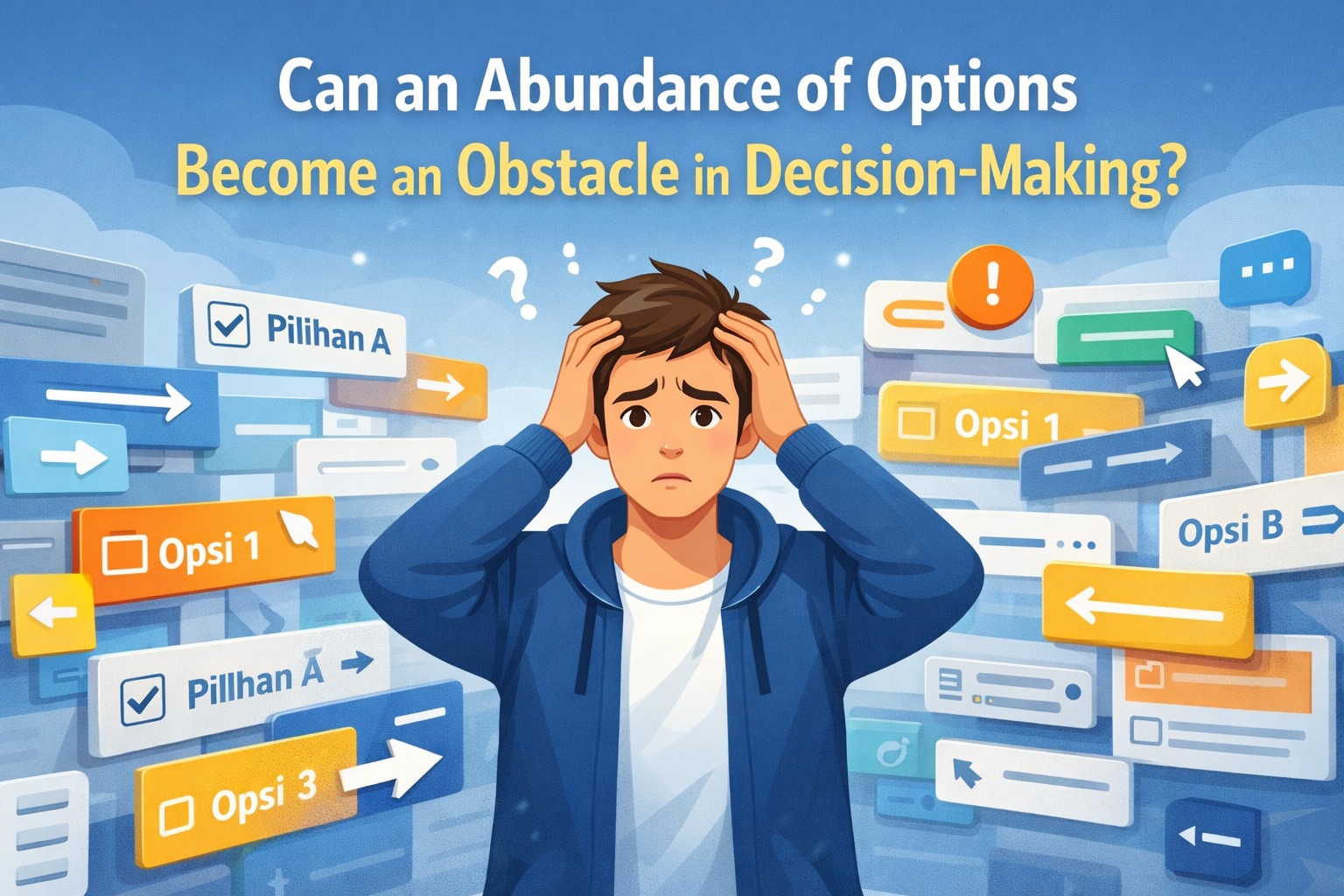
Advances in technology and widespread access to information have placed people in the midst of an abundance of options. From choosing career paths and deciding which products to buy to making simple everyday decisions, we are constantly faced with numerous alternatives. At first glance, this condition seems advantageous. In practice, however, many people feel confused, hesitant, and struggle to make choices. This raises a crucial question: does an abundance of options truly help, or does it hinder the decision-making process?
This article discusses how too many choices affect the way we think, why confusion arises, and how to respond more healthily and effectively.
When Too Many Choices Become a Burden
Choices are meant to provide freedom. However, when their number becomes excessive, that freedom turns into a mental burden. Each option demands attention, evaluation, and comparison. The brain is forced to process multiple possibilities at once, including risks and long-term consequences.
This condition triggers cognitive fatigue. The more choices that must be considered, the more mental energy is drained. As a result, instead of making well-thought-out decisions, individuals feel overwhelmed and tend to postpone action.
The Paradox of Choice in Modern Life
This phenomenon is often referred to as the paradox of choice. The more alternatives available, the harder it becomes for individuals to feel satisfied with their decisions. This happens because the mind continues to compare the chosen option with those that were left behind.
In modern life, this paradox is increasingly evident. Digital platforms, social media, and e-commerce offer thousands of alternatives at once. Unconsciously, this environment fosters habitual doubt and fear of making mistakes, as there always seems to be a better option available.
Fear of Mistakes and the Desire to Choose the Best
An abundance of options often amplifies fear of making mistakes. People feel compelled to find the most ideal decision and avoid regret. However, the pursuit of the “best” option often becomes a trap.
The desire for perfection leads individuals to keep evaluating and delaying decisions. In many situations, a decision that is good enough and made on time is far more valuable than a perfect decision that is never realized.
Psychological Impact of Decision Confusion
The inability to make decisions can have significant psychological effects. Anxiety increases, self-confidence declines, and feelings of dissatisfaction with oneself emerge. Even after a decision is made, individuals may still feel doubtful and continue comparing it to other options.
Over time, this pattern can hinder personal and professional growth. Opportunities that should have been utilized are missed because too much time is spent in the consideration phase.
Strategies for Dealing with an Abundance of Options
Facing many choices requires a more conscious approach. An important first step is to establish clear criteria before choosing. With firm boundaries, the number of options can be narrowed, making evaluation easier.
It is also important to accept that not every decision needs to be perfect. Focus on the main goal and the most significant impact of the choice. Developing the habit of making small decisions quickly can also build confidence in handling larger decisions.
Finally, evaluate decisions after they are made, rather than overanalyzing them beforehand. Real-life experience is often the best source of learning.
Conclusion
An abundance of options does offer freedom, but without awareness and clear boundaries, it can become an obstacle in decision-making. Too many choices trigger confusion, fear, and mental fatigue, making it difficult to move forward.
By understanding personal limits, simplifying options, and daring to make decisions that are good enough, we can escape the trap of excessive choice and move ahead with greater confidence.
Keywords:
Tentang Penulis
Gusti Ayu Tita
Penulis — Universitas STEKOM
Penulis aktif yang berfokus pada isu-isu akademik, teknologi pendidikan, dan pengembangan sumber daya manusia di lingkungan kampus.