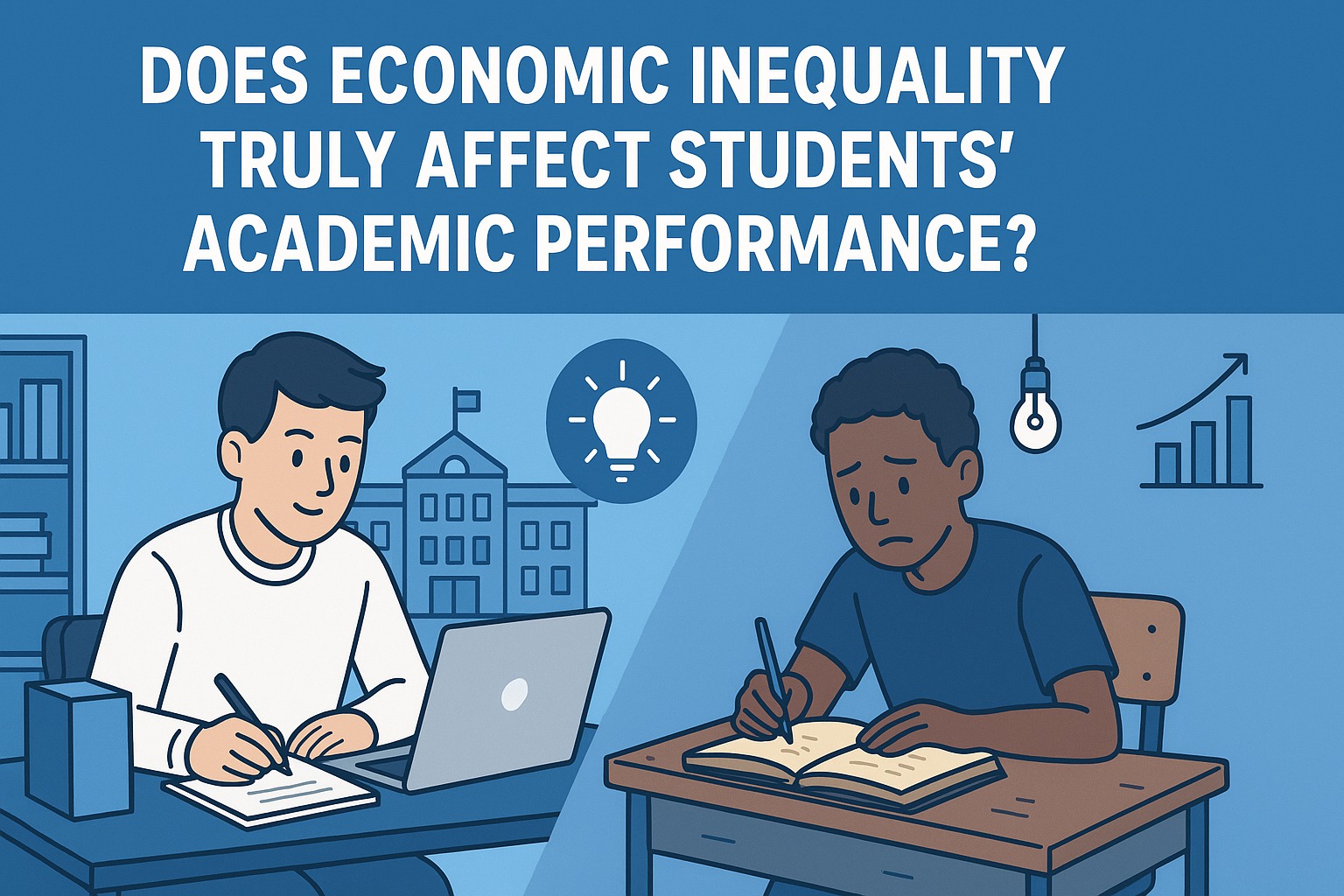
Economic inequality is not a new issue, but its impact on education continues to be a topic of ongoing discussion. Many people wonder: can a family’s economic condition really determine a student’s academic performance? This article examines the relationship between economic factors and academic achievement objectively, based on current educational realities.
UNDERSTANDING ECONOMIC INEQUALITY IN EDUCATION
Economic inequality in education is often reflected in unequal access to:
- Learning facilities
- Family support
- School resources
- Opportunities for personal development
These differences directly and indirectly influence learning patterns and students’ ability to adapt within academic environments.
HOW DOES ECONOMIC STATUS AFFECT ACADEMIC ACHIEVEMENT?
a. Access to Learning Tools and Infrastructure
Students from middle- to upper-income families typically have:
- Adequate gadgets
- Stable internet access
- Books and additional learning materials
- Comfortable study spaces
These advantages help them perform better, especially as digital learning becomes more prevalent.
b. Quality of the School Environment
Schools in higher-income communities typically offer:
- Qualified teachers
- Well-equipped laboratories
- Diverse extracurricular programs
- Smaller class sizes
These factors significantly enhance the learning experience and academic outcomes.
c. Emotional Support and Psychological Burden
Students from low-income families often face additional pressures such as:
- Needing to help parents earn a living
- Concerns about daily necessities
- Limited learning support at home
- Stress caused by financial instability
These psychological challenges can affect concentration and motivation.
EVIDENCE AND REAL-WORLD PHENOMENA
Various national education surveys indicate that:
- Students from financially stable families have a higher chance of entering top schools.
- Average student grades often correlate with parental income and education levels.
- Educational assistance programs such as KIP Kuliah and PIP help reduce gaps, though the impact is not yet fully optimal.
These trends show that economic inequality has a measurable influence on academic achievement.
ARE ALL LOW-INCOME STUDENTS ACADEMICALLY WEAK?
Not always. Many students from low-income families achieve excellent results. Their success is often supported by:
- Strong motivation
- A positive social environment
- Supportive teachers
- Scholarships or educational assistance
This means that economic inequality is not an absolute determinant, but it significantly affects opportunities and learning processes.
EFFORTS TO REDUCE THE IMPACT OF ECONOMIC INEQUALITY
Some actionable measures include:
a. Equal Distribution of Educational Facilities
Governments and schools must ensure equitable access to devices and internet.
b. Enhanced Teacher Training
High-quality teachers can help bridge the gap for underprivileged students.
c. Scholarships and Assistance Programs
Need-based scholarships are effective when distributed accurately.
d. Collaboration Among Parents, Schools, and Communities
Educating parents about the importance of supporting children's learning can make a real difference.
CONCLUSION
So, does economic inequality significantly affect students’ academic achievement?
The answer is: yes, it has a strong influence—from access to facilities and opportunities to psychological conditions. However, this does not mean that students from low-income families cannot succeed. With the right support, equitable policies, and strong motivation, academic success remains achievable.
Tentang Penulis
Gusti Ayu Tita
Penulis — Universitas STEKOM
Penulis aktif yang berfokus pada isu-isu akademik, teknologi pendidikan, dan pengembangan sumber daya manusia di lingkungan kampus.