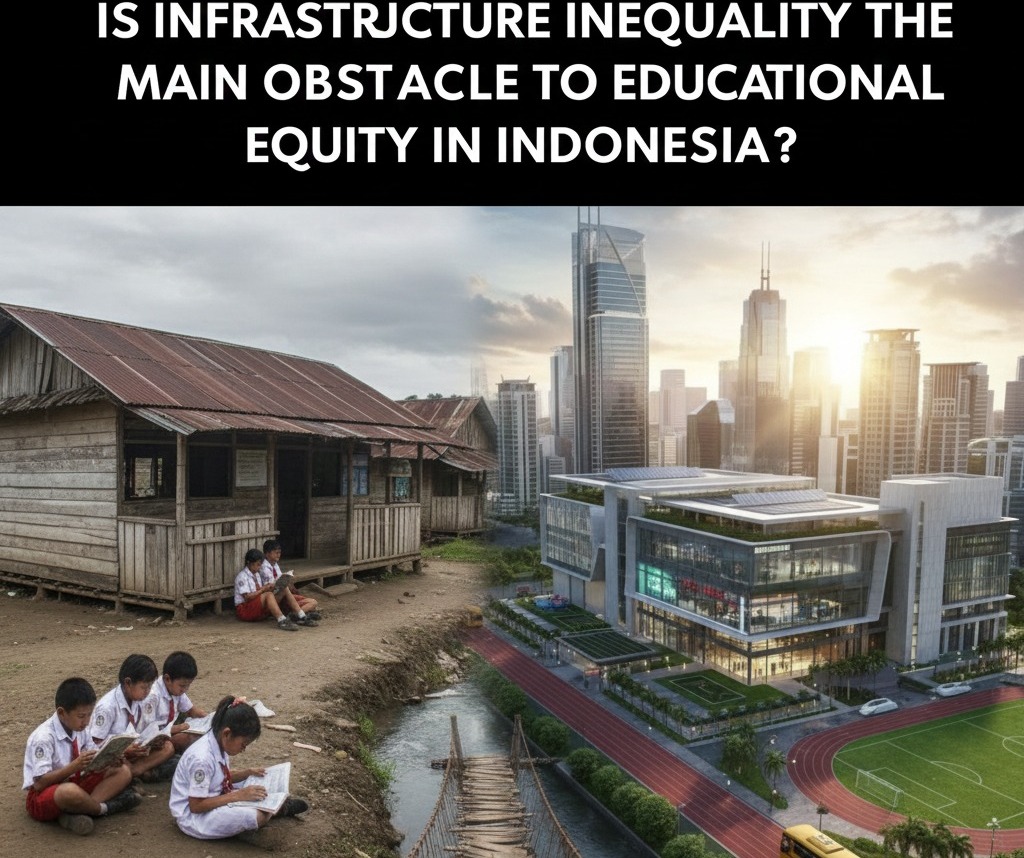
Education is a fundamental right of every citizen. However, achieving equal access to education in Indonesia remains a major challenge. One of the recurring issues is the infrastructure gap between urban and rural areas. So, is uneven infrastructure truly the main barrier to educational equity in Indonesia? This article discusses the causes, impacts, and potential solutions.
EDUCATIONAL INFRASTRUCTURE INEQUALITY IN INDONESIA
Educational infrastructure is not limited to school buildings; it also includes supporting facilities such as electricity, internet access, transportation, and adequate learning spaces. Unfortunately, many remote areas still lack these facilities, resulting in unequal education quality.
Examples from the Field
- Schools with inadequate or damaged buildings
- Shortage of classrooms and laboratories
- Limited transportation access for students
- Lack of technology and internet connectivity
These disparities make it difficult for students in remote areas to keep up with modern educational development.
IMPACTS OF INFRASTRUCTURE INEQUALITY ON EDUCATIONAL EQUITY
Infrastructure inequality has both direct and indirect impacts on teaching and learning.
Key Impacts
1.Limited Access to Education
Children in remote areas are at higher risk of dropping out due to difficulty reaching school.
2.Lower Student Competency
Insufficient learning facilities reduce the quality of education compared to that in urban schools.
3.Digital Literacy Gap
Lack of technology causes students to fall behind in innovation and digital skills.
4.Uneven Teacher Distribution
Teachers are often reluctant to work in areas with poor facilities.
These factors show that infrastructure plays a decisive role in determining educational quality and equity.
IS INFRASTRUCTURE INEQUALITY THE MAIN OBSTACLE?
Many factors influence educational equity, including teacher quality, family economic conditions, and government policy. However, infrastructure is a fundamental requirement that must be fulfilled first.
Without adequate infrastructure:
- Schools cannot provide effective learning
- Technology cannot be utilized optimally
- Educational programs cannot be implemented properly
Therefore, infrastructure inequality can be considered one of the most significant obstacles that must be addressed immediately.
SOLUTIONS TO REDUCE EDUCATIONAL INFRASTRUCTURE GAPS
Several strategic steps can be taken by the government and communities:
Possible Efforts
- Building and renovating school facilities in remote regions
- Expanding internet access and digital learning technologies
- Providing free transportation programs for students in isolated areas
- Collaborating with the private sector for infrastructure development
- Monitoring and evaluating the fairness of education budget distribution
Strong collaboration is essential to ensure no region is left behind in accessing education
CONCLUSION
So, is infrastructure inequality a major barrier to educational equity in Indonesia?
The answer: Yes. Infrastructure disparity plays a significant role in widening the education gap. By improving and equalizing educational facilities, learning opportunities can be expanded for all children.
Ensuring equitable education is not only the government's responsibility but a shared commitment to building a stronger, more competitive future for Indonesia.
Tentang Penulis
Gusti Ayu Tita
Penulis — Universitas STEKOM
Penulis aktif yang berfokus pada isu-isu akademik, teknologi pendidikan, dan pengembangan sumber daya manusia di lingkungan kampus.