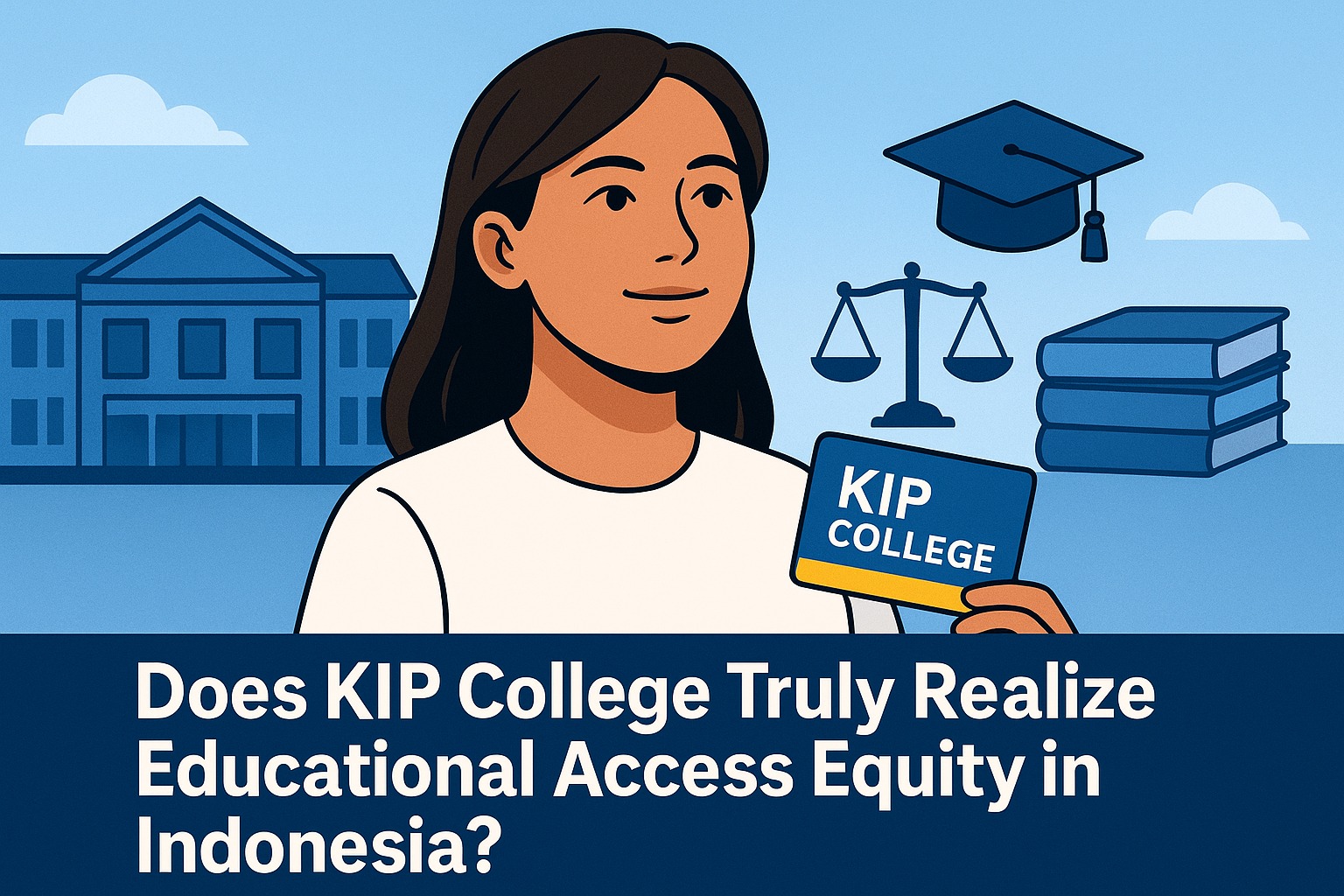
Higher education is a key factor in improving the quality of human resources and creating better social and economic opportunities. However, not all students in Indonesia have equal access to higher education due to economic limitations. The Kartu Indonesia Pintar Kuliah (KIP Kuliah) program was introduced by the government as a solution to support equal access to education.
Yet, an important question arises: has KIP Kuliah truly succeeded in creating educational equity, or does it still leave gaps?
WHAT IS KIP KULIAH AND WHO IS ELIGIBLE?
KIP Kuliah is a government-funded education assistance program for students from low-income families. The program covers tuition fees and provides a living allowance throughout the study period.
Its primary targets include:
- High school graduates with good academic performance but facing financial hardship,
- Students who previously received KIP during school or are registered in the Social Welfare Integrated Data (DTKS),
- University students from low-income households.
This program is designed to ensure that no Indonesian student has to abandon their dream of pursuing higher education due to financial constraints. In essence, KIP Kuliah aims to break the cycle of poverty through education.
POSITIVE IMPACTS OF KIP KULIAH IN IMPROVING EDUCATION ACCESS
Since its introduction, KIP Kuliah has helped hundreds of thousands of students across Indonesia. Some of its positive impacts include:
- A decrease in college dropout rates caused by financial issues,
- Increased participation in higher education, especially from remote areas,
- Greater motivation among underprivileged students to pursue academic excellence.
Many KIP Kuliah recipients have successfully completed their studies and secured decent jobs. This shows that the program plays a significant role in opening fairer opportunities in the world of education.
CHALLENGES IN IMPLEMENTING KIP KULIAH
Despite its benefits, the KIP Kuliah program still faces several implementation challenges:
- Inaccurate targeting: Some recipients actually come from financially capable families, while truly poor students are overlooked.
- Lack of information and outreach in remote regions, leading to many eligible students not applying.
- Verification processes that are not fully transparent or well-integrated.
These issues hinder the optimal effectiveness of KIP Kuliah in creating equitable educational access across Indonesia.
STEPS TOWARD ACHIEVING TRUE EDUCATIONAL EQUITY
To ensure that KIP Kuliah truly delivers fair access to education, several strategic steps are needed:
- Improving accuracy of recipient data through cross-ministerial and regional data integration,
- Expanding information dissemination to schools in rural and remote areas,
- Continuous monitoring and evaluation to ensure the program remains well-targeted,
- Collaboration with universities and educational institutions to ensure recipients receive adequate academic support.
With these efforts, KIP Kuliah can become a solid foundation for educational equity in Indonesia.
CONCLUSION
KIP Kuliah is a significant step toward realizing equitable access to higher education in Indonesia. The program has provided opportunities for thousands of underprivileged students to pursue their studies and build a better future.
However, true equity can only be achieved if implementation is transparent, inclusive, and sustained. With support from all parties — the government, universities, and society — KIP Kuliah can truly become a symbol of educational equality in the nation.
Tentang Penulis
Gusti Ayu Tita
Penulis — Universitas STEKOM
Penulis aktif yang berfokus pada isu-isu akademik, teknologi pendidikan, dan pengembangan sumber daya manusia di lingkungan kampus.