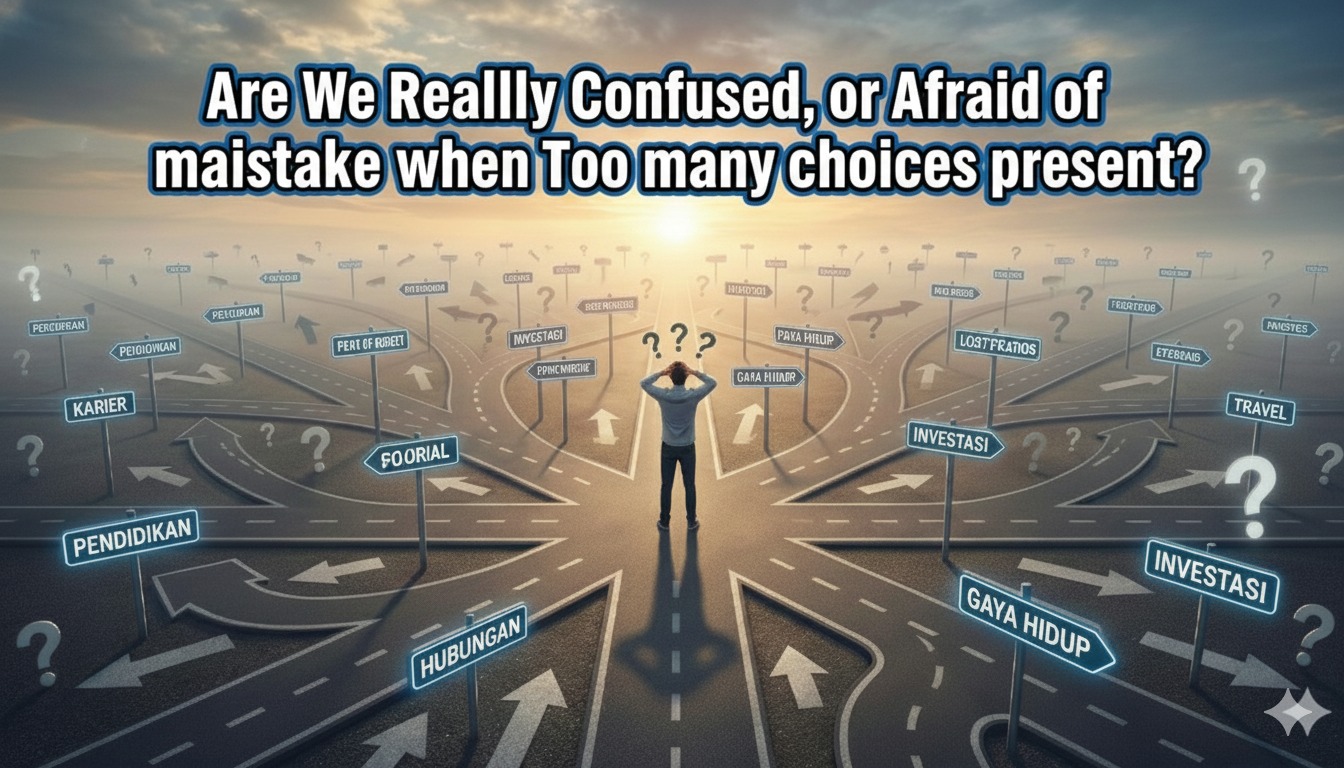
Are We Truly Confused, or Afraid of Making the Wrong Choice?
In the midst of modern life filled with endless alternatives, we are constantly faced with choices—from small everyday decisions to major ones that shape our life direction. At first glance, confusion seems to be the main reason people struggle to make decisions. However, when examined more deeply, a more intriguing question emerges: are we truly confused, or are we actually afraid of making the wrong choice when too many options are available?
Many Choices Are Not Always a Sign of Freedom
Many people view having numerous options as a form of freedom. We feel in control because we can decide for ourselves what to choose. Yet this freedom often turns into mental pressure when every option appears equally important.
When confronted with too many alternatives, the mind becomes filled with endless considerations. Instead of feeling free, individuals become trapped in uncertainty, making decisions increasingly difficult.
Fear of Making the Wrong Choice as the Source of Anxiety
Behind confusion, there is often an unrecognized fear: the fear of making the wrong decision. The more choices available, the greater the imagined negative consequences of each option.
This fear manifests as:
* Worry about future regret
* Fear of being judged as a failure by others
* Fear of missing out on better opportunities
Eventually, this fear leads people to choose not to choose at all, because staying still feels safer than taking a risk.
Mental Fatigue Caused by Overthinking
Spending too much time weighing different options can result in mental fatigue. This condition reduces clarity of thought and heightens emotional sensitivity. When exhausted, every decision feels heavy and overwhelming.
This fatigue is often mistaken for a lack of decision-making ability, when in fact the mind is simply overloaded with analysis and comparison.
Staying Still as a Form of Avoidance
When fear and exhaustion combine, the most common response is procrastination. Remaining inactive is often seen as being cautious, but it can actually be a form of avoiding uncertainty.
Without realizing it, repeated delays cause people to lose momentum. Opportunities pass by, while feelings of confusion grow stronger.
Learning to Choose Without Needing Perfection
Making a decision does not always have to result in the best possible choice. In many cases, a “good enough” decision is more than sufficient to help us move forward.
Some simple steps that can help include:
* Setting clear priorities instead of considering every possibility
* Limiting the number of options being evaluated
* Accepting that mistakes are part of the learning process
* Focusing on small, actionable steps that can be taken now
With this approach, choosing becomes less frightening and more of a process of growth.
Conclusion
Often, the real issue is not confusion, but fear of choosing incorrectly. Too many options can amplify fear and weaken the courage to take action. By recognizing that no decision is entirely risk-free, we can learn to choose more calmly. Moving forward—even with uncertainty—is far more meaningful than remaining still in confusion.
Tentang Penulis
Gusti Ayu Tita
Penulis — Universitas STEKOM
Penulis aktif yang berfokus pada isu-isu akademik, teknologi pendidikan, dan pengembangan sumber daya manusia di lingkungan kampus.