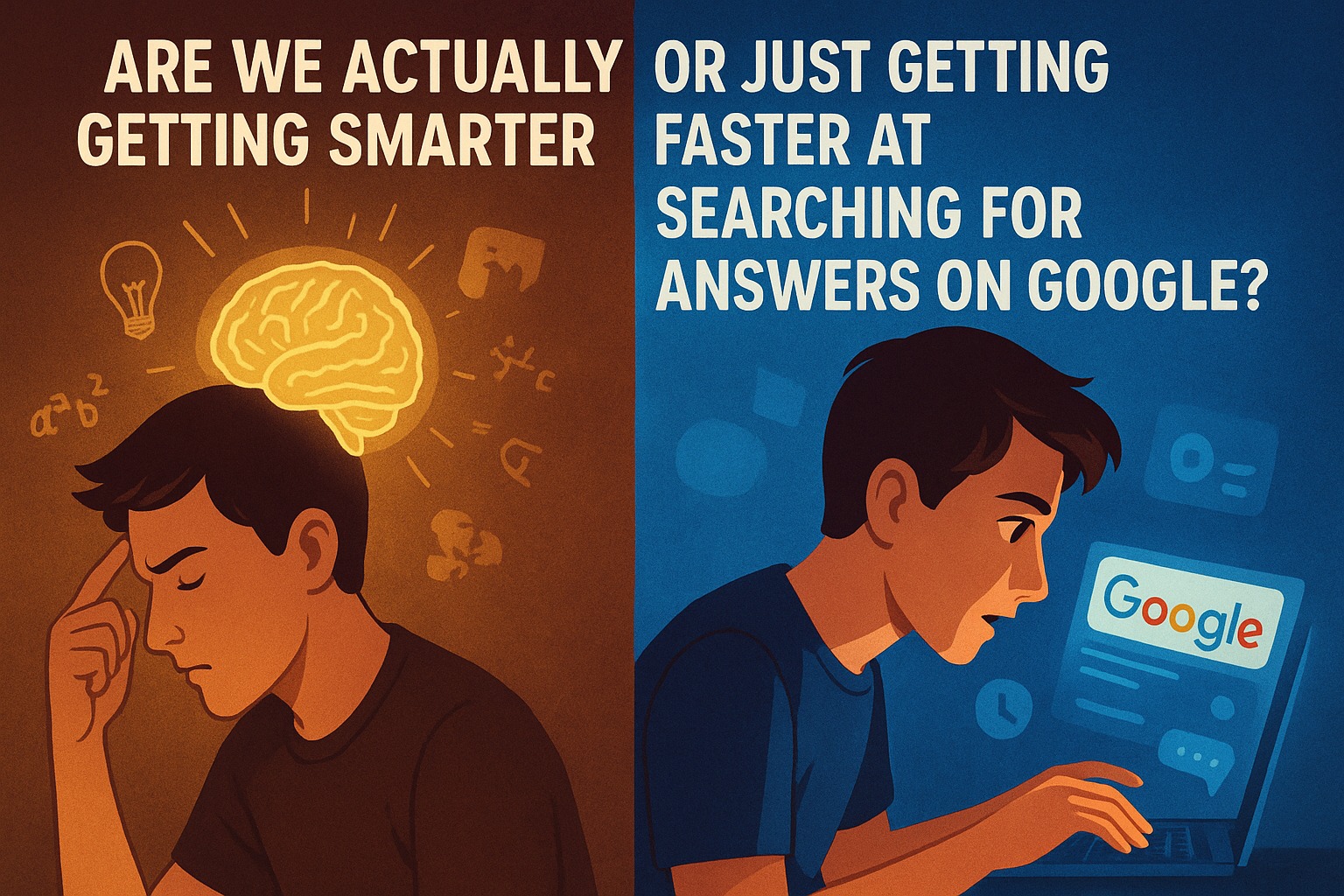
In the midst of the rapid flow of information, Google has become a “backup brain” for many people. Whenever we don’t know something, we immediately open a search engine. However, this raises an important question: are we truly becoming smarter thanks to easy access to information, or are we simply becoming more dependent on Google to find answers?
DIGITAL ERA AND THE ILLUSION OF THINKING FASTER
Technological advancements often make us feel smarter because we can find information quickly. In reality, the speed of accessing knowledge does not always correlate with the depth of understanding. Many people know a lot of things at a glance, but not everyone understands them deeply.
We are used to reading summaries, snippets, and instant answers without truly processing them. As a result, our ability to memorize, think critically, and solve problems independently tends to weaken.
CHANGES IN HOW THE BRAIN PROCESSES INFORMATION
Before the digital era, learning required more effort: reading books, taking notes, and understanding lessons. Today, the brain shifts to becoming more efficient but less profound. We tend to remember where the information is (where to find it) rather than memorizing the content itself.
This phenomenon is known as the “Google Effect,” which refers to the tendency to remember how to find an answer rather than the answer itself.
DOES GOOGLE REALLY MAKE US SMARTER?
Google can make someone smarter if it is used to strengthen understanding rather than just search for quick answers. When a person reads, processes, and applies the information, genuine learning still happens.
However, if Google is used merely as a shortcut without sharpening cognitive skills, dependency can arise. Intelligence is not measured only by how much information we know, but by how we analyze and use that information.
FINDING BALANCE IN THE INFORMATION ERA
The key is to benefit from technology without losing our ability to think independently. Some steps that may help include:
- getting used to reading full explanations, not just summaries,
- analyzing information before accepting it,
- trying to answer a question on our own before searching it on Google,
- using technology as a tool, not as the primary decision-maker.
With this approach, we not only find answers quickly but also understand and remember them.
CONCLUSION
We can become smarter thanks to Google, but only if we use it wisely. Otherwise, we may become faster at finding answers without truly understanding them. In the end, real intelligence comes from the ability to process, critique, and apply knowledge—not merely to search for it.
Tentang Penulis
Gusti Ayu Tita
Penulis — Universitas STEKOM
Penulis aktif yang berfokus pada isu-isu akademik, teknologi pendidikan, dan pengembangan sumber daya manusia di lingkungan kampus.