
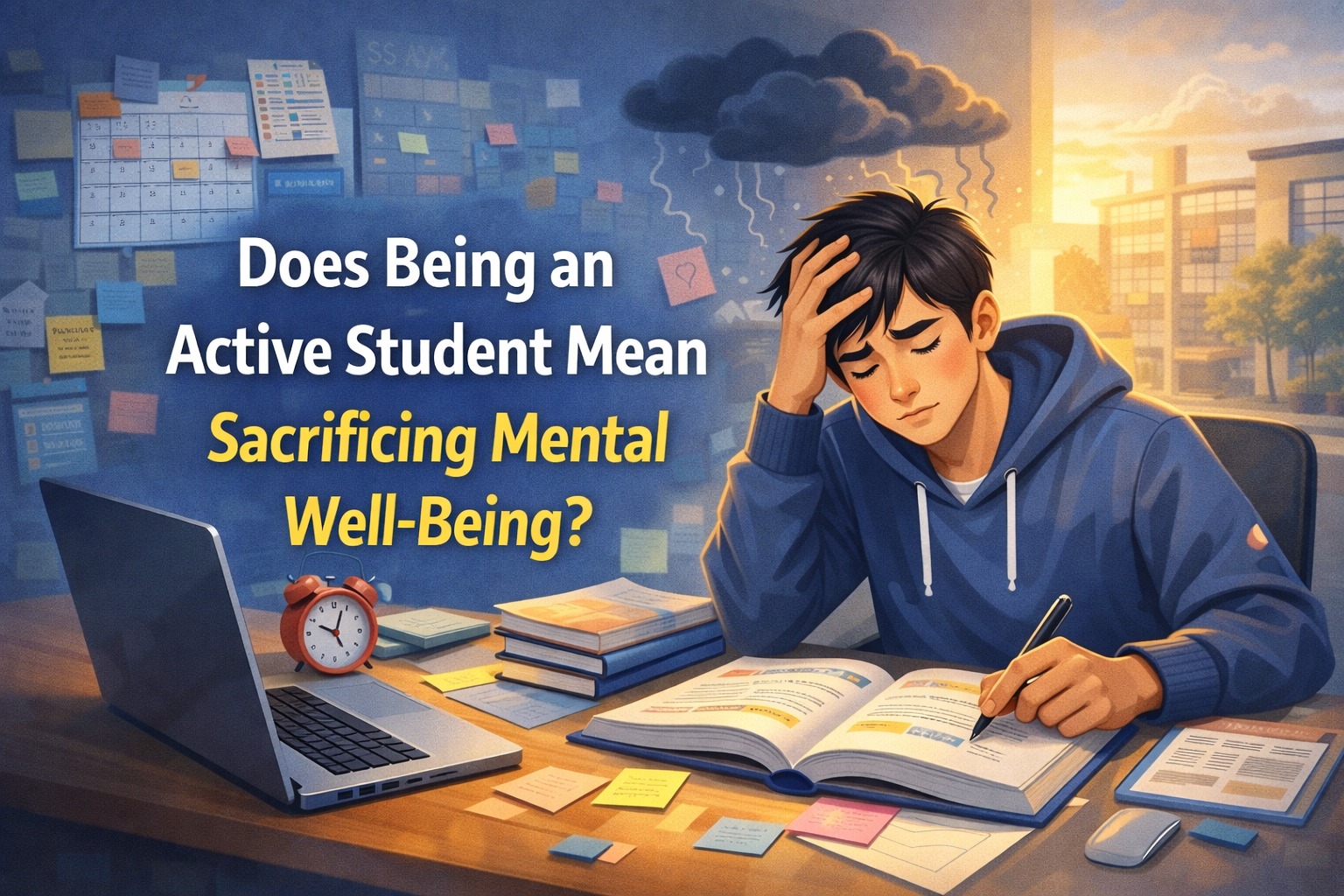
Being an active student is often considered the ideal model of campus life. Being involved in organizations, joining committees, excelling academically, and maintaining social relationships are seen as the complete package of a “successful student.” But behind this image lies an important question that is rarely addressed openly: Does being an active student require sacrificing mental well-being?
At many campuses, busyness is often viewed as a measure of worth. The busier the schedule, the more “productive” a student is perceived to be. However, many students gradually lose balance, feel emotionally drained, or experience pressure due to excessive demands.
THE DEFINITION OF AN ACTIVE STUDENT IN MODERN CAMPUS LIFE
Active students are no longer defined merely by academic participation. The term has expanded to refer to students involved in various non-academic activities such as organizations, committees, competitions, and social events.
These activities indeed offer many benefits: leadership, teamwork, communication, and time-management skills. However, when this level of activity becomes a social expectation rather than a conscious choice, risks begin to appear. The line between being active and overextending oneself becomes increasingly blurry.
HIDDEN PRESSURES BEHIND BUSY SCHEDULES
Many students appear fine on the surface but quietly carry significant pressure. Academic deadlines, organizational responsibilities, expectations from lecturers, and the constant push to seem productive can
This pressure often goes unnoticed because it is normalized as “part of student life.” Thinking like “everyone is tired” or “this is what it means to be active” makes exhaustion seem acceptable rather than something to address.
If this continues for long periods, students may experience persistent stress or burnout and struggle to maintain motivation.
WHEN PRODUCTIVITY CULTURE TURNS UNHEALTHY
Campuses may unintentionally cultivate a rigid productivity culture. Busy students are labeled as ambitious, while those who prioritize balance may be seen as lacking effort.
The problem arises when productivity is not paired with proper rest. Students may feel guilty when taking breaks, worry about not being involved enough, or fear falling behind peers.
At this point, being “active” no longer supports growth but instead becomes an emotional burden.
REAL IMPACTS ON MENTAL WELL-BEING
The consequences of neglecting mental well-being are real, such as:
- feeling more easily tired,
- difficulty concentrating on academic work,
- disrupted sleep patterns,
- persistent worry,
- loss of interest in activities previously enjoyed.
These signs often go unaddressed because students feel they “don’t have time” to pause and reflect.
ACTIVENESS DOES NOT MEAN LOSING YOURSELF
Being an active student should not mean sacrificing mental well-being. Healthy involvement comes from an understanding of personal limits, not pressure to meet external expectations.
Students should recognize that choosing not to participate in everything does not mean failure. Focusing on activities relevant to personal goals is far more impactful than spreading oneself too thin.
Balance does not mean being passive—it means setting realistic priorities.
STRATEGIES FOR MAINTAINING BALANCE AS A STUDENT
Some steps that can help students stay active without harming their well-being include:
1. Recognizing personal limits and learning to say no
2. Prioritizing academic, organizational, and personal time
3. Treating rest as a necessity, not a luxury
4. Avoiding comparison with others’ activity levels
5. Reaching out for help or sharing feelings when overwhelmed
These simple steps can support a healthier and more sustainable campus life.
THE ROLE OF CAMPUS AND SOCIAL ENVIRONMENTS
The responsibility for supporting student mental well-being does not lie solely on individuals. Campuses and social environments play a major role in creating a healthier ecosystem.
Student organizations, lecturers, and institutions need to shift the narrative from “busy is impressive” to “balance is healthy.” Support for mental well-being should be part of campus culture, not merely a slogan.
CONCLUSION
Being an active student should not require sacrificing mental well-being. Problems arise when activeness becomes a social obligation rather than a meaningful choice.
Students deserve to grow without losing themselves. Mental well-being is not an obstacle to achievement—it's the foundation that enables healthy learning, meaningful involvement, and long-term success.
Campuses should be spaces for growth, not endurance.
Tentang Penulis
Gusti Ayu Tita
Penulis — Universitas STEKOM
Penulis aktif yang berfokus pada isu-isu akademik, teknologi pendidikan, dan pengembangan sumber daya manusia di lingkungan kampus.



