
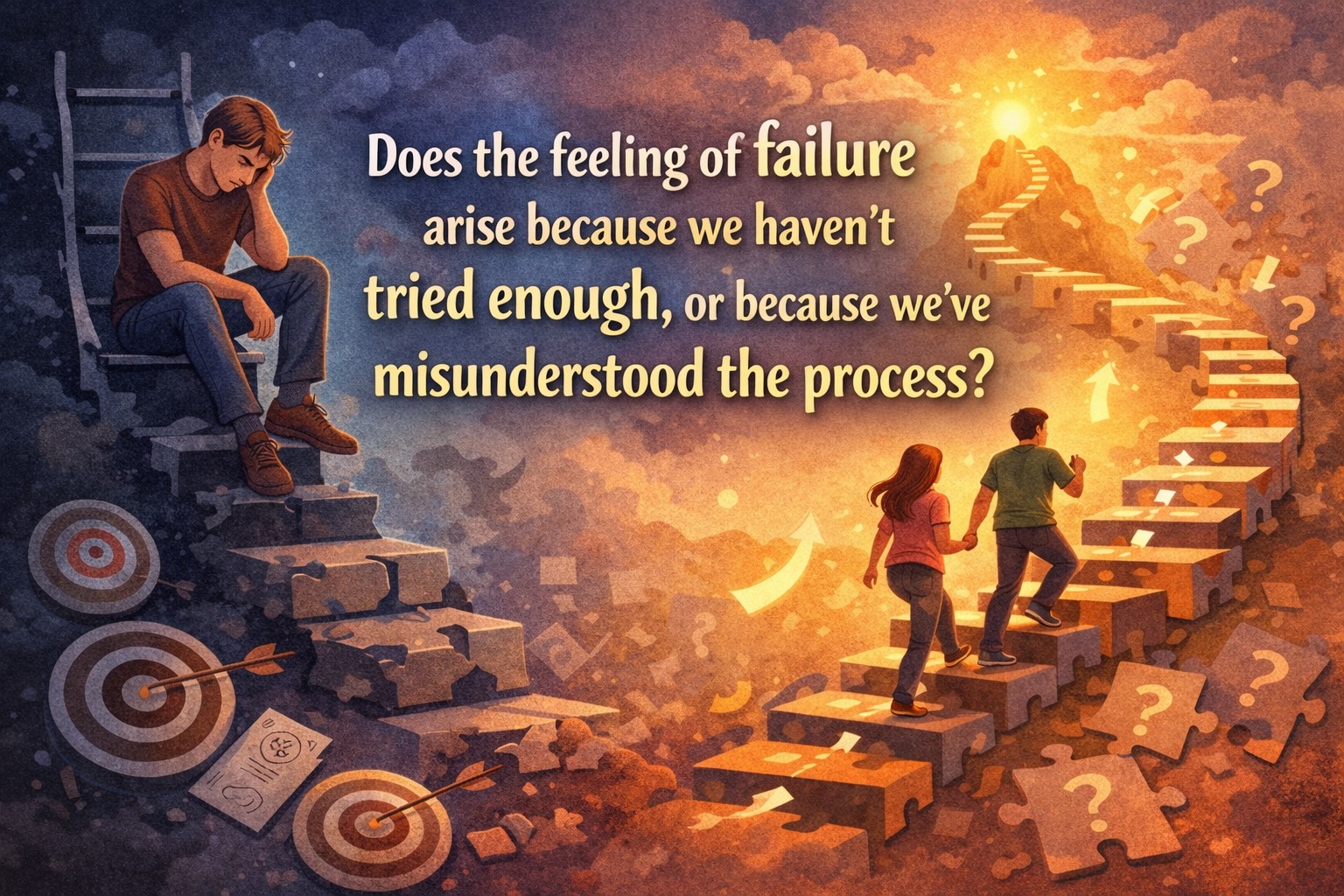
The feeling of failure often appears quietly, even when we believe we have tried our best. This feeling does not always arise from a lack of effort, but rather from how we interpret the journey we are going through. This raises an important question: is failure always about insufficient effort, or is it more about the flawed meaning we assign to the process itself?
FAILURE IS NOT ALWAYS PROPORTIONAL TO EFFORT
Many people equate outcomes that fall short of expectations with total failure. In reality, effort and results do not always align fairly. Factors such as timing, circumstances, and opportunity are often beyond our control.
When results are not yet visible, it does not mean our efforts are wasted. The process may be shaping skills and capacities whose impact will only be felt later.
OVERLY NARROW STANDARDS OF SUCCESS
The feeling of failure often arises because we set success standards that are too narrow and rigid. When success is measured by only one final outcome, the entire long process is easily dismissed.
In fact, learning, enduring challenges, and continuing to try are essential parts of success itself. When the meaning of success is reduced, the sense of failure becomes more likely—even when progress is actually taking place.
PROCESSES ARE OFTEN INVISIBLE, YET IMPACTFUL
Not all growth can be measured instantly. The development of self-confidence, mental resilience, and maturity of thought often occurs without clear signs. As a result, we may feel stagnant when we are, in fact, growing.
Misinterpreting the process causes us to overlook small but meaningful changes that are continuous and important.
COMPARISON INTENSIFIES THE FEELING OF FAILURE
The sense of failure is often reinforced by the habit of comparing ourselves to others. We see their outcomes without knowing the long processes behind them. Such comparisons create the illusion that our efforts are always insufficient.
In reality, everyone moves at a different pace and faces different challenges. Measuring ourselves by others’ standards only obscures the value of our own journey.
REFRAMING THE MEANING OF THE PROCESS
Reducing the feeling of failure does not mean lowering our effort, but expanding how we understand the process. The process is not merely a path toward results, but a space for learning that builds long-term capability.
With this perspective, failure is no longer seen as an end, but as a signal for reflection and realignment.
CONCLUSION: FAILURE OFTEN COMES FROM A MISINTERPRETED MEANING
The feeling of failure does not always stem from insufficient effort. More often, it arises from a narrow and rushed interpretation of the process. By recognizing that the process holds value beyond final outcomes, we can view our life journey more fairly and realistically.
Changing the way we perceive the process helps us make peace with imperfection and continue growing without being trapped in prolonged feelings of failure.
Tentang Penulis
Gusti Ayu Tita
Penulis — Universitas STEKOM
Penulis aktif yang berfokus pada isu-isu akademik, teknologi pendidikan, dan pengembangan sumber daya manusia di lingkungan kampus.



