
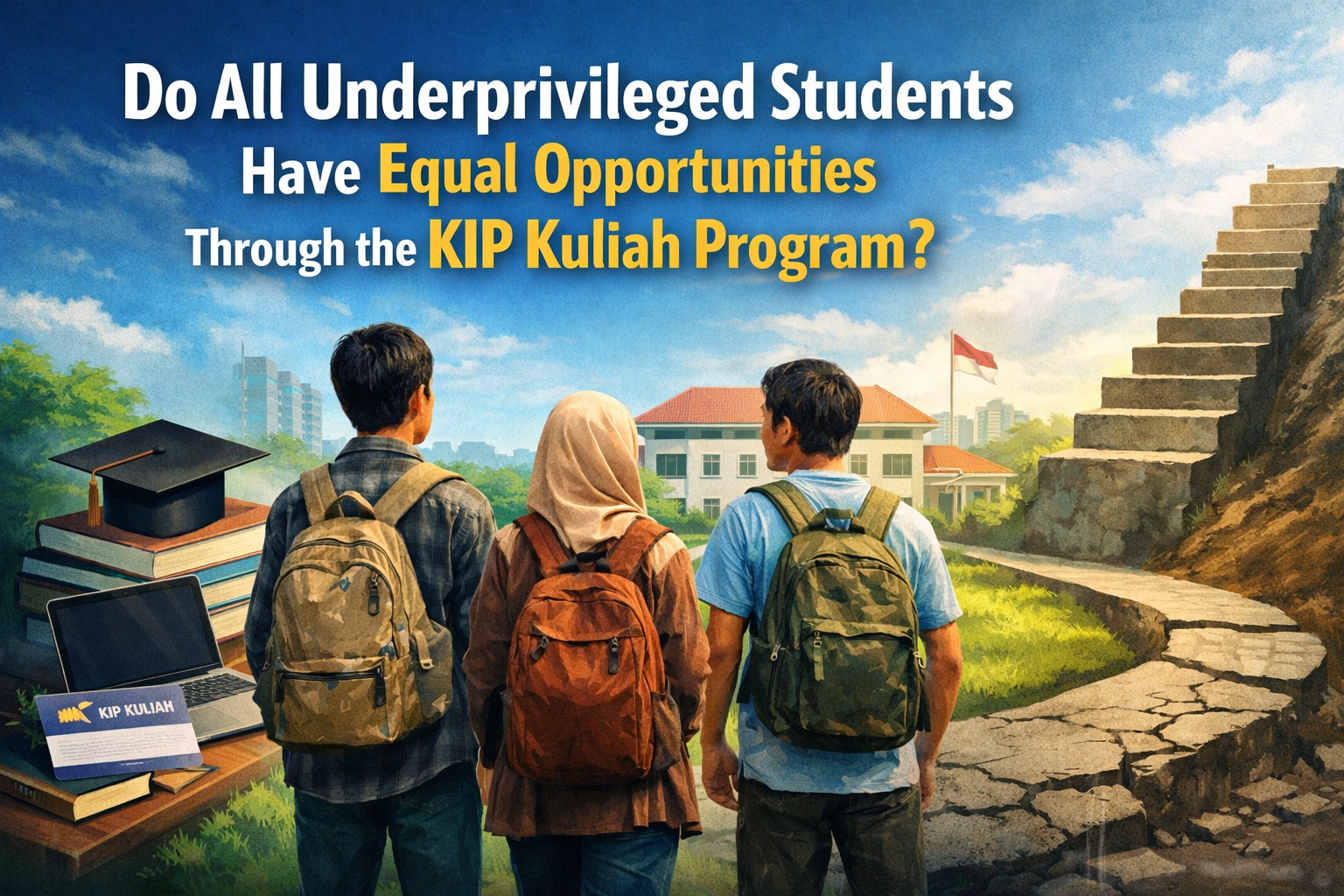
Higher education is often described as a bridge to a better future. However, in reality, not all students have equal opportunities to pursue higher education due to economic limitations. In response to this issue, the Indonesian government launched the Kartu Indonesia Pintar Kuliah (KIP Kuliah) program as an effort to promote equal access to higher education for underprivileged students.
This raises an important question—do all underprivileged students truly have equal opportunities through KIP Kuliah, or do gaps still exist in its implementation?
GETTING TO KNOW THE KIP KULIAH PROGRAM MORE CLOSELY
KIP Kuliah is a government-funded educational assistance program designed for prospective university students from economically disadvantaged families who demonstrate strong motivation and academic potential.
The program provides:
- Full tuition fee coverage throughout the study period,
- Monthly living allowance,
- Opportunities to study at both public and private universities.
Its primary goal is to ensure that no young citizen is left behind due to financial barriers. In this sense, KIP Kuliah represents a form of social justice in the field of education.
KIP KULIAH AND EFFORTS TO EQUALIZE OPPORTUNITIES
Since its launch, KIP Kuliah has supported hundreds of thousands of students across Indonesia. Some of its key achievements include:
1. Reducing the number of students unable to attend university due to financial constraints.
2. Increasing higher education participation among low-income families.
3. Encouraging underprivileged students to pursue university education with greater motivation.
Many KIP Kuliah recipients have gone on to become outstanding graduates who inspire their communities, proving that economic hardship does not have to be a barrier to success.
ACCESS GAPS: ARE SOME STUDENTS STILL LEFT BEHIND?
Despite its significant impact, the implementation of KIP Kuliah has not yet fully ensured equal opportunities for all underprivileged students. Several challenges remain, including:
- Limited access to information in remote areas, leaving many prospective students unaware of the application process.
- Imperfect data verification systems, causing some low-income students not registered in the national social assistance database (DTKS) to be excluded.
- Limited enrollment quotas, meaning not all eligible applicants receive assistance.
- Disparities in school quality and access to academic guidance, making it harder for students from disadvantaged regions to compete for admission to top universities.
These realities indicate that equal opportunity has not yet been fully realized, particularly for students living far from centers of information and educational resources.
TOWARD FAIRER OPPORTUNITIES
To ensure that all underprivileged students truly have equal opportunities, improvements in both the system and implementation of KIP Kuliah are necessary, such as:
1. Expanding program outreach to remote villages through schools and local governments.
2. Integrating educational aid recipient data with national social welfare systems to improve accuracy and inclusivity.
3. Increasing quotas for underdeveloped regions to reduce regional disparities.
4. Providing academic mentoring for KIP Kuliah recipients to support academic success and timely graduation.
These measures can help ensure that KIP Kuliah becomes not just a symbol of equality, but a true instrument of social transformation.
CONCLUSION
KIP Kuliah is a strategic government initiative aimed at opening the doors of higher education to underprivileged students across Indonesia. The program has helped many young people transform their lives through education.
However, achieving equal opportunities for all economically disadvantaged students remains a major challenge. As long as access to information, quota distribution, and data systems are not fully optimized, some students risk being left behind.
With comprehensive improvements, KIP Kuliah has the potential to become a concrete realization of educational justice in Indonesia—where every child, regardless of background or economic condition, has the right to a brighter future.
Keywords:
Tentang Penulis
Gusti Ayu Tita
Penulis — Universitas STEKOM
Penulis aktif yang berfokus pada isu-isu akademik, teknologi pendidikan, dan pengembangan sumber daya manusia di lingkungan kampus.



