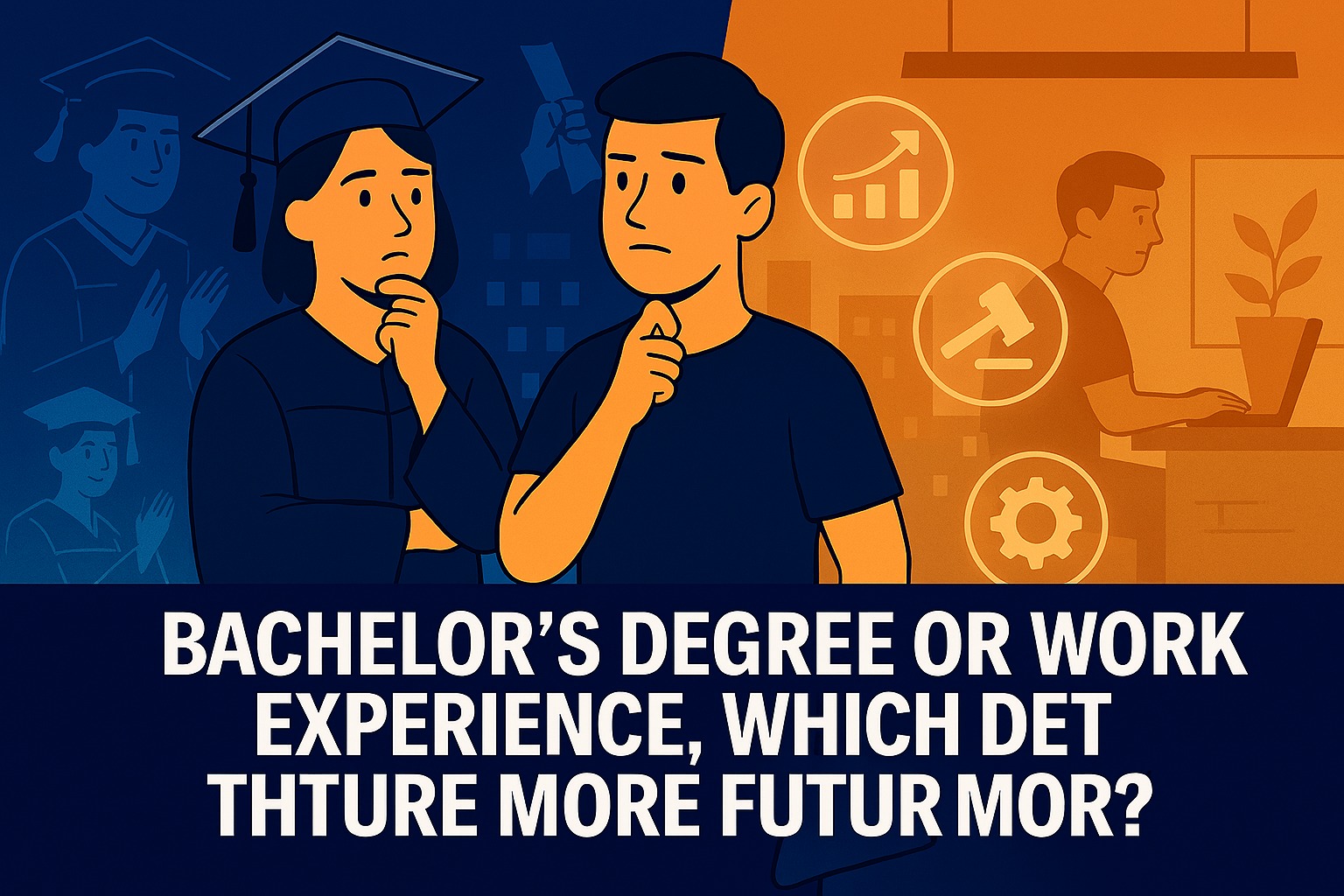
In today’s competitive and fast-changing professional landscape, one of the most debated questions among students and young professionals is whether a bachelor’s degree or work experience plays a more decisive role in shaping the future. As industries evolve due to technological innovation, globalization, and shifting economic demands, traditional educational pathways are increasingly compared with practical, hands-on experience. Some argue that real-world exposure builds competence faster than academic study, while others believe that higher education provides a critical foundation for long-term career growth. The reality is more nuanced. Both a bachelor’s degree and work experience contribute significantly to professional success, but their influence depends on industry context, career goals, and long-term aspirations.
THE VALUE OF A BACHELOR’S DEGREE IN LONG-TERM CAREER DEVELOPMENT
A bachelor’s degree remains one of the most widely recognized educational credentials worldwide. It represents more than the completion of coursework; it signals structured intellectual training, analytical capability, and commitment to academic standards.
Undergraduate education develops critical thinking, research ability, theoretical understanding, and communication skills. Students learn how to analyze complex problems, evaluate data, construct logical arguments, and present ideas effectively. These competencies are transferable across industries and remain relevant even as specific technologies change.
In many professions such as engineering, healthcare, education, law, finance, and management, a bachelor’s degree is either mandatory or strongly preferred. Without it, access to regulated or specialized fields may be limited. Additionally, a degree often serves as a prerequisite for advanced studies, professional certifications, and leadership opportunities.
Over time, degree holders tend to benefit from broader career mobility. As industries evolve, a strong educational foundation makes it easier to adapt, reskill, and pursue new opportunities.
THE POWER OF WORK EXPERIENCE IN SKILL DEVELOPMENT
While academic education builds theoretical knowledge, work experience cultivates practical competence. Real-world environments teach problem-solving under pressure, teamwork, adaptability, and time management. These skills are often developed more rapidly in professional settings than in classrooms.
Employers frequently prioritize candidates who can demonstrate applied experience. Internships, part-time jobs, freelance projects, and full-time roles provide tangible proof of capability. Work experience also exposes individuals to organizational culture, client interaction, and performance expectations, which cannot always be replicated academically.
In fast-moving sectors such as technology, creative industries, sales, and entrepreneurship, demonstrated performance sometimes outweighs formal credentials. A strong portfolio, measurable achievements, and industry experience can open doors even without a traditional degree.
Moreover, work experience helps individuals clarify career interests. Direct exposure to professional environments enables more informed decisions about long-term goals.
INDUSTRY DIFFERENCES AND CONTEXTUAL FACTORS
The importance of a bachelor’s degree versus work experience often depends on the industry. In highly technical or regulated professions, formal education is essential for credibility and compliance. In contrast, skill-based industries may emphasize demonstrated ability over academic background.
Economic conditions also influence employer preferences. In competitive job markets, companies may use educational qualifications as an initial screening tool. Conversely, during talent shortages, practical skills and experience may become more valuable.
Geographical location plays a role as well. In some regions, higher education is deeply embedded in hiring culture, while in others, entrepreneurial pathways and informal skill development are more common.
Therefore, determining which factor influences the future more requires careful consideration of specific career paths and regional labor market dynamics.
LONG-TERM EARNING POTENTIAL AND CAREER ADVANCEMENT
Research consistently suggests that individuals with bachelor’s degrees often experience higher average lifetime earnings compared to those without formal education. A degree can provide access to structured career ladders, promotions, and management roles.
However, work experience contributes significantly to earning growth as well. Performance-based promotions, industry reputation, and specialized expertise developed through hands-on practice can lead to substantial financial rewards.
In many cases, the combination of education and experience creates the strongest foundation. Employers often seek professionals who possess both theoretical understanding and applied competence. Those who integrate academic learning with internships, cooperative education, or early career exposure tend to stand out.
ADAPTABILITY IN A CHANGING WORLD
The modern workforce is shaped by rapid technological advancement, automation, and digital transformation. In such an environment, adaptability becomes a critical determinant of long-term success.
A bachelor’s degree equips individuals with learning agility—the ability to acquire new knowledge efficiently. Work experience, on the other hand, builds resilience and practical decision-making skills.
When industries shift, professionals who have both a strong educational foundation and meaningful experience are better positioned to navigate uncertainty. The future increasingly rewards continuous learning, making the integration of education and experience more valuable than choosing one over the other.
BALANCING EDUCATION AND EXPERIENCE FOR FUTURE SUCCESS
The debate between a bachelor’s degree and work experience should not be framed as a strict competition. Instead, it is more productive to view them as complementary elements of professional development.
For some individuals, entering the workforce early may provide immediate financial benefits and rapid skill acquisition. For others, investing in higher education may create broader long-term opportunities and credibility.
Ultimately, what determines the future more is not solely the possession of a degree or years of experience, but the ability to leverage either pathway effectively. Strategic decision-making, continuous skill development, and adaptability play decisive roles.
CONCLUSION
The question of whether a bachelor’s degree or work experience determines the future more does not have a single universal answer. Both pathways offer distinct advantages. A bachelor’s degree provides structured intellectual growth, professional credibility, and long-term mobility. Work experience develops practical skills, industry insight, and immediate employability.
In a rapidly evolving global economy, the most sustainable approach often involves combining formal education with meaningful professional exposure. Rather than choosing one exclusively, individuals who strategically integrate both are likely to build stronger, more resilient careers.
The future belongs to those who continuously learn, adapt, and apply their knowledge effectively—whether gained in classrooms, workplaces, or both.
Tentang Penulis
Gusti Ayu Tita
Penulis — Universitas STEKOM
Penulis aktif yang berfokus pada isu-isu akademik, teknologi pendidikan, dan pengembangan sumber daya manusia di lingkungan kampus.