How KIP Kuliah Helps Underprivileged Students Access Higher Education
Higher education is often a big dream for many young Indonesians. However, many are forced to abandon this dream due to financial limitations. To address this challenge, the Indonesian government introduced KIP Kuliah (Kartu Indonesia Pintar Kuliah) as a solution to ensure that every student has equal opportunities to pursue higher education.
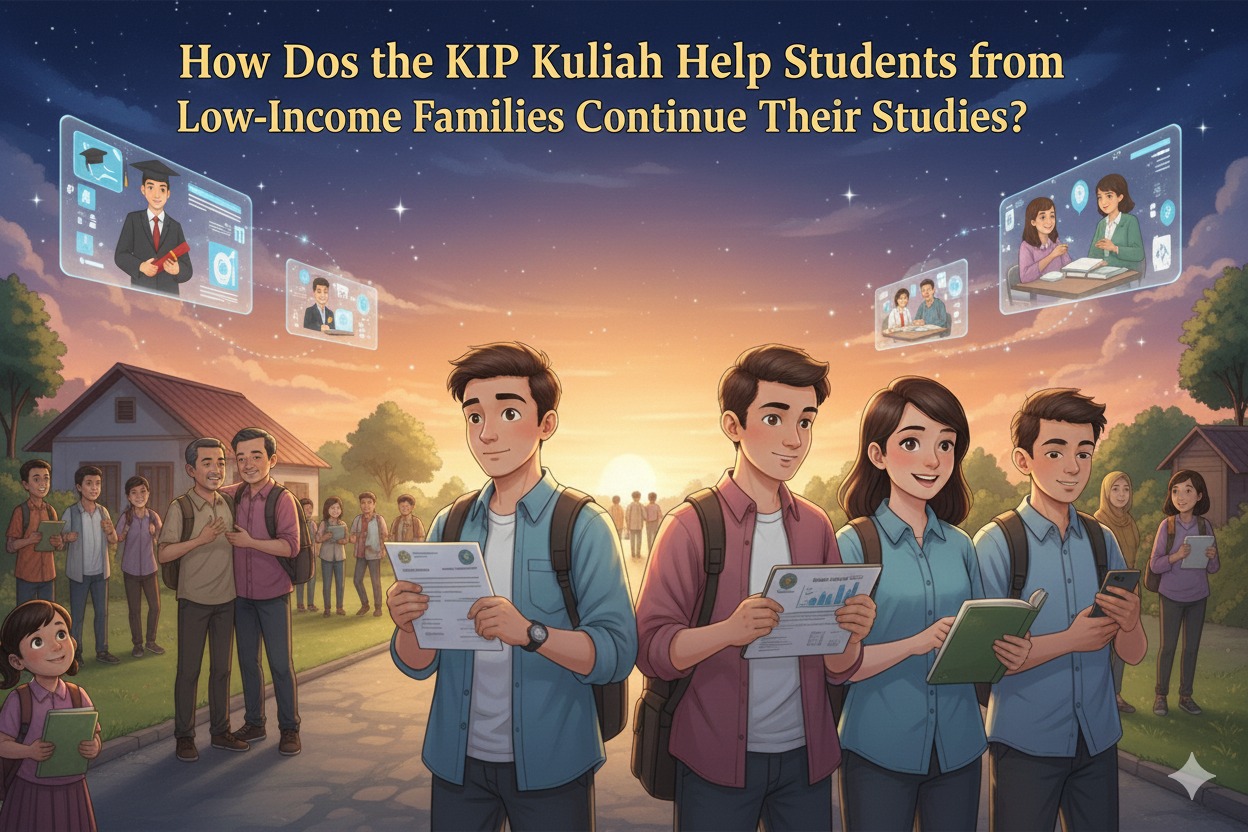
So, how does KIP Kuliah actually help students from underprivileged families continue their studies? Let’s explore this further.
WHAT IS KIP KULIAH AND WHO IS ELIGIBLE?
KIP Kuliah is a government-funded financial aid program designed for students with strong academic potential who face economic barriers. This program represents the government’s commitment to creating fair and inclusive access to higher education across Indonesia.
Typical KIP Kuliah recipients include:
* Graduates of senior high schools, vocational schools, or equivalent institutions who are accepted into public or private universities.
* Students from low-income families.
* Applicants registered in the Integrated Social Welfare Database (DTKS) or those who can provide valid proof of financial hardship.
BENEFITS OF KIP KULIAH FOR UNDERPRIVILEGED STUDENTS
The support provided by KIP Kuliah goes beyond covering tuition fees—it is about opportunity and educational equity. Key benefits include:
1. Full Tuition Coverage
KIP Kuliah recipients are exempt from paying tuition fees (UKT), as all academic costs are fully covered by the government. This allows students to focus on their studies without financial stress.
2. Living Allowance Support
In addition to tuition coverage, recipients receive monthly living allowances adjusted to the campus location and basic student needs. This support helps cover daily expenses during college.
3. Increased Learning Motivation and Opportunity
KIP Kuliah opens wider opportunities for students from remote areas and low-income families to compete fairly. Financial support boosts motivation by reinforcing the belief that education can lead to a better future.
4. Encouraging Social Mobility
By enabling access to higher education, students from economically disadvantaged backgrounds gain better chances to improve their living standards in the future. This reflects a genuine effort toward equal educational opportunity.
HOW TO APPLY FOR KIP KULIAH
To apply for KIP Kuliah, prospective students must complete the following steps:
1. Register on the official website: **kip-kuliah.kemdikbud.go.id**.
2. Fill in personal data and upload required documents such as family cards, academic records, and certificates of financial hardship.
3. Select preferred universities and study programs.
4. Undergo verification and selection by the university or the Higher Education Service Institution (LLDikti).
5. Monitor the application results through the KIP Kuliah account.
Following these steps increases the chances of receiving educational assistance.
CHALLENGES IN IMPLEMENTING KIP KULIAH
Despite benefiting millions of students, several challenges remain:
* Limited access to information in remote areas, causing many students to miss application opportunities.
* Lengthy verification processes, especially when data does not match the DTKS database.
* Limited funding quotas, meaning not all applicants can be accepted.
The government continues to improve the system to ensure that KIP Kuliah becomes more inclusive and well-targeted.
CONCLUSION
The KIP Kuliah program is a concrete government initiative to promote equal access to higher education. By covering tuition fees and providing living allowances, KIP Kuliah has enabled many underprivileged students to pursue higher education without financial concerns.
Through this program, it is hoped that more young Indonesians can achieve their dreams and contribute meaningfully to national development.
Tentang Penulis
Gusti Ayu Tita
Penulis — Universitas STEKOM
Penulis aktif yang berfokus pada isu-isu akademik, teknologi pendidikan, dan pengembangan sumber daya manusia di lingkungan kampus.