
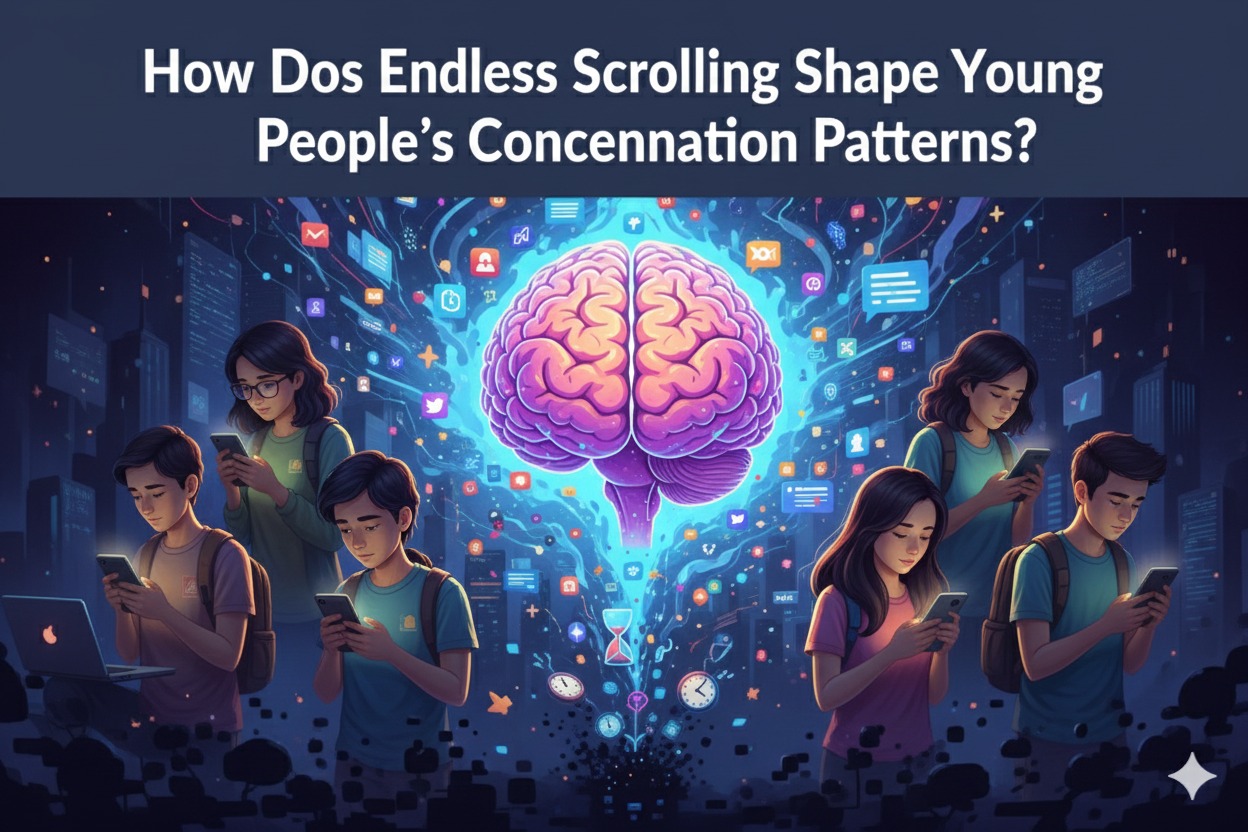
How Endless Scrolling Shapes Focus and Attention in Young People
The habit of endlessly scrolling through social media has become a daily routine for young people. Without realizing it, this simple activity shapes how the brain works and affects the ability to concentrate. In today’s fast-paced digital era, the constant consumption of instant information brings significant changes to how the younger generation focuses, thinks, and completes tasks.
WHAT IS ENDLESS SCROLLING?
Endless scrolling, also known as infinite scroll, is a feature that allows users to continuously view new content without reaching a stopping point. Platforms such as Instagram, TikTok, and YouTube Shorts use this design to keep users engaged for long periods of time.
The problem is that this easy access makes it difficult for young people to stop, forming a habit of consuming fast, short, and repetitive content.
DOPAMINE AND THE SCROLLING HABIT
Every time users encounter interesting content, the brain releases dopamine—a hormone associated with pleasure and curiosity. Because new content appears continuously, the brain becomes accustomed to receiving instant stimulation.
As a result:
* Young people crave immediate gratification
* Patience for long-term focus decreases
* The brain becomes used to shifting attention within seconds
This habit makes tasks that require deep concentration feel difficult and boring.
FRAGMENTED ATTENTION PATTERNS
Endless scrolling creates fragmented attention. Young people become easily distracted because they are accustomed to rapidly changing streams of information.
The effects include:
* Difficulty reading long texts
* Frequent loss of focus while studying
* Reduced productive time
* Shallow understanding of material
A brain that is used to constant change eventually struggles to maintain attention on a single task for extended periods.
LONG-TERM IMPACT ON COGNITIVE ABILITIES
If left unmanaged, endless scrolling can alter the way young people think. Some long-term effects include:
* Declining analytical skills
* Difficulty completing complex tasks
* Increased anxiety when separated from smartphones
* Reduced creativity due to limited opportunities for deep thinking
This habit affects not only learning activities but also how information is processed and interpreted.
HOW TO MANAGE SCROLLING HABITS
To prevent a decline in focus, young people can take several simple steps:
1. Set time limits for social media use.
2. Use screen-tracking apps to monitor usage duration.
3. Create focus zones, such as turning off internet access while studying.
4. Replace scrolling with productive activities like reading or exercising.
5. Practice digital detox for at least a few hours each day.
With the right strategies, scrolling habits can be managed without eliminating social media entirely.
CONCLUSION
Endless scrolling is no longer just a form of entertainment; it is an activity that shapes the concentration patterns of young people. As the consumption of instant content increases, greater awareness is needed to regulate social media use so the brain can remain focused, productive, and capable of optimal performance. Understanding this issue is essential to ensure that the younger generation can benefit from technology without losing the ability to think deeply.
Tentang Penulis
Gusti Ayu Tita
Penulis — Universitas STEKOM
Penulis aktif yang berfokus pada isu-isu akademik, teknologi pendidikan, dan pengembangan sumber daya manusia di lingkungan kampus.



