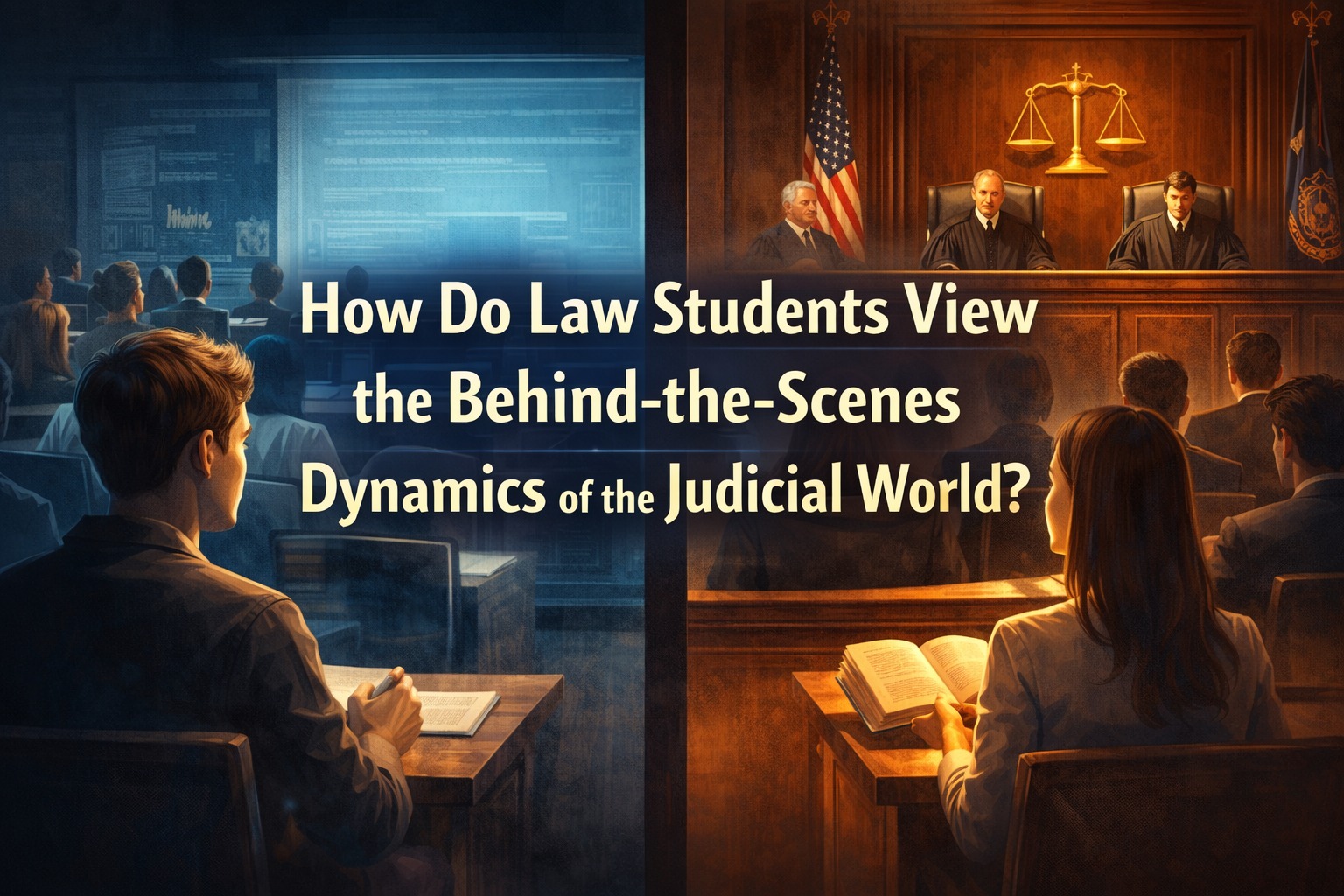
For the general public, the judicial system often appears grand, orderly, and authoritative. However, for law students, the courtroom is not merely a stage for legal drama—it is a real laboratory for understanding how justice is actually carried out. Behind the sound of the judge’s gavel lies a complex dynamic that is rarely visible on the surface. This is what drives law students to uncover the hidden realities behind the judicial system.
1. Between Theory and Practice: A Challenging Gap
When entering the courtroom, many law students realize that legal practice is often far less neat than what is written in textbooks.
Court procedures, the attitudes of the parties involved, and the way judges manage proceedings reveal that law does not operate mechanically—it is alive and adapts to context.
This gap between theory and reality sparks students’ curiosity to explore the true dynamics of legal practice.
2. Interaction Among Judicial Actors
Behind the formal process, there are deeply human interactions among various actors:
judges who must maintain authority and objectivity,
prosecutors who balance legal demands with substantive justice,
defense attorneys striving to represent their clients to the fullest,
and litigants who bring their own emotions and expectations into the courtroom.
Law students observe how decisions are shaped not only by case files, but also by communication, strategy, and psychological dynamics throughout the process.
3. Ethical Challenges Not Found in Textbooks
Ethical issues are among the most “alive” aspects of the judicial world. Law students often encounter situations never discussed in lectures:
how judges avoid conflicts of interest,
how lawyers maintain professionalism when dealing with manipulative clients,
or how prosecutors adjust charges according to their conscience.
From these experiences, students learn that the judicial system is not only about legal articles, but also about moral judgment.
4. Tension Between Justice and Procedure
Behind-the-scenes realities show that not every case can be resolved ideally. Legal procedures often limit the room for discretion.
Law students witness how judges and law enforcement officers attempt to balance two often conflicting principles:
substantive justice (what is most fair) and procedural justice (what is legally permitted).
These observations spark critical discussions that shape students’ academic perspectives.
5. Workload and Systemic Pressure
One dynamic rarely known to the public is the bureaucratic pressure within the judiciary.
Through internships or field studies, students observe:
piles of unresolved case files,
increasing numbers of cases,
limited human resources,
and social or political pressure surrounding certain trials.
This awareness broadens their understanding that the judiciary is not just a legal institution, but a massive system operating under constant pressure.
6. The Role of Students as Critical Observers
With these experiences, law students do not remain passive observers. They have the potential to become moral watchdogs who voice criticism and recommendations.
Through campus discussions, legal research, and public opinion, they can help push the judicial system toward greater transparency, responsiveness, and accountability.
Observing the behind-the-scenes dynamics of the judicial world helps law students realize that justice is not merely the final verdict of a trial, but a long and challenging process.
With critical perspectives and strong curiosity, they are in a strategic position to analyze, evaluate, and eventually improve the legal system they observe today.
A fair judiciary requires not only sound laws, but also a new generation capable of looking deeper, understanding complexity, and committing to integrity within the system.
Tentang Penulis
Gusti Ayu Tita P
Penulis — Universitas STEKOM
Penulis aktif yang berfokus pada isu-isu akademik, teknologi pendidikan, dan pengembangan sumber daya manusia di lingkungan kampus.