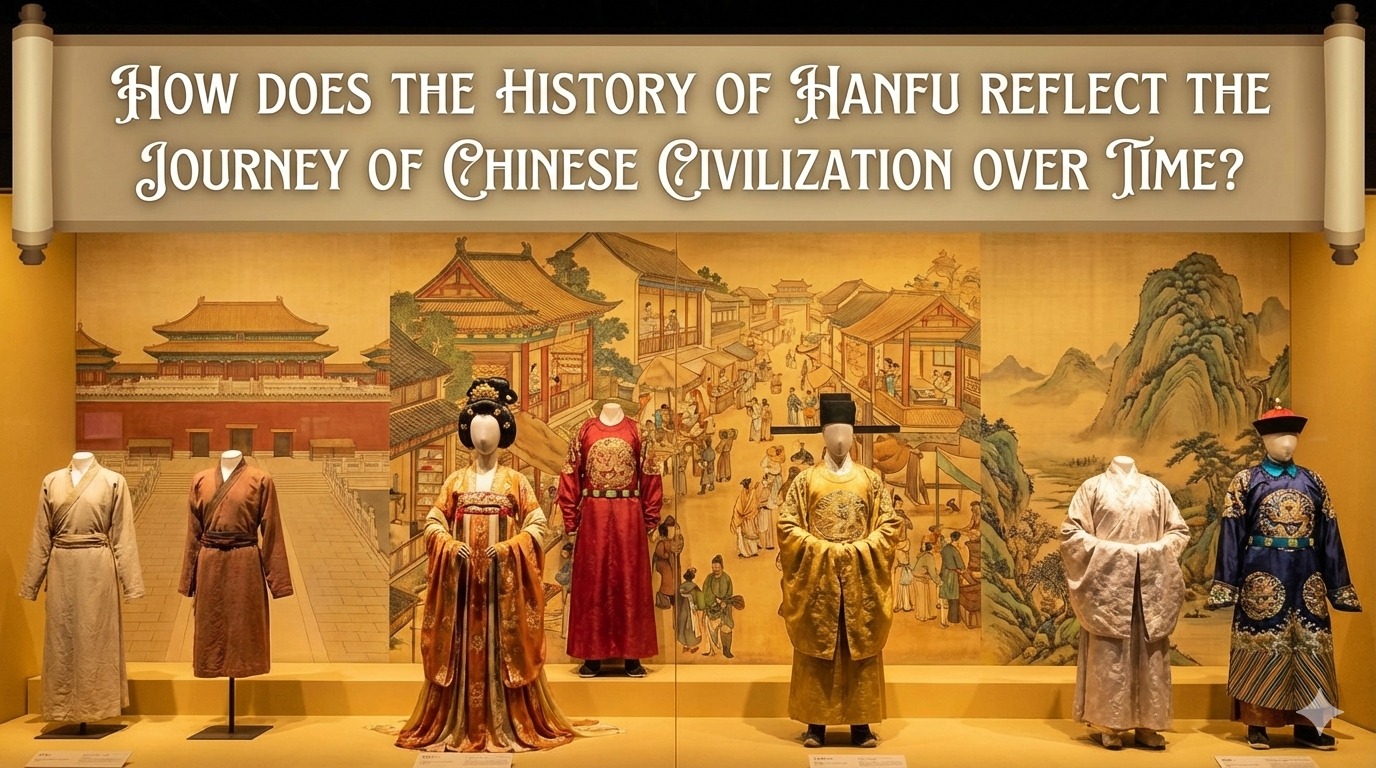
Hanfu: More Than Just Traditional Clothing
Every great civilization has symbols that reflect its values, philosophy, and way of life. For China, one of those symbols is Hanfu. This traditional attire is not merely a form of clothing, but a silent witness to the long journey of Chinese civilization from ancient times to the modern era.
Through the history of Hanfu, we can observe how political, social, and cultural changes have shaped Chinese identity across generations.
Hanfu as a Mirror of Civilization
Hanfu (汉服) is the traditional clothing of the Han ethnic group that has been worn for thousands of years. Every detail—ranging from its cut, colors, to the way it is worn—represents core values of Chinese civilization, such as:
* Harmony between humans and nature
* Social hierarchy and ethics
* Simplicity rooted in philosophy
By understanding Hanfu, we are essentially reading a “visual text” of Chinese history.
Early Civilization: Hanfu and the Birth of Social Order
Hanfu in the Early Dynasties
During the Xia, Shang, and Zhou dynasties, Hanfu developed alongside the emergence of social systems and ritual practices. Clothing was not freely designed, but regulated by norms and state ceremonies.
Clothing as a Tool of Social Regulation
In the Zhou Dynasty, Hanfu symbolized moral order:
* Nobility and commoners wore different styles
* Colors and accessories indicated social status
* Proper dress reflected personal character
This shows that from early on, Chinese civilization viewed clothing as part of moral education.
The Han Dynasty: The Formation of National Identity
Hanfu and Cultural Consolidation
The Han Dynasty marked a crucial turning point in Chinese history. During this era, Hanfu became not only everyday attire but also a symbol of ethnic and national identity.
Key characteristics of Han Dynasty Hanfu included:
* Simple and elegant forms
* Emphasis on function and comfort
* Reflection of political stability
The consistency of Hanfu designs mirrored an era of strong cultural and political consolidation.
The Name “Han” and Historical Legacy
The term “Han people,” still used today, originates from this dynasty. Hanfu thus became a lasting symbol of a unified civilization.
The Tang Dynasty: Prosperity, Openness, and Cultural Confidence
Hanfu in a Cosmopolitan Era
The Tang Dynasty is widely regarded as a golden age of Chinese civilization. Hanfu during this period reflected economic prosperity and cultural openness.
Distinct features of Tang Dynasty Hanfu included:
* Bright and bold colors
* More relaxed silhouettes
* Strong foreign cultural influences
Women’s clothing became more expressive, reflecting a relatively open social role for women compared to other eras.
Clothing as a Symbol of Civilizational Confidence
Tang-era Hanfu represented a confident, prosperous civilization willing to engage with the outside world.
Simplicity and Reflection: From the Song to the Ming Dynasty
Song Dynasty: A Return to Intellectual Values
During the Song Dynasty, Hanfu became more modest and restrained. This shift aligned with the rise of Neo-Confucianism, which emphasized morality, discipline, and intellectual refinement.
Ming Dynasty: The Revival of Tradition
The Ming Dynasty marked a revival of classical Hanfu:
* Structured and orderly designs
* Strong symbolic meanings in motifs
* Balance between aesthetics and ethics
Hanfu in this era reflected a civilization seeking to reaffirm its traditional roots after foreign rule.
Major Transformations: Decline and Modern Revival
The Qing Dynasty and Identity Shift
Under the Qing Dynasty, Hanfu usage declined significantly due to Manchu dress policies. This period marked a major transformation in the visual identity of Chinese civilization.
Hanfu in the Modern Era
In contemporary times, Hanfu has re-emerged as a symbol of:
* Historical awareness
* Cultural pride
* Youth identity
The modern revival of Hanfu shows how Chinese society reinterprets and reconnects with its cultural heritage.
Hanfu as a Living Historical Narrative
The history of Hanfu is a direct reflection of the journey of Chinese civilization—from the formation of social order, cultural prosperity, and periods of transformation, to the search for modern identity.
Hanfu is not merely a historical relic, but a living narrative that continues to evolve with time.
Tentang Penulis
Gusti Ayu Tita
Penulis — Universitas STEKOM
Penulis aktif yang berfokus pada isu-isu akademik, teknologi pendidikan, dan pengembangan sumber daya manusia di lingkungan kampus.