
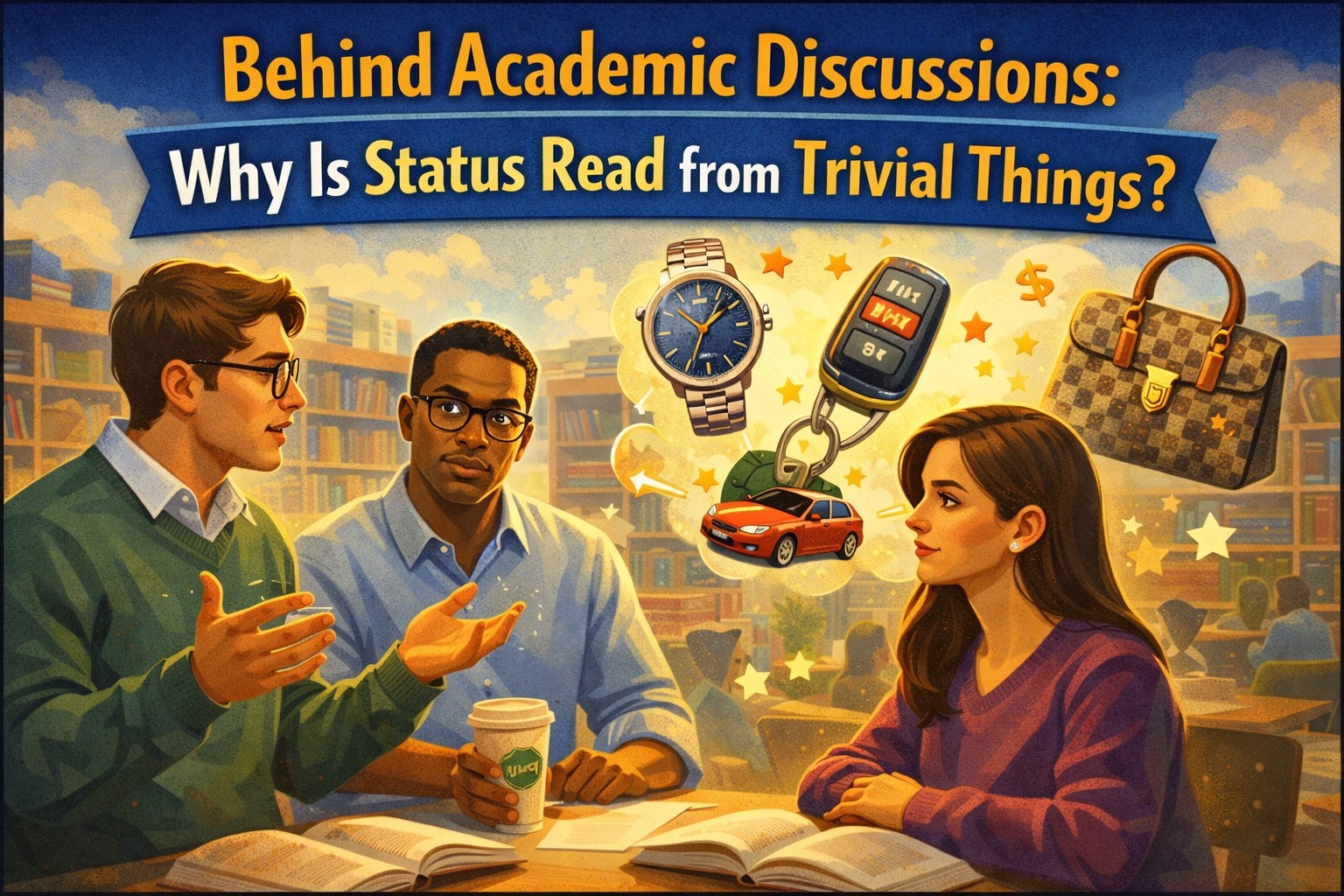
Academic discussions are often imagined as spaces where ideas stand on their own. Arguments, evidence, and logic are expected to determine whose voice carries weight. Yet behind these discussions, status is frequently read from things that appear trivial. Small details, rather than intellectual depth, often shape authority and influence. This article explores why minor attributes become powerful markers of status in academic settings.
THE MYTH OF PURELY RATIONAL DISCUSSION
In theory, academic spaces value rational exchange. In practice, discussions are social interactions shaped by perception.
Before an idea is fully expressed, listeners often form judgments based on appearance, tone, and confidence. These judgments influence how seriously a contribution is taken. As a result, status begins to matter before content is evaluated.
WHAT COUNTS AS “TRIVIAL” THINGS
Trivial things include everyday details that are not directly related to knowledge. Clothing choices, speech rhythm, posture, and even seating position can signal status.
Although these elements seem insignificant, they are easily visible and quickly interpreted. Because they require little effort to notice, they become convenient tools for social categorization.
HOW STATUS IS QUIETLY ASSIGNED
Status in academic discussions is rarely declared. It emerges through subtle patterns of attention.
Who is interrupted and who is allowed to finish speaking? Whose comments receive follow-up questions and whose are ignored? These micro-interactions reveal how status is assigned based on perception rather than merit.
Over time, these patterns solidify. Individuals seen as high-status gain more confidence and speaking time, reinforcing their position.
SOCIAL SHORTCUTS IN COMPLEX ENVIRONMENTS
Academic discussions can be intellectually demanding. To reduce complexity, people rely on shortcuts.
Trivial attributes become indicators of credibility because they are faster to assess than ideas. This reliance on shortcuts explains why appearance and style often overshadow substance, especially in fast-moving discussions.
THE IMPACT ON PARTICIPATION AND DIVERSITY
When status is read from trivial things, participation becomes uneven. Those who do not fit dominant norms may speak less or withdraw entirely.
This dynamic limits diversity of thought. Valuable perspectives are lost, not because they lack quality, but because they come from voices marked as low-status.
QUESTIONING THE POWER OF THE TRIVIAL
Recognizing this pattern is the first step toward change. Academic spaces can encourage deeper listening and create structures that value content over delivery.
By slowing down discussions and reflecting on interaction habits, communities can reduce the influence of trivial markers and refocus on ideas.
CONCLUSION
Behind academic discussions, status is often constructed from trivial things because they are visible, familiar, and easy to interpret. Understanding this hidden process helps explain why authority does not always align with knowledge. Challenging these assumptions is essential for building academic environments where ideas matter more than appearances.
Tentang Penulis
Gusti Ayu Tita
Penulis — Universitas STEKOM
Penulis aktif yang berfokus pada isu-isu akademik, teknologi pendidikan, dan pengembangan sumber daya manusia di lingkungan kampus.



