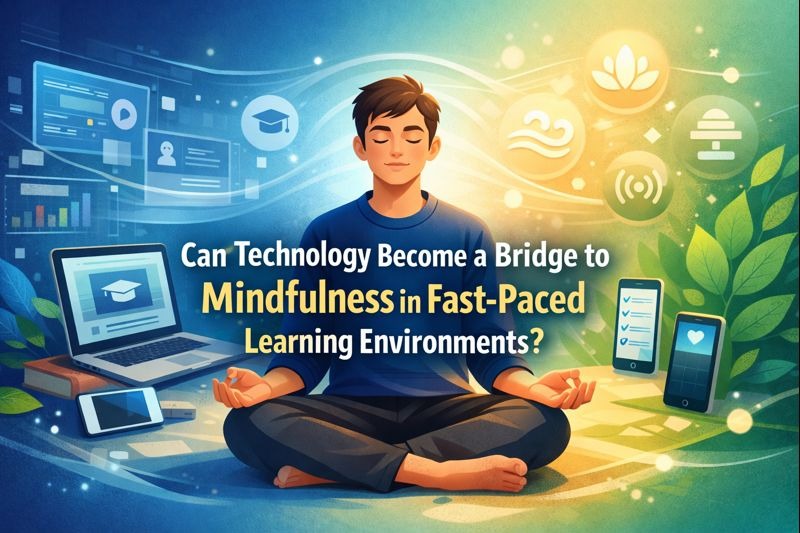
The world of education is moving at an increasingly rapid pace. Assignments arrive nonstop, online learning notifications constantly demand attention, and academic pressure continues to rise. In such conditions, many students struggle with focus and mental fatigue.
At the same time, mindfulness—full awareness of the present moment—has emerged as a solution for maintaining mental clarity and emotional balance. This leads to an intriguing question: can technology, often seen as a source of distraction, actually become a bridge to mindfulness in modern learning environments?
What Is Mindfulness and Why Is It Important in Education?
Mindfulness is not merely meditation; it is the ability to be fully present without judgment.
In educational settings, mindfulness helps students:
- Manage academic stress and social pressure,
- Improve concentration and clear thinking,
- Develop empathy and healthier social relationships at school.
Research shows that students who regularly practice mindfulness tend to demonstrate more stable academic performance and stronger mental resilience.
The Role of Technology in Supporting Mindfulness
Technology is often viewed as the opposite of mindfulness. However, when used wisely, it can support self-awareness and mental well-being.
1. Mindfulness and Meditation Applications
Apps such as Headspace, Calm, and Insight Timer provide guided meditation, breathing exercises, and daily reflections. Students can use short breaks between study sessions to restore focus and calm.
2. Human-Centered Learning Platforms
Some e-learning platforms now include break reminders and self-reflection features to reduce digital fatigue. These innovations help students maintain a balanced learning rhythm.
3. Wearable Technology for Body Awareness
Smartwatches and fitness trackers monitor heart rate, sleep patterns, and stress levels. This data helps students recognize signs of fatigue and engage in mindfulness practices when needed.
4. School Programs Based on Mindful Technology
Some schools worldwide have implemented “Digital Mindfulness Classes” that teach students to use technology consciously—understanding its psychological and emotional impact.
Challenges: When Technology Becomes a Barrier to Mindfulness
Despite its potential, technology also has drawbacks. Addictive social media, constant notifications, and multitasking culture can weaken natural focus.
Without strong digital literacy, students may become reactive rather than reflective—constantly responding to stimuli without pausing for self-awareness.
Strategies for Using Technology Mindfully in Learning
1. Use technology with clear intentions for each learning session.
2. Schedule regular digital breaks to restore mental clarity.
3. Practice daily reflection using mindfulness apps for 5–10 minutes.
4. Encourage collaboration among teachers, students, and parents to build a mindful digital culture.
Conclusion
Technology does not have to be the enemy of mindfulness. With thoughtful use, it can become a bridge to self-awareness rather than a distraction.
Mindfulness does not require rejecting the digital world—it requires **bringing awareness into its use**. Through the integration of technology and mindfulness, modern education can nurture learners who are not only intellectually capable but also emotionally resilient and deeply self-aware.
**Keywords:**
Tentang Penulis
Gusti Ayu Tita
Penulis — Universitas STEKOM
Penulis aktif yang berfokus pada isu-isu akademik, teknologi pendidikan, dan pengembangan sumber daya manusia di lingkungan kampus.