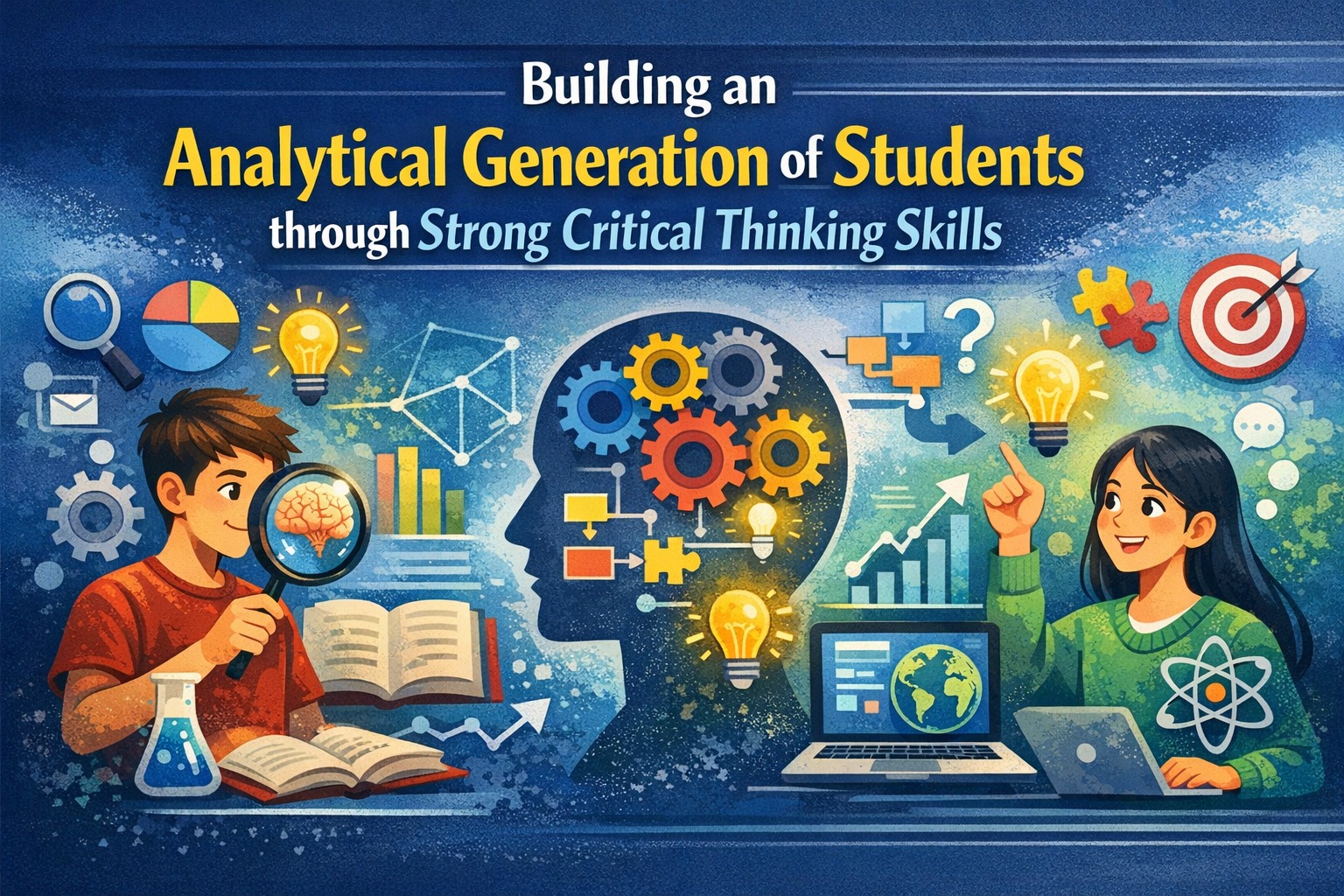
Education plays a vital role in shaping the future of society. Universities and schools are not only responsible for transferring knowledge but also for preparing students to become thoughtful, responsible, and innovative individuals. In an increasingly complex world, one of the most important goals of education is to develop an analytical generation of students.
Critical thinking serves as the cornerstone for achieving this goal. By strengthening students’ ability to analyze information, evaluate arguments, and make logical conclusions, education systems can help cultivate individuals who are capable of understanding complex issues and contributing meaningful solutions to global challenges.
THE IMPORTANCE OF BUILDING AN ANALYTICAL GENERATION
The future will be shaped by individuals who can think carefully and act responsibly. Societies face numerous challenges, including technological transformation, environmental sustainability, economic development, and social change. Addressing these issues requires individuals who can analyze problems deeply and develop innovative strategies.
Students who develop strong analytical skills are more capable of understanding these complex challenges. They learn to evaluate different perspectives, interpret data carefully, and identify the most effective solutions.
By building an analytical generation, education institutions can help create leaders who are able to guide society toward sustainable progress.
THE ROLE OF CRITICAL THINKING IN MODERN EDUCATION
Critical thinking encourages students to engage actively with the knowledge they acquire. Instead of simply accepting information, they learn to question assumptions, analyze evidence, and connect ideas across different disciplines.
This approach strengthens intellectual independence. Students become more confident in forming their own perspectives while remaining open to new ideas and constructive dialogue.
Modern education increasingly recognizes that critical thinking is essential not only for academic success but also for personal development and civic responsibility.
HOW EDUCATIONAL ENVIRONMENTS CAN SUPPORT CRITICAL THINKING
Educational institutions play an important role in fostering critical thinking among students. Classrooms that encourage discussion, debate, and collaborative learning provide opportunities for students to practice analytical reasoning.
Project-based learning and research activities also help students develop critical thinking skills. These methods require learners to explore problems, gather information from multiple sources, and present well-supported conclusions.
Teachers can further support this process by encouraging curiosity and guiding students to ask meaningful questions. When students feel comfortable exploring ideas critically, they become more engaged and motivated learners.
THE LONG-TERM IMPACT OF ANALYTICAL STUDENTS
Students who develop strong critical thinking abilities carry these skills into their future careers and social roles. They become professionals who are capable of analyzing data, evaluating strategies, and making responsible decisions.
In addition, analytical thinkers contribute to healthier public discussions and more informed communities. Their ability to evaluate information objectively helps reduce the spread of misinformation and encourages thoughtful dialogue.
As a result, building an analytical generation of students has long-term benefits not only for individuals but also for society as a whole.
CONCLUSION
The development of strong critical thinking skills is essential for preparing students to face the challenges of the modern world. Education must move beyond simple knowledge transfer and focus on cultivating analytical abilities that enable students to interpret and apply information effectively.
By nurturing critical thinking, educational institutions can help build a generation of students who are intellectually curious, analytically skilled, and ready to contribute innovative solutions to global challenges.
In the long run, an analytical generation will play a crucial role in shaping a more thoughtful, responsible, and progressive society.
Tentang Penulis
Gusti Ayu Tita
Penulis — Universitas STEKOM
Penulis aktif yang berfokus pada isu-isu akademik, teknologi pendidikan, dan pengembangan sumber daya manusia di lingkungan kampus.