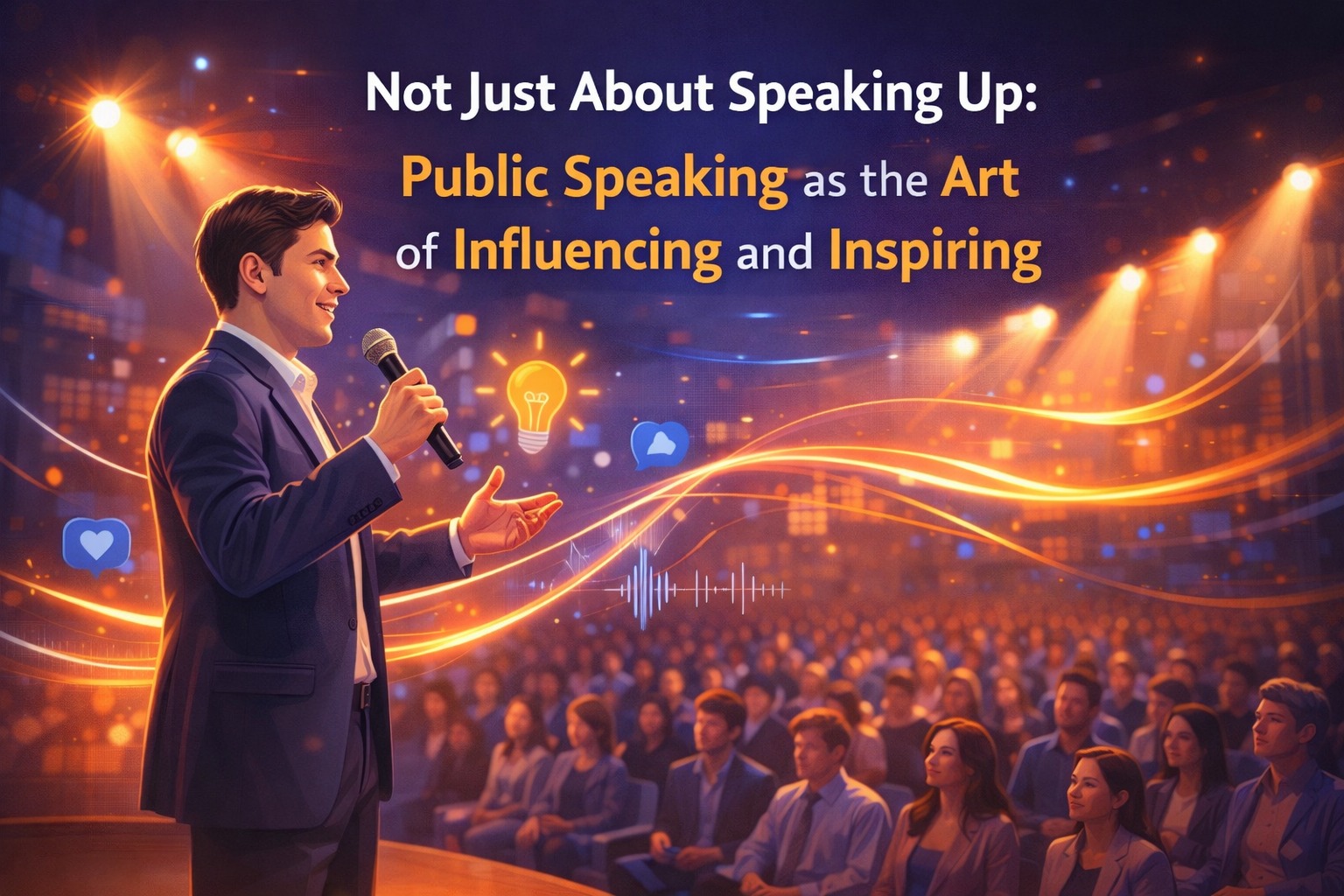
Public speaking is often narrowly understood as the courage to stand in front of an audience and speak without feeling nervous. In reality, behind the act of speaking in public lies a process that is far more complex and strategically valuable. Public speaking is the art of shaping messages, emotions, and trust so that audiences do not merely listen, but are also moved and inspired. In educational, professional, and leadership contexts, this skill determines whether an idea comes alive or simply fades away.
In an era saturated with information, courage alone is no longer enough. Anyone can speak, but not everyone can influence. This is why public speaking deserves to be regarded as an art. Art requires sensitivity, practice, and a deep understanding of the audience. When practiced with such awareness, public speaking becomes a powerful tool of transformation—shaping opinions, building trust, and igniting inspiration.
Public Speaking as the Art of Communication
Public speaking is considered an art because it combines technique, intuition, and empathy. An effective speaker does not merely deliver data but also builds an emotional connection with the audience. This process requires awareness of context, situation, and the characteristics of those being addressed.
Before focusing on technical aspects, it is essential to understand that the art of public speaking is rooted in the ability to read people. Audiences are not passive recipients of information; they are individuals with diverse backgrounds, emotions, and expectations. Therefore, speakers must craft messages that are relevant and meaningful. In practice, this art of communication can be seen through several key elements:
1. Mastery of the message
A speaker must thoroughly understand the material. This mastery allows delivery to feel convincing and natural, without rigid dependence on scripts or memorization.
2. Appropriate use of language
Word choice, language style, and sentence structure influence how messages are received. Clear and contextual language helps audiences process ideas more easily.
3. Voice and intonation management
Variations in tone, speaking pace, and emphasis add color to delivery. Controlled voice use helps maintain audience attention throughout the session.
4. Aligned body language
Hand gestures, eye contact, and facial expressions reinforce verbal messages. Consistent body language conveys confidence and openness.
Building Influence Through Public Speaking
Influence is the result of trust. In public speaking, trust does not emerge instantly but is built through consistency between message, attitude, and delivery. Speakers who influence effectively are those who appear authentic and have a clear purpose.
Before influencing others, speakers must realize that audiences evaluate not only what is said, but also who is saying it. Personal credibility becomes the foundation upon which influence grows. Some ways public speaking builds influence include:
1. Delivering values, not just information
Audiences are more influenced when messages contain values relevant to their lives rather than raw data alone.
2. Creating logical and emotional flow
A combination of logic and emotion makes messages feel both reasonable and emotionally engaging.
3. Demonstrating empathy toward the audience
Empathy is reflected in understanding the audience’s needs and concerns. When people feel understood, influence forms naturally.
4. Consistency between words and behavior
Alignment between verbal and nonverbal communication builds trust, while inconsistency weakens influence.
5. Inviting rather than lecturing
A persuasive approach that invites audiences to think together is more effective than one that feels judgmental or dominant.
Public Speaking as a Source of Inspiration
Beyond influence, public speaking also plays a vital role in inspiring others. Inspiration arises when audiences feel emotionally touched and see new possibilities within themselves. An inspiring speaker does not have to be perfect, but must be honest about their journey.
Before delivering inspirational messages, speakers should reflect on relevant personal experiences. Authentic stories often leave deeper impressions than abstract concepts. From this emotional closeness, inspiration grows. Key elements of inspirational public speaking include:
1. Meaningful stories
Real experiences shared honestly evoke empathy and convey lessons without sounding preachy.
2. Messages that spark hope
Inspiration grows from the belief that change is possible. Optimistic yet realistic messages energize audiences.
3. The courage to show vulnerability
Acknowledging failures and learning processes makes speakers feel human and relatable.
4. A call to action
Inspiration becomes stronger when followed by concrete actions, even small ones, that audiences can take afterward.
Practice and Awareness as the Main Keys
Public speaking as an art cannot be mastered instantly. It requires continuous practice and self-awareness. Every speaking opportunity is a learning space to refine technique and deepen understanding of audiences.
Before reaching maturity, speakers must go through evaluation and reflection. Mistakes are not failures but part of character formation in communication. With the right approach, public speaking can develop into a sustainable personal strength. Important steps in this development include:
1. Consistent practice
Practice builds confidence and fluency. The more one practices, the sharper communication instincts become.
2. Receiving feedback
Input from audiences or peers serves as a mirror to identify strengths and weaknesses.
3. Observing other speakers
Learning from experienced speakers enriches perspective and personal references.
Summary
Public speaking is not merely about the courage to speak in public, but the art of influencing and inspiring through meaningful communication. By mastering messages, understanding audiences, and managing emotions and values, public speaking can build influence and spark inspiration. Through practice, awareness, and empathy, this skill becomes a vital asset in various aspects of life, from education to leadership.
Keywords:
Tentang Penulis
Gusti Ayu Tita
Penulis — Universitas STEKOM
Penulis aktif yang berfokus pada isu-isu akademik, teknologi pendidikan, dan pengembangan sumber daya manusia di lingkungan kampus.