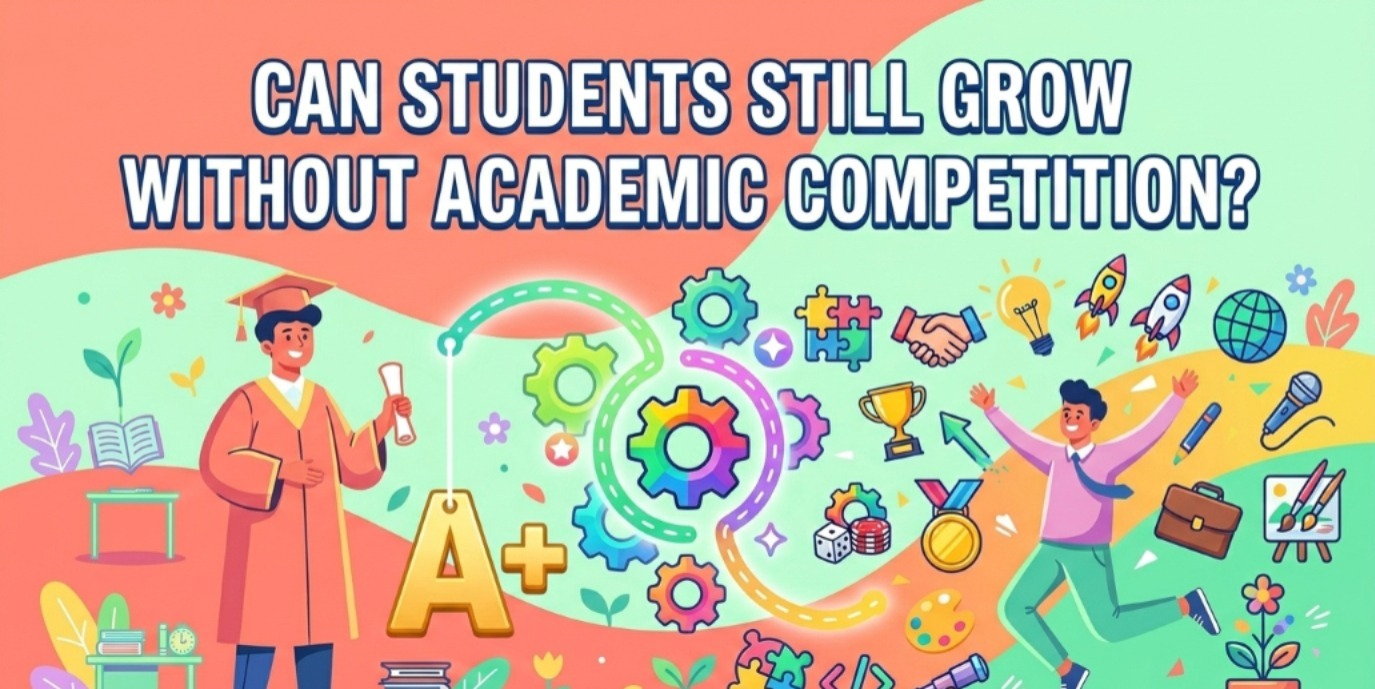
Academic competition is often considered a driving force in education. Rankings, awards, and contests are commonly used to measure performance and motivate learners. However, an important question arises: can students still grow without academic competition?
Growth in education is not limited to winning contests or achieving the highest scores. Student development involves intellectual progress, emotional maturity, creativity, and character building. These aspects can develop through various learning approaches, not only through competitive systems.
THE ROLE OF INTERNAL MOTIVATION
One of the strongest factors in student growth is internal motivation. Students who learn because of curiosity and personal goals often achieve deep understanding.
Without academic competition, students can still build strong learning habits. They may focus more on mastering concepts rather than comparing themselves with others.
Intrinsic motivation encourages long-term learning consistency.
COLLABORATIVE LEARNING ENVIRONMENTS
Collaborative learning provides an alternative to competitive education. Group discussions, team projects, and peer mentoring allow students to exchange ideas.
In cooperative environments, students learn communication, empathy, and teamwork. These skills are essential for personal and professional development.
Collaboration can stimulate creativity because students feel safer sharing innovative ideas without fear of losing.
CHARACTER AND EMOTIONAL DEVELOPMENT
Student growth is not only academic. Emotional intelligence, responsibility, and adaptability are equally important.
Non-competitive learning environments often reduce stress and anxiety. Students may feel more comfortable exploring new subjects.
This comfort can enhance confidence and independent thinking.
SELF-BASED PERFORMANCE EVALUATION
Without academic competition, performance measurement can still exist through personal goal setting. Students can evaluate progress based on individual improvement.
Self-assessment encourages reflection. Learners analyze strengths and weaknesses without relying on external rankings.
Continuous self-improvement remains possible even without competitive pressure.
CONCLUSION
Students can still grow without academic competition. Development depends on motivation, supportive environments, and effective learning strategies.
While competition can stimulate achievement for some individuals, it is not the only path to quality education. Balanced learning systems that emphasize curiosity, collaboration, and character building can also produce capable and confident students.
Tentang Penulis
Gusti Ayu Tita
Penulis — Universitas STEKOM
Penulis aktif yang berfokus pada isu-isu akademik, teknologi pendidikan, dan pengembangan sumber daya manusia di lingkungan kampus.