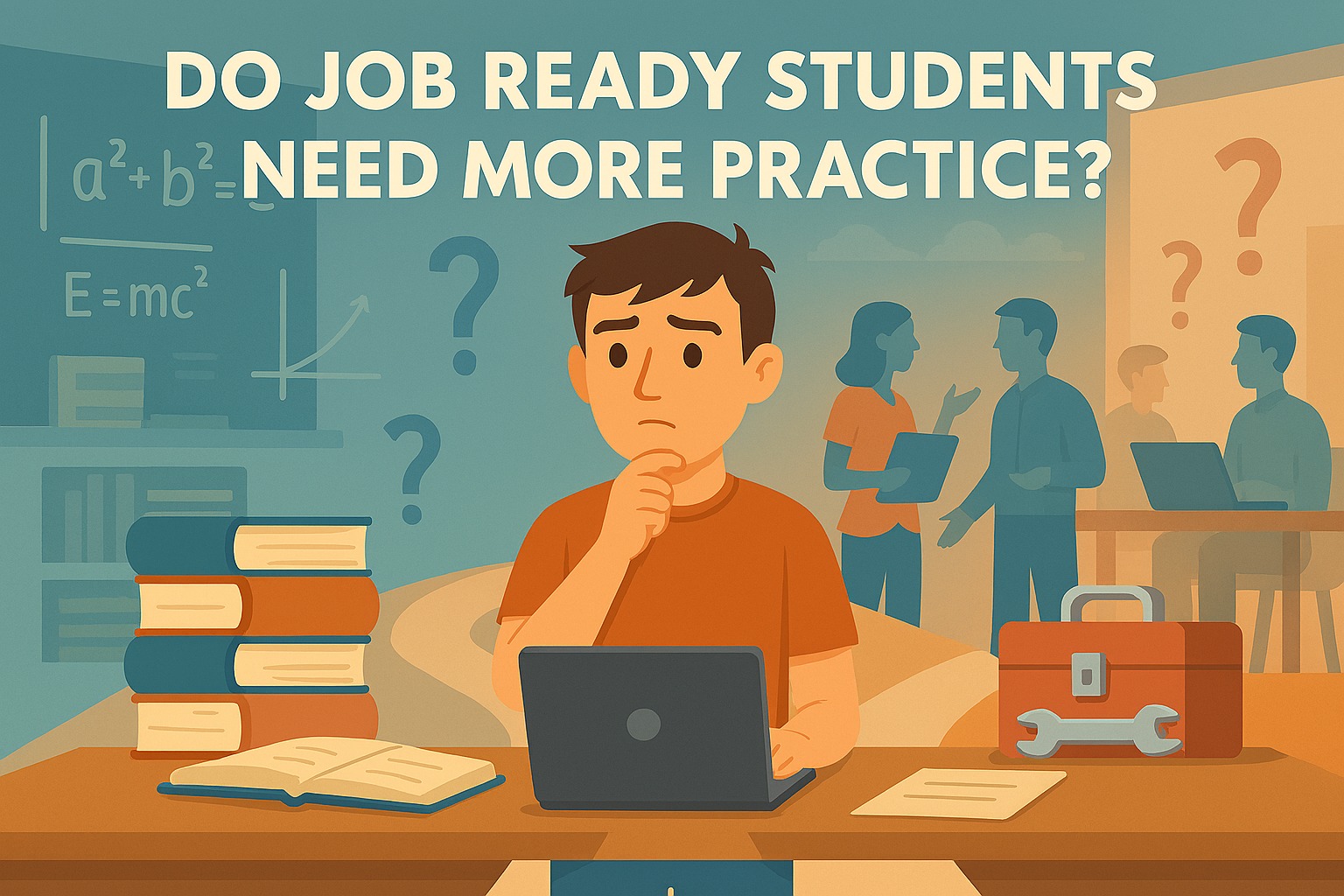
In today’s competitive world, the term job-ready is often used to describe students who are prepared to enter the workforce immediately after graduation. Many students focus on achieving good grades, completing assignments, and meeting academic requirements. However, employers frequently say that academic success alone is not enough. This raises an important question: do job-ready students actually need more practical experience? The answer is closely related to how education prepares students for real-world challenges.
WHAT DOES “JOB-READY” REALLY MEAN?
Being job-ready does not simply mean graduating with a degree. It refers to a combination of knowledge, skills, attitude, and adaptability. A job-ready student understands the basics of their field and is also capable of applying that knowledge in real situations.
Employers often look for candidates who can communicate effectively, work in teams, manage time, solve problems, and adapt to changing conditions. These qualities are difficult to measure through exams alone.
A student may understand theories perfectly, but if they cannot apply them in real scenarios, they may still struggle in the workplace.
THE LIMITATIONS OF THEORY-BASED LEARNING
Theory-based learning is important because it builds the intellectual foundation of a profession. It helps students understand why certain methods work and how systems function. However, theory alone does not guarantee competence.
Many academic environments focus heavily on lectures, textbooks, and written exams. Students are trained to understand concepts, but not always to practice them. As a result, some graduates know the theory but feel uncertain when asked to perform real tasks.
This gap between knowledge and action is one of the main reasons why some students are not fully job-ready.
HOW PRACTICE BUILDS REAL-WORLD SKILLS
Practical experience allows students to transform knowledge into usable skills. When students engage in internships, projects, or real-world assignments, they face situations that cannot be simulated in classrooms.
Through practice, students learn how to:
- Communicate with colleagues and clients
- Work under deadlines
- Solve unexpected problems
- Collaborate with teams
- Take responsibility for real outcomes
These experiences help students become more confident and adaptable. They also provide valuable insights into what the professional world actually expects.
WHY EVEN GOOD STUDENTS STILL NEED PRACTICE
Some students believe that strong academic performance is enough to prepare them for work. While good grades are important, they do not replace real-world experience.
Even top students benefit from practical exposure because it helps them apply their knowledge in dynamic situations. Practice teaches lessons that textbooks cannot provide, such as handling pressure, making quick decisions, and working with diverse personalities.
Without these experiences, students may enter the workforce feeling unsure, even if they have excellent academic records.
THE BALANCE BETWEEN KNOWLEDGE AND EXPERIENCE
Job readiness is achieved when students balance theoretical knowledge with practical experience. Theory provides direction and understanding, while practice builds skill and confidence.
Students who combine both tend to adapt faster in professional environments. They are not only able to explain concepts but also demonstrate their abilities through action.
This balance makes them more attractive to employers and helps them transition smoothly from campus life to the workplace.
CONCLUSION
Job-ready students do need practical experience, not because theory is unimportant, but because knowledge alone is not enough. Practice transforms theoretical understanding into real skills that can be applied in professional settings.
Students who actively seek practical opportunities during their studies develop stronger confidence, clearer career direction, and greater adaptability. In the end, true job readiness comes from the combination of knowledge and experience.
Tentang Penulis
Gusti Ayu Tita
Penulis — Universitas STEKOM
Penulis aktif yang berfokus pada isu-isu akademik, teknologi pendidikan, dan pengembangan sumber daya manusia di lingkungan kampus.