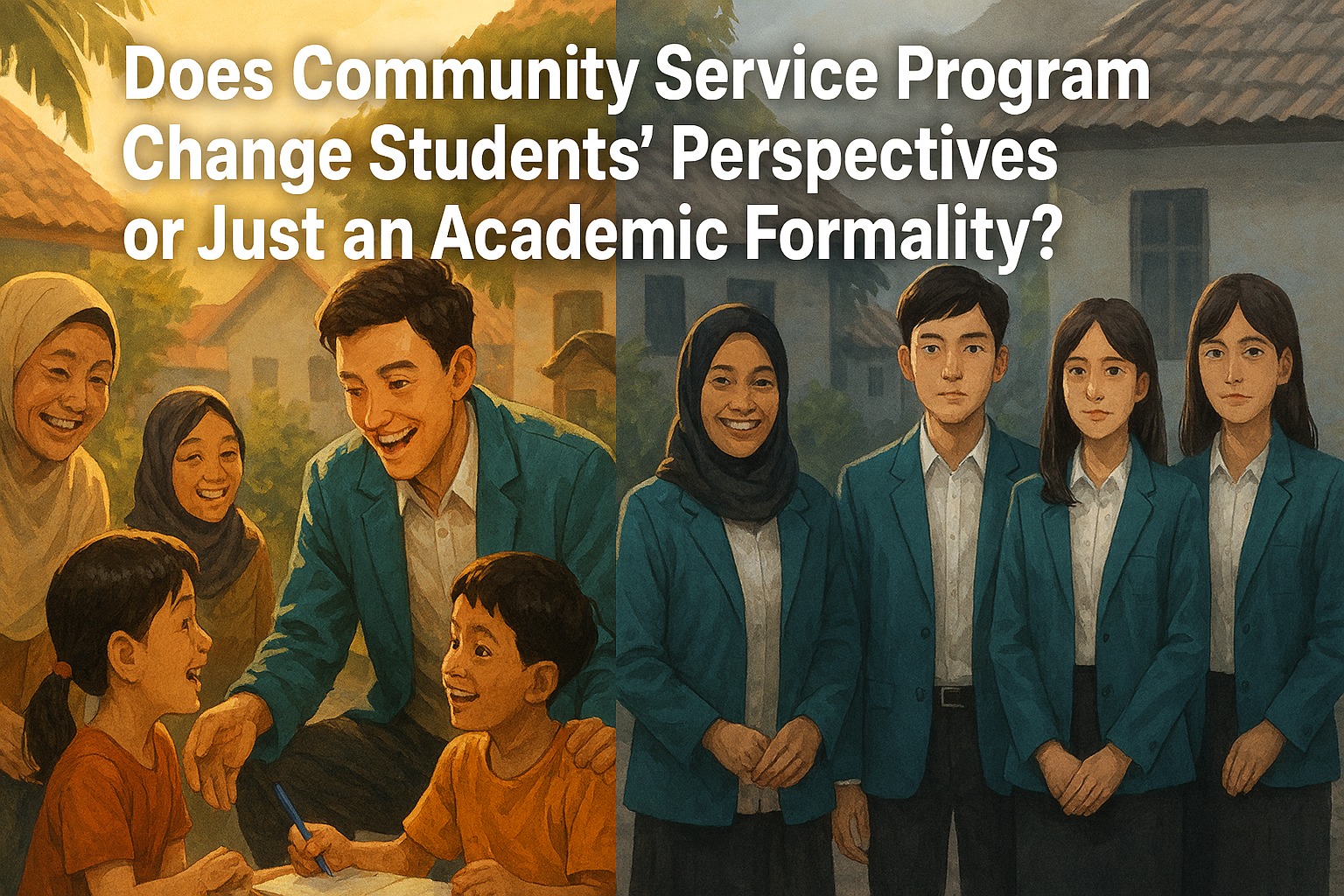
Community Service Program has long been positioned as a bridge between higher education and society. Universities promote it as a transformative experience where students apply academic knowledge to real-world challenges. Yet, many still question whether this program truly reshapes students’ perspectives or merely serves as a requirement to complete academic credits.
In many institutions, participation in a Community Service Program is mandatory before graduation. Students are assigned to communities, expected to design projects, and submit final reports. While the structure appears meaningful, the real impact often depends on how deeply students engage with the process.
This article explores whether the Community Service Program genuinely changes students’ mindsets or functions primarily as an academic formality. By examining its goals, outcomes, and challenges, we can better understand its role in student self-development and social responsibility.
THE PURPOSE BEHIND COMMUNITY SERVICE PROGRAMS
Community Service Programs are rooted in the idea that higher education should extend beyond classrooms. Universities aim to connect theory with practice by sending students directly into communities. This approach encourages experiential learning that cannot be replicated through lectures alone.
The program is designed to cultivate social awareness and civic responsibility. Students are expected to identify local issues, collaborate with residents, and propose practical solutions. Through this process, they gain insight into social realities that textbooks often simplify.
Moreover, the program supports the broader mission of higher education institutions to contribute to society. It reinforces the principle that knowledge should generate positive impact. Students are positioned not only as learners but also as agents of change.
However, the intended purpose does not always align with actual outcomes. Without meaningful engagement, the program risks becoming a routine obligation rather than a transformative experience.
EXPOSURE TO REAL-WORLD CHALLENGES
One of the most significant aspects of a Community Service Program is exposure to real-world conditions. Students encounter social, economic, and cultural dynamics that differ from campus life. This exposure can broaden their understanding of inequality, diversity, and community resilience.
In many cases, students realize that theoretical solutions require adaptation. What seems effective in academic discussions may not suit the practical needs of a community. This realization encourages critical thinking and flexibility.
Direct interaction with local residents also strengthens empathy. Listening to personal stories and observing daily struggles allows students to develop a deeper emotional connection to societal issues. Such experiences often leave lasting impressions.
Yet, the depth of this exposure varies. If students focus solely on completing assigned tasks, they may miss opportunities for reflection and growth. Meaningful transformation requires active participation and genuine curiosity.
DEVELOPMENT OF SOFT SKILLS AND LEADERSHIP
Beyond academic application, Community Service Programs contribute to soft skill development. Students must communicate clearly, manage teamwork, and adapt to unfamiliar environments. These competencies are essential in both professional and personal contexts.
Working in diverse groups challenges students to collaborate effectively. Differences in academic backgrounds and personalities require negotiation and compromise. Through this process, leadership qualities often emerge.
Public speaking and community engagement further enhance confidence. Presenting project ideas to local stakeholders pushes students to articulate their thoughts persuasively. Over time, they become more comfortable interacting with various audiences.
Nevertheless, if roles are unevenly distributed within teams, some students may remain passive. To maximize benefits, universities must ensure active participation from all members.
THE RISK OF BECOMING ACADEMIC FORMALITY
Despite its potential, the Community Service Program can sometimes feel like a checklist requirement. Students may prioritize documentation and report completion over meaningful interaction. When this happens, the essence of community engagement fades.
Short program durations can also limit impact. Sustainable change often requires long-term commitment, while most programs operate within a few weeks or months. This time constraint may reduce opportunities for deeper involvement.
Another issue lies in mismatched expectations. Communities may hope for tangible improvements, while students focus on fulfilling academic standards. Without clear alignment, both sides can feel dissatisfied.
If institutions emphasize grades more than reflection, students might approach the program strategically rather than sincerely. In such cases, it becomes closer to an academic formality than a transformative journey.
IMPACT ON STUDENT PERSPECTIVES
For students who engage wholeheartedly, the impact can be profound. Many report increased awareness of social responsibility and a broader worldview. They begin to see their education as a tool for contributing to society.
Experiencing community life firsthand often reshapes career aspirations. Some students become interested in social entrepreneurship, public service, or grassroots development. The program can influence long-term professional direction.
Personal growth is another outcome. Living outside comfort zones encourages independence and resilience. Students learn to navigate uncertainty and solve problems creatively.
However, perspective change is not automatic. It depends on reflection, mentorship, and the willingness to learn from challenges. Without these elements, the experience may not significantly alter attitudes.
STRATEGIES TO MAXIMIZE MEANINGFUL IMPACT
To ensure that Community Service Programs truly transform students, universities must refine their approach. Pre-departure training can help students understand community contexts and ethical engagement principles. Preparation enhances readiness and sensitivity.
Continuous supervision and mentorship are equally important. Faculty guidance encourages reflection and critical analysis of experiences. Structured discussions can deepen understanding beyond surface-level observations.
Collaboration with community leaders should also be prioritized. Programs designed through participatory planning are more likely to address real needs. Mutual cooperation strengthens trust and sustainability.
Ultimately, when thoughtfully implemented, Community Service Programs can move beyond academic formality. They can serve as powerful platforms for perspective change, skill development, and meaningful societal contribution.
Tentang Penulis
Gusti Ayu Tita
Penulis — Universitas STEKOM
Penulis aktif yang berfokus pada isu-isu akademik, teknologi pendidikan, dan pengembangan sumber daya manusia di lingkungan kampus.