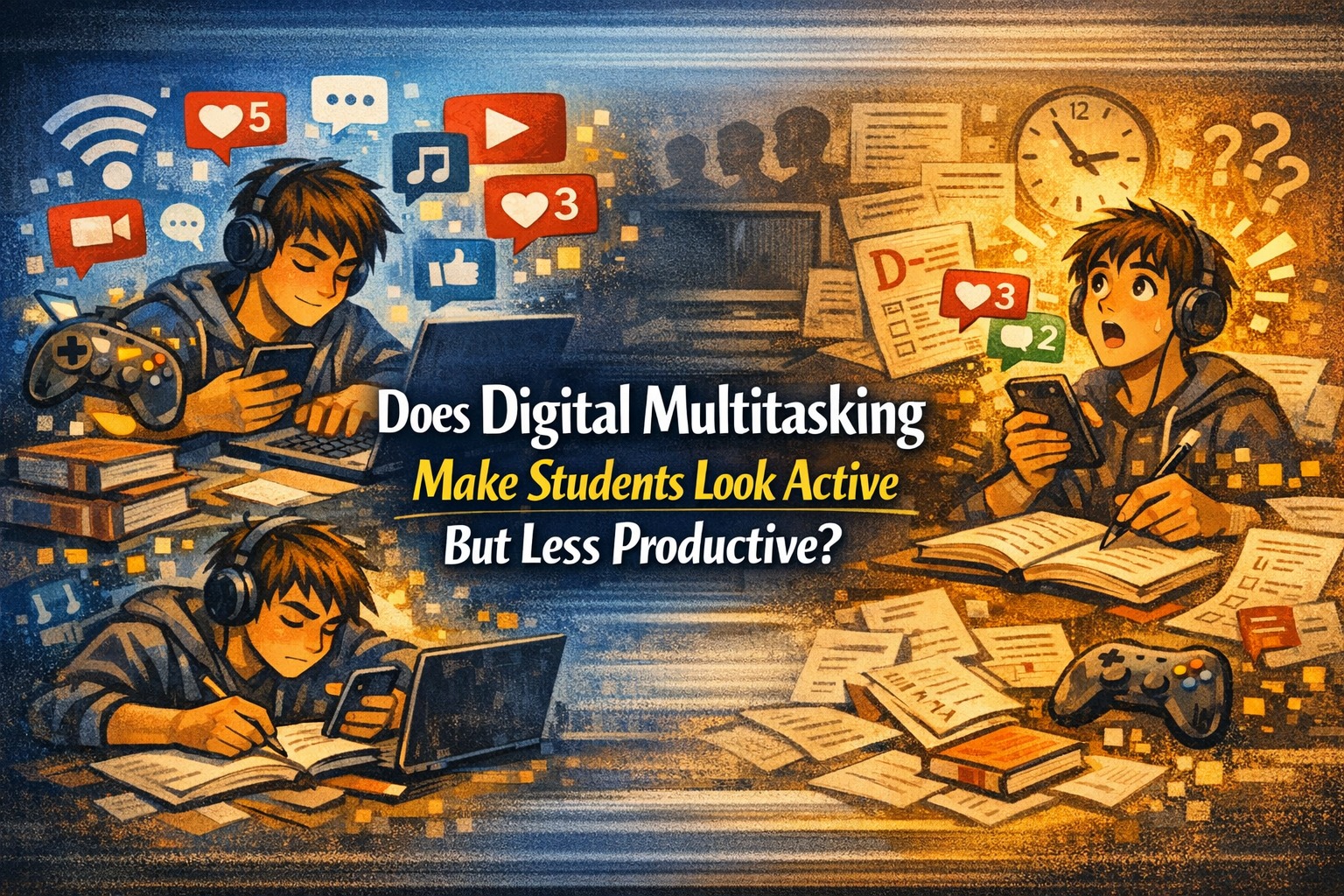
In today’s technology-driven learning environment, students often use multiple digital devices while studying. Laptops, smartphones, tablets, and online platforms provide instant access to information and communication. At first glance, students who switch between tasks—checking messages, browsing resources, and completing assignments—appear highly active and engaged.
However, this constant digital activity does not always translate into real academic progress. Many students spend hours interacting with digital tools yet struggle to produce meaningful learning results. This raises an important question: does digital multitasking make students look active but less productive?
Understanding how multitasking affects learning can help students develop better study habits in the digital age.
THE RISE OF DIGITAL MULTITASKING
Digital multitasking has become common among students. While studying, they may simultaneously open multiple tabs, watch educational videos, reply to messages, and browse social media. Technology allows all of these activities to happen within the same device, making multitasking feel natural and efficient.
Students often believe that performing several tasks at once helps them save time. The ability to switch quickly between applications creates the impression of constant productivity. However, research on learning and attention suggests that the human brain is not designed to process multiple complex tasks at the same time.
Instead of true multitasking, the brain repeatedly shifts focus from one task to another.
THE COST OF CONSTANT TASK SWITCHING
Every time students move their attention from one activity to another, their brains must adjust to the new task. This process, known as task switching, requires mental effort and reduces cognitive efficiency.
When task switching occurs frequently, students lose valuable time and energy. They may forget important details, misunderstand information, or make more mistakes in their work.
Although the switching process may happen quickly, the cumulative effect can significantly reduce overall productivity during study sessions.
THE ILLUSION OF BEING BUSY
Digital multitasking often creates the illusion of productivity. Students may feel busy because they are constantly interacting with different applications and tasks. However, activity alone does not guarantee meaningful progress.
For example, a student might spend time switching between a research article, a messaging app, and several browser tabs. While it seems like a productive use of time, the constant interruptions prevent deep understanding of the material.
As a result, students may complete tasks more slowly or produce lower-quality work despite spending long hours studying.
HOW MULTITASKING AFFECTS LEARNING AND MEMORY
Effective learning requires concentration and sustained attention. When students focus on a single task, their brains can process information more deeply and store it in long-term memory.
Multitasking disrupts this process by dividing attention across several activities. Instead of fully understanding a topic, students may only grasp surface-level information. This makes it more difficult to recall knowledge during exams or apply it to complex problems.
Over time, frequent multitasking can weaken learning habits and reduce academic performance.
STRATEGIES TO IMPROVE STUDY PRODUCTIVITY
Students can improve their productivity by reducing digital multitasking during study sessions. One effective approach is focusing on one task at a time. Completing a single activity before moving to the next helps maintain deeper concentration.
Another helpful strategy is creating a distraction-free study environment. Closing unnecessary browser tabs, turning off notifications, and using digital tools only for academic purposes can help students stay focused.
In addition, scheduling short breaks between study sessions allows students to relax without interrupting their concentration while working.
DEVELOPING HEALTHIER DIGITAL STUDY HABITS
Building strong study habits in the digital era requires awareness and discipline. Students who understand the impact of multitasking on their learning are more likely to manage their digital behavior effectively.
Setting clear study goals, organizing tasks by priority, and limiting unnecessary online activity can significantly improve focus. Over time, these habits help students transform digital technology into a tool that supports learning rather than a source of distraction.
CONCLUSION
Digital multitasking may make students appear active and busy, but it often reduces real productivity. Constant task switching interrupts concentration, weakens memory, and slows academic progress.
By focusing on single-task learning, minimizing digital distractions, and building disciplined study routines, students can improve both their productivity and the quality of their learning in the digital age.
Tentang Penulis
Gusti Ayu Tita
Penulis — Universitas STEKOM
Penulis aktif yang berfokus pada isu-isu akademik, teknologi pendidikan, dan pengembangan sumber daya manusia di lingkungan kampus.