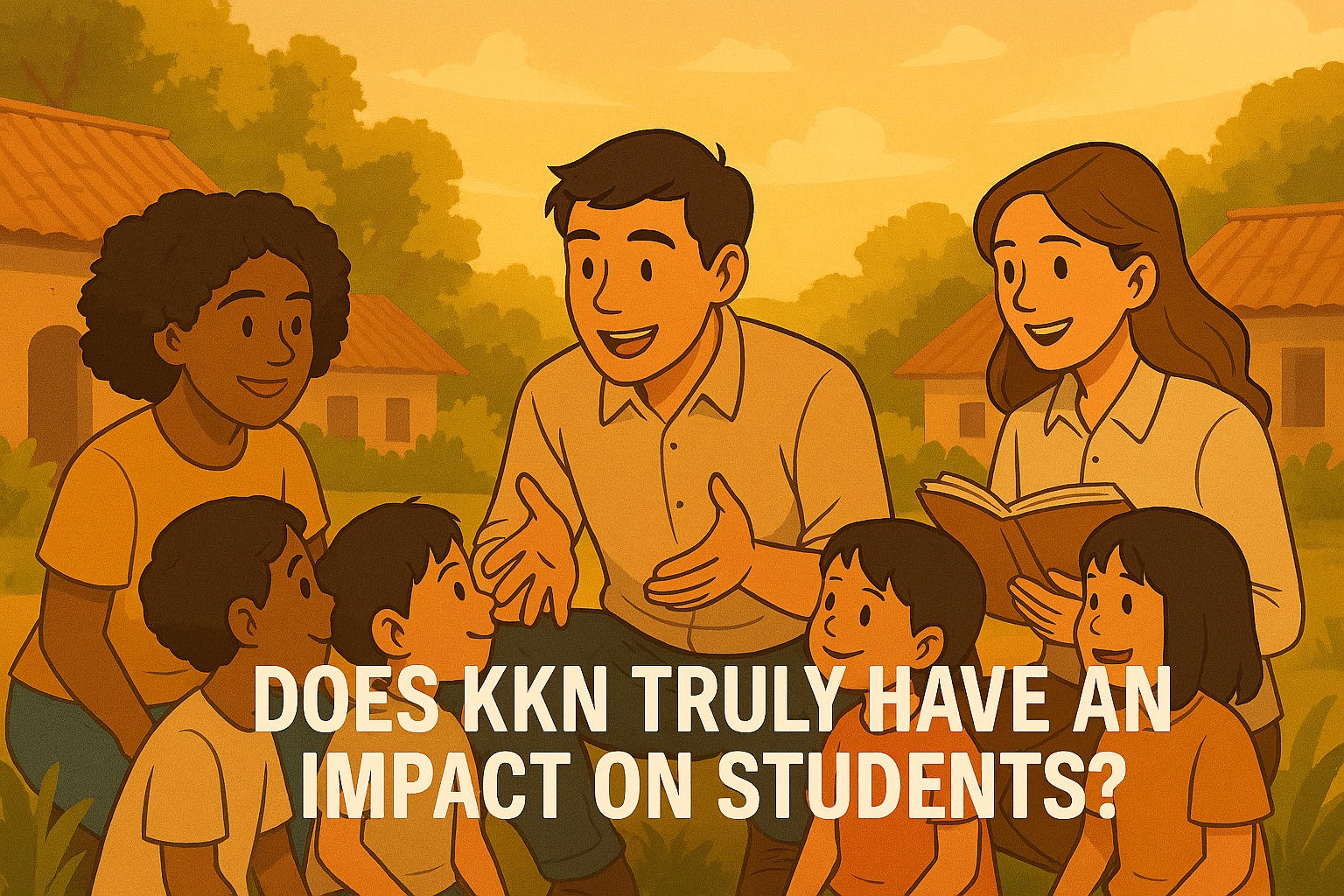
Kuliah Kerja Nyata (KKN), widely known as a community service program integrated into university curricula, has long been considered a defining academic experience. Designed to connect students with real societal conditions, KKN requires them to step outside the classroom and apply their knowledge directly within communities. Yet an important question continues to arise: does KKN truly have a lasting impact on students, or is its influence overstated? To answer this question, it is necessary to examine KKN from multiple dimensions, including academic relevance, personal development, social awareness, and long-term influence on students’ perspectives and career readiness.
THE EDUCATIONAL PURPOSE BEHIND KKN
KKN is not simply an extracurricular activity. It is formally structured as part of higher education’s commitment to community engagement. Universities aim to ensure that students do not remain confined to theoretical frameworks but instead experience the practical implications of their disciplines.
Through KKN, students are expected to identify local challenges, design relevant programs, and collaborate with community members. This approach promotes experiential learning, where knowledge is tested and refined in real-world contexts. Students often realize that theories discussed in lectures must be adapted when faced with cultural norms, economic limitations, and diverse social dynamics.
From an educational standpoint, this practical immersion strengthens analytical thinking and problem-solving skills. It forces students to bridge the gap between academic concepts and societal needs, creating a more comprehensive learning experience.
EXPOSURE TO SOCIAL REALITIES
One of the most significant impacts of KKN lies in direct exposure to social realities. Many students spend years studying issues such as poverty, education inequality, public health, or environmental sustainability through textbooks and academic discussions. However, witnessing these issues firsthand creates a deeper and more emotional understanding.
Living within a community, even temporarily, allows students to observe daily struggles, resilience, and local wisdom. They learn that societal problems are rarely simple or isolated. Instead, they are interconnected and influenced by historical, cultural, and economic factors.
This exposure often reshapes how students perceive privilege, opportunity, and responsibility. Social awareness becomes more personal rather than theoretical. Such awareness can influence future decisions, including career paths and civic engagement.
PERSONAL GROWTH AND EMOTIONAL MATURITY
Beyond academic and social insights, KKN significantly contributes to personal growth. Students must adapt to unfamiliar environments, manage group dynamics, and communicate effectively with diverse stakeholders. These situations test patience, leadership, and emotional control.
Challenges are inevitable. Programs may not run as planned, community participation may fluctuate, and internal team conflicts may arise. Facing these obstacles builds resilience and flexibility. Students learn to compromise, negotiate, and seek solutions collaboratively.
Emotional maturity often develops through this process. Students who previously relied on structured campus systems learn to operate independently. They become more confident in handling uncertainty and more reflective about their strengths and weaknesses.
Such development cannot be easily quantified through grades. However, it represents a profound internal transformation that shapes future professional and personal behavior.
PROFESSIONAL SKILLS AND CAREER READINESS
Another critical dimension of KKN’s impact is professional skill development. While academic knowledge provides technical expertise, KKN nurtures soft skills that are highly valued in the workforce. Communication, teamwork, leadership, and adaptability are strengthened through real interaction with communities.
Students must prepare proposals, conduct presentations, and coordinate activities. These experiences mirror workplace scenarios where collaboration and initiative are essential. As a result, KKN indirectly enhances career readiness.
Furthermore, exposure to community issues may inspire entrepreneurial ideas or social innovation initiatives. Some students discover new interests aligned with community development, education reform, or sustainable business practices. This realization can influence long-term career aspirations.
DOES THE IMPACT DEPEND ON THE STUDENT?
Although KKN has strong potential to influence students positively, its impact is not automatic. The depth of transformation depends largely on the student’s mindset. Those who approach KKN merely as a graduation requirement may focus only on completing tasks and submitting reports.
In contrast, students who actively engage, listen, and reflect on their experiences are more likely to experience meaningful change. Reflection plays a central role in converting experience into insight. Without reflection, activities may remain superficial.
Therefore, the impact of KKN is shaped by both program design and individual intention. Universities can provide the platform, but students determine how deeply they engage with the opportunity.
A BROADER PERSPECTIVE ON IMPACT
When evaluated holistically, KKN does indeed have the capacity to create lasting influence. It strengthens the connection between education and society, fosters empathy, and develops critical life skills. The combination of academic application, social immersion, and personal reflection makes KKN a multidimensional learning experience.
However, the true measure of impact is not limited to short-term outcomes. The real influence often becomes visible years later, when former participants demonstrate stronger social responsibility, ethical awareness, and adaptability in professional environments.
Thus, while the experience may differ among individuals, it is difficult to dismiss KKN as insignificant. When approached with openness and commitment, KKN can leave a meaningful imprint on students’ perspectives, values, and future directions.
Tentang Penulis
Gusti Ayu Tita
Penulis — Universitas STEKOM
Penulis aktif yang berfokus pada isu-isu akademik, teknologi pendidikan, dan pengembangan sumber daya manusia di lingkungan kampus.