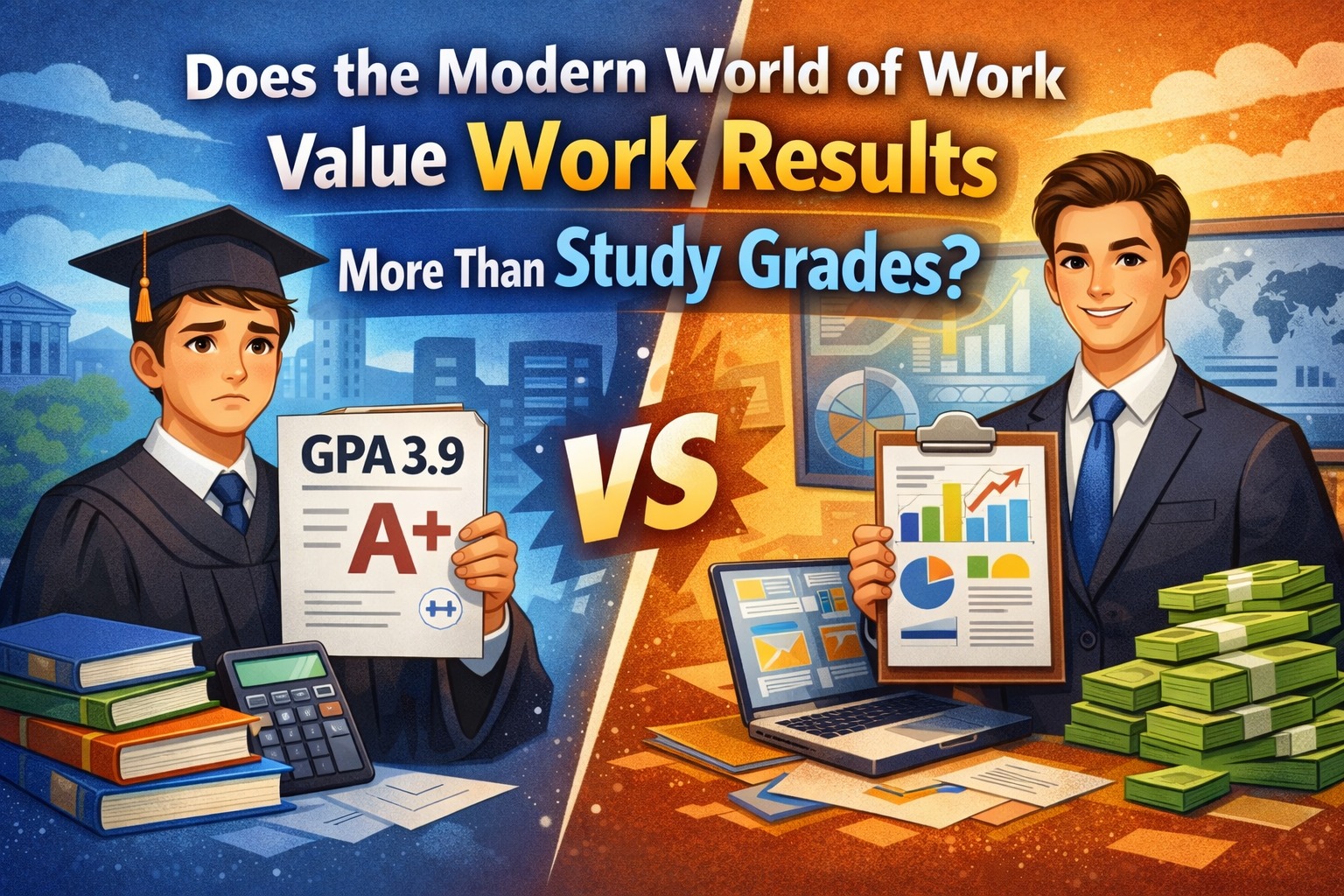
Rapid changes in the modern workplace have shifted the way companies evaluate job candidates. In the past, academic grades or GPA were often used as the primary benchmark. Today, however, many companies are increasingly focusing on tangible work outcomes. This shift raises an important question: Does the modern workplace value work results more than academic grades?
The Shift in Evaluation Standards in the Modern Workplace
The modern workplace is shaped by technological advancement, global competition, and demands for efficiency. Companies need individuals who can deliver real performance and make immediate contributions. As a result, candidate evaluation is no longer based solely on academic grades but also on the ability to produce relevant solutions and measurable results.
Employers prioritize practical contributions over academic scores alone.
The Limitations of Academic Grades in Measuring Performance
Academic grades reflect theoretical understanding and academic capability, but they do not always represent practical competence. Many essential skills—such as communication, collaboration, and problem-solving—are not fully captured by academic assessments. This limitation makes grades less representative of real workplace readiness.
Academic grades do not fully reflect real-world performance.
Work Results as Evidence of Real Competence
Work results in the form of portfolios, projects, or work experience provide concrete evidence of an individual’s abilities. Through real outcomes, companies can assess quality, creativity, and problem-solving approaches.
Tangible work results are considered more objective because they demonstrate skills that can be directly applied in the workplace.
Real work outcomes validate practical competence.
The Role of Skills and Experience in the Modern Workplace
Skills and experience are key factors in determining a candidate’s value. Hard skills indicate technical expertise, while soft skills support effective teamwork and organizational performance.
Internships, projects, and hands-on experience help candidates prove their abilities in real professional settings.
Skills and experience strengthen employability.
Are Academic Grades Still Relevant?
Despite the shift in focus, academic grades still have a certain role. They are often used as an initial screening tool and indicate a basic level of knowledge and learning discipline.
However, academic grades now function more as a complementary factor rather than the main determinant of career success.
Grades support, but no longer dominate, hiring decisions.
Strategies for Students Facing the Modern Workplace
To succeed in the modern workplace, students need to develop themselves holistically by:
* Maintaining solid academic performance
* Developing industry-relevant skills
* Participating in internships and real-world projects
* Building a strong work portfolio
* Strengthening soft skills and professional attitudes
These strategies help students remain competitive and adaptable.
Balanced development ensures long-term career readiness.
Conclusion
The modern workplace tends to value tangible work results more than academic grades alone. Work outcomes, skills, and experience provide clearer insights into an individual’s capabilities. While academic grades remain relevant, career success today is largely determined by one’s ability to deliver real contributions in the professional world.
Tentang Penulis
Gusti Ayu Tita
Penulis — Universitas STEKOM
Penulis aktif yang berfokus pada isu-isu akademik, teknologi pendidikan, dan pengembangan sumber daya manusia di lingkungan kampus.