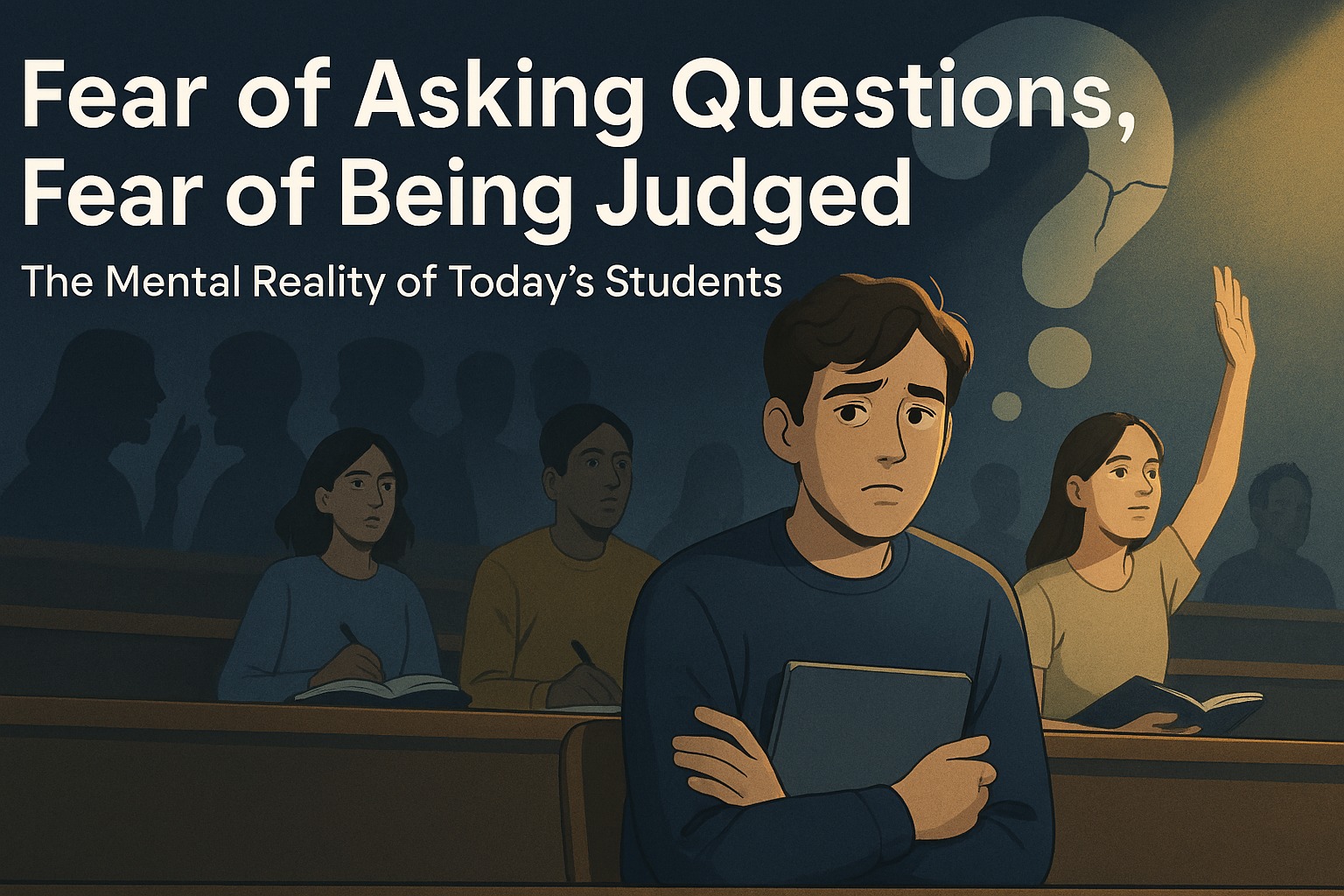
In many modern classrooms, silence is often misunderstood as focus. Students sit still, nod politely, and take notes as if everything is clear. Yet behind that calm exterior, many are struggling to keep up. The fear of asking questions has become a quiet but powerful force shaping the academic experience of today’s students.
This fear is not always about the difficulty of the material. Often, it is about perception. Students worry that asking a question will expose them as less intelligent or less prepared than their peers. In competitive academic environments, image can feel just as important as performance.
Social comparison intensifies this pressure. When surrounded by high-achieving classmates, students may assume they are the only ones who do not understand. This assumption fuels self-doubt and reinforces silence, even when clarification would benefit everyone in the room.
As a result, classrooms that should encourage curiosity sometimes become spaces of quiet anxiety. The absence of questions does not always signal understanding. It can signal fear.
WHY STUDENTS ARE AFRAID OF BEING JUDGED
The fear of being judged often begins long before university. Many students grow up in systems where mistakes are penalized more than effort is rewarded. Over time, they learn that being wrong can feel embarrassing or even shameful.
In higher education, this mindset becomes more complicated. Students are expected to think critically, debate ideas, and challenge assumptions. However, the emotional risk of speaking up can overshadow the intellectual opportunity. No one wants to be remembered as the person who asked a “basic” question.
Digital culture also plays a role. Social media constantly showcases achievements, awards, and academic milestones. Students may internalize the idea that everyone else is confident and capable. This illusion makes vulnerability in the classroom feel even more dangerous.
Judgment does not always come from others. Sometimes, the harshest critic is internal. Self-judgment can be louder than any external comment, creating a mental barrier that prevents students from raising their hands.
THE IMPACT ON MENTAL HEALTH AND LEARNING
When students suppress their questions, learning suffers. Education is not meant to be passive absorption. It thrives on interaction, clarification, and discussion. Without questions, misunderstandings accumulate.
Over time, this pattern can lead to chronic stress. Students may leave class feeling confused but too embarrassed to seek help. The gap between expectation and understanding grows, increasing anxiety before exams or presentations.
The emotional toll extends beyond academics. Constantly monitoring how one appears to others can be exhausting. The effort to look competent while feeling uncertain creates cognitive and emotional strain.
Mental health challenges such as anxiety and imposter feelings can intensify in this environment. Students begin to believe that their confusion is proof that they do not belong, rather than a natural part of the learning process.
THE CULTURE OF PRETENDING TO UNDERSTAND
A subtle culture of pretending often develops in competitive academic settings. Students nod, smile, and avoid eye contact when lecturers ask if everything is clear. Silence becomes a shared agreement to move forward, even if clarity has not been achieved.
This culture is reinforced when participation is dominated by a few outspoken individuals. Others may feel that the discussion is already advanced, making their questions seem irrelevant or simplistic. Instead of risking exposure, they choose invisibility.
Over time, pretending becomes habitual. Students convince themselves they will review the material later or figure it out on their own. While independent learning is valuable, isolation driven by fear is not.
The danger lies in normalization. When everyone pretends, no one realizes how widespread the confusion truly is. The classroom appears confident on the surface, while many students quietly struggle beneath it.
REBUILDING A SAFE LEARNING ENVIRONMENT
Addressing the fear of asking questions requires cultural change. Educators play a key role in shaping classroom dynamics. When lecturers openly welcome questions and normalize confusion, they reduce the stigma around not understanding.
Peer culture is equally important. Students can support one another by recognizing that uncertainty is universal. When one person asks a question, it often helps others who were too hesitant to speak.
Institutions can also create structured opportunities for anonymous questions or small group discussions. These approaches lower the psychological barrier and make participation feel less risky.
Most importantly, students need to redefine what intelligence means. True academic growth is not about appearing flawless. It is about engaging deeply, admitting uncertainty, and being willing to learn publicly.
CHOOSING COURAGE OVER IMAGE
Breaking the cycle of silence begins with small acts of courage. Raising a hand once, sending a follow-up email, or seeking clarification after class can gradually weaken the grip of fear.
Courage does not mean eliminating anxiety. It means acting despite it. Every question asked challenges the assumption that understanding must be immediate and perfect.
When students shift their focus from protecting their image to improving their comprehension, the classroom transforms. Curiosity replaces competition, and learning becomes collaborative rather than performative.
In the end, asking a question is not a sign of weakness. It is a declaration of commitment to growth. For today’s students, overcoming the fear of being judged may be one of the most important lessons they learn.
Tentang Penulis
Gusti Ayu Tita
Penulis — Universitas STEKOM
Penulis aktif yang berfokus pada isu-isu akademik, teknologi pendidikan, dan pengembangan sumber daya manusia di lingkungan kampus.