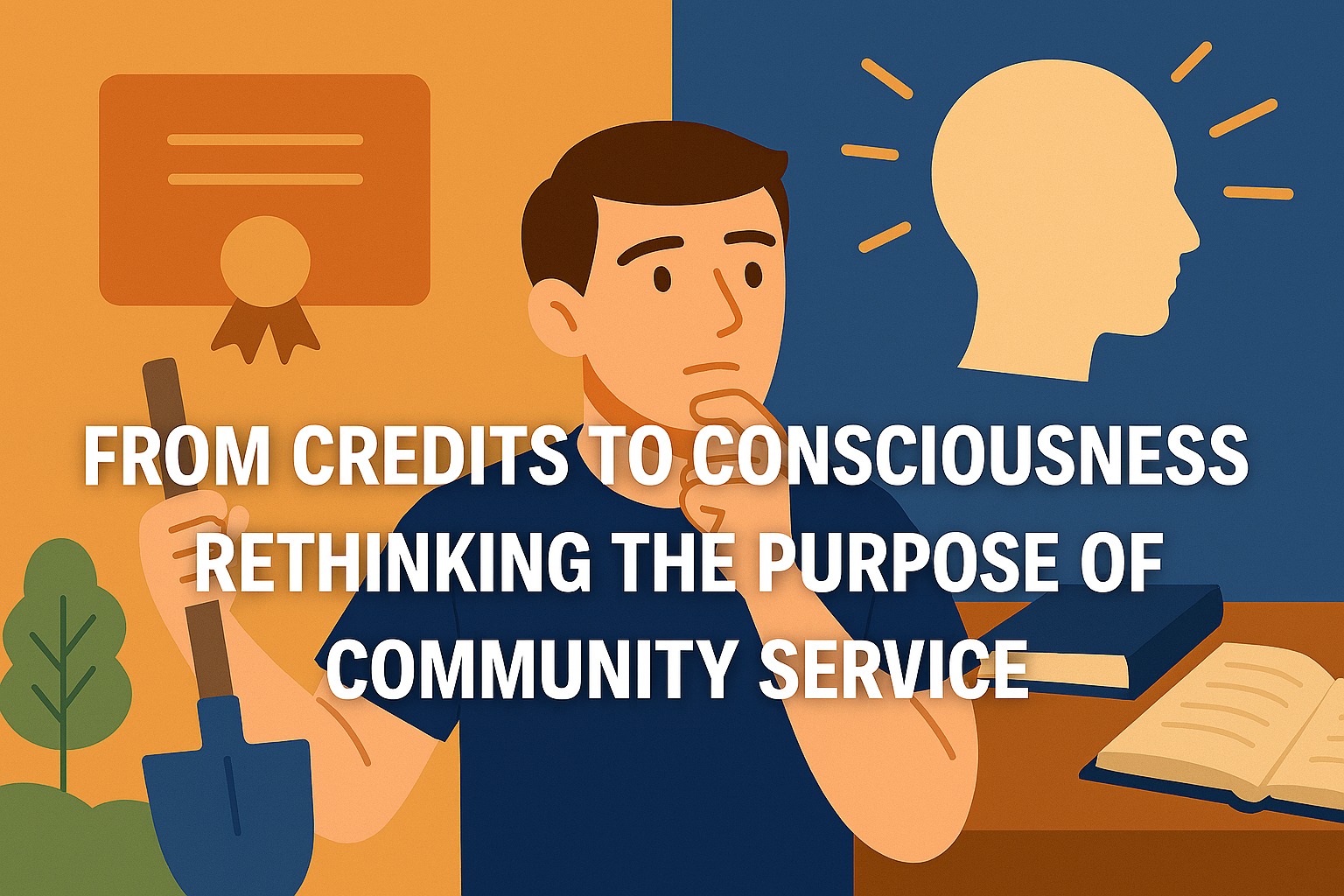
Community service is often introduced to students as a graduation requirement tied to academic credits. While the structure may focus on hours completed and reports submitted, the deeper purpose goes far beyond administrative fulfillment. The real question is whether community service remains a credit-based obligation or evolves into a journey of social consciousness.
Rethinking the purpose of community service allows students and institutions to rediscover its transformative potential. When approached intentionally, it becomes a powerful platform for personal growth, civic responsibility, and long-term impact.
THE ORIGINAL INTENT OF COMMUNITY SERVICE
Community service programs were designed to bridge higher education and society. Universities recognize that learning should not remain confined to classrooms. By engaging with communities, students can apply theoretical knowledge to real challenges.
The original intent is to cultivate awareness, empathy, and ethical responsibility. Through direct interaction with diverse populations, students gain insights into social structures, inequalities, and local strengths. This exposure encourages a broader understanding of their role as educated individuals within society.
WHEN COMMUNITY SERVICE REVOLVES AROUND CREDITS
Despite its meaningful objectives, community service can sometimes be reduced to a checklist activity. Students may prioritize attendance, documentation, and evaluation forms over authentic engagement. When the focus remains solely on credit completion, the experience risks losing its transformative value.
In such cases, community service becomes transactional rather than relational. The learning process becomes limited, and the opportunity for deeper social awareness may be overlooked.
SHIFTING FROM OBLIGATION TO CONSCIOUSNESS
Transformation begins with mindset. When students shift their perspective from “earning credits” to “building consciousness,” community service gains new meaning. Instead of asking how quickly tasks can be completed, students begin to ask how their contributions can create sustainable impact.
This shift encourages active listening, collaborative planning, and reflective evaluation. Students learn to respect community voices and adapt solutions to local contexts. As a result, community service evolves into a shared learning experience rather than a one-sided academic exercise.
DEVELOPING LONG-TERM IMPACT AND PERSONAL GROWTH
Community service that fosters consciousness influences both professional and personal development. Students strengthen essential soft skills such as communication, leadership, and problem-solving. More importantly, they develop empathy and social sensitivity.
These qualities extend beyond graduation. Students who internalize social responsibility are more likely to pursue ethical careers and community-oriented initiatives. The impact continues long after the required credits have been recorded.
CONCLUSION
From credits to consciousness, rethinking the purpose of community service reveals its true value. While academic requirements may initiate participation, the lasting impact depends on engagement, reflection, and genuine commitment.
Community service has the potential to shape socially aware graduates who understand that education is not only about personal success but also about meaningful contribution. When embraced fully, it becomes a transformative milestone rather than just another requirement.
Tentang Penulis
Gusti Ayu Tita
Penulis — Universitas STEKOM
Penulis aktif yang berfokus pada isu-isu akademik, teknologi pendidikan, dan pengembangan sumber daya manusia di lingkungan kampus.