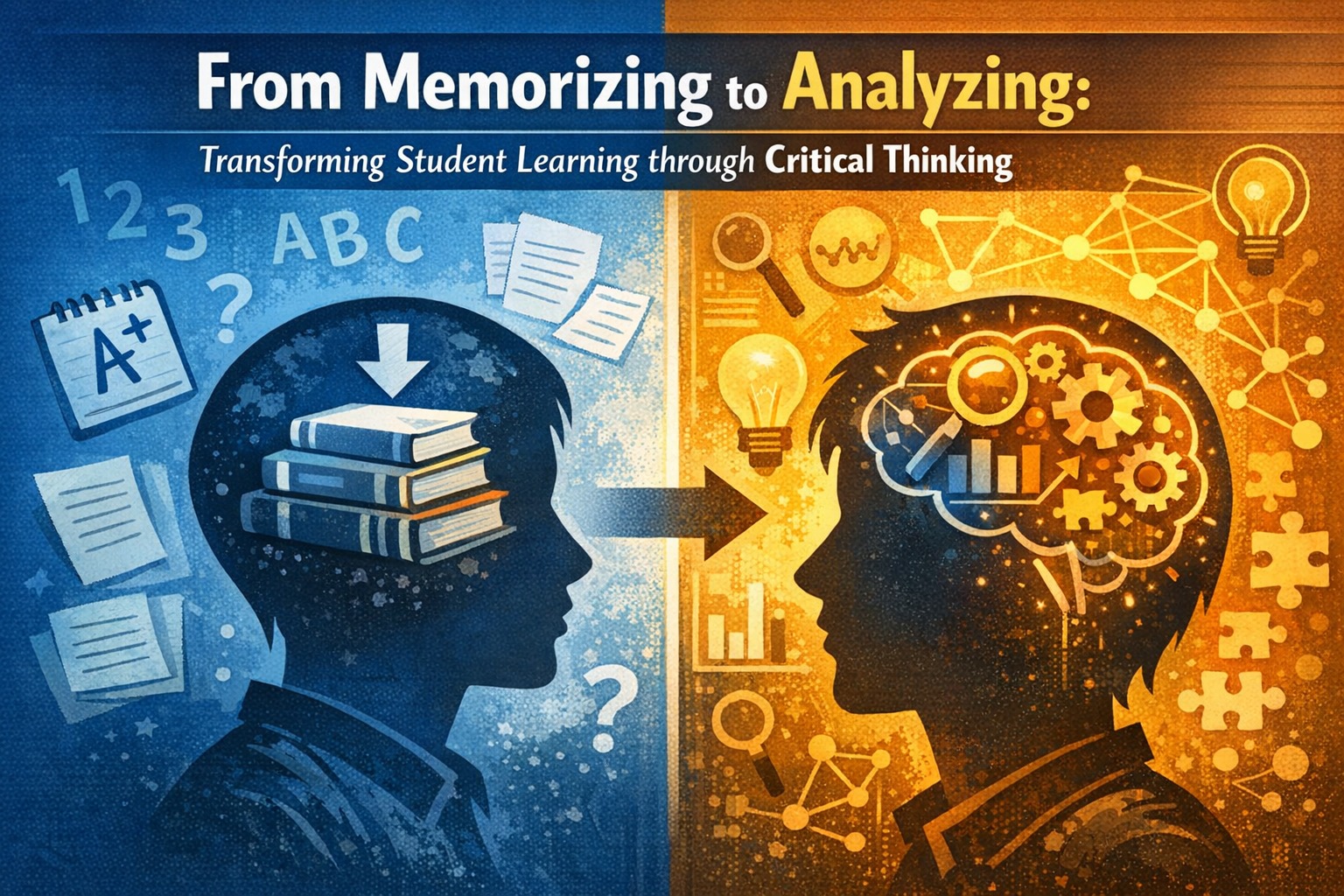
For decades, many students associated learning with memorizing information. Success in school often meant remembering definitions, formulas, and theories long enough to pass exams. However, the demands of modern education are changing rapidly. Today, learning is no longer about how much information students can remember, but how well they can understand, analyze, and apply knowledge.
This shift highlights the growing importance of critical thinking. By developing analytical abilities, students move beyond surface-level learning and begin to explore ideas more deeply. Critical thinking encourages them to question assumptions, examine evidence, and connect concepts in meaningful ways. As a result, learning becomes more engaging, practical, and intellectually rewarding.
LIMITATIONS OF MEMORIZATION IN MODERN EDUCATION
Memorization can help students remember basic facts, but it often does not lead to deep understanding. When students rely only on memorizing information, they may struggle to apply that knowledge in new situations. Once exams are over, much of the memorized material is quickly forgotten.
In the modern world, where information is easily accessible through digital platforms, simply remembering facts is no longer the most valuable skill. Instead, students need the ability to interpret information, identify patterns, and evaluate ideas critically.
Critical thinking helps overcome these limitations by encouraging students to actively engage with the material they study.
THE ROLE OF ANALYTICAL THINKING IN STUDENT LEARNING
Analytical thinking is at the heart of critical thinking. It involves breaking down complex ideas into smaller components, examining relationships between concepts, and drawing logical conclusions.
When students practice analytical thinking, they develop a deeper understanding of the subjects they study. For example, instead of memorizing historical dates, they analyze the causes and consequences of historical events. In science, they evaluate experimental results and consider alternative explanations.
This approach strengthens comprehension and makes learning more meaningful. Students become active participants in the learning process rather than passive receivers of information.
HOW CRITICAL THINKING TRANSFORMS THE LEARNING EXPERIENCE
Critical thinking changes the way students approach academic tasks. Rather than asking “What is the correct answer?”, they begin to ask “Why is this answer correct?” and “What evidence supports it?”
This transformation encourages curiosity and intellectual exploration. Students become more confident in discussing ideas, defending their arguments, and questioning assumptions. They learn to support their opinions with logical reasoning and credible evidence.
In addition, critical thinking enhances creativity. When students analyze problems from multiple perspectives, they often discover innovative solutions and fresh insights.
PRACTICAL METHODS TO SHIFT FROM MEMORIZATION TO ANALYSIS
Teachers and students can work together to encourage analytical learning strategies. One effective method is inquiry-based learning, where students explore questions and investigate topics independently. This process encourages deeper understanding and problem-solving.
Writing analytical essays is another powerful strategy. When students organize arguments and evaluate evidence, they strengthen their reasoning skills and improve their ability to communicate ideas clearly.
Group discussions and debates also provide opportunities for students to practice critical thinking. By listening to different viewpoints, they learn to evaluate arguments and refine their own perspectives.
CONCLUSION
The transition from memorizing to analyzing represents an important transformation in modern education. While memorization still has a role in learning, it should not be the primary goal of academic development.
Critical thinking empowers students to understand knowledge more deeply and apply it effectively in real-life situations. By cultivating analytical thinking skills, students become more adaptable, curious, and intellectually independent.
In an increasingly complex world, the ability to analyze information and think critically will remain one of the most valuable assets for the next generation of learners.
Tentang Penulis
Gusti Ayu Tita
Penulis — Universitas STEKOM
Penulis aktif yang berfokus pada isu-isu akademik, teknologi pendidikan, dan pengembangan sumber daya manusia di lingkungan kampus.