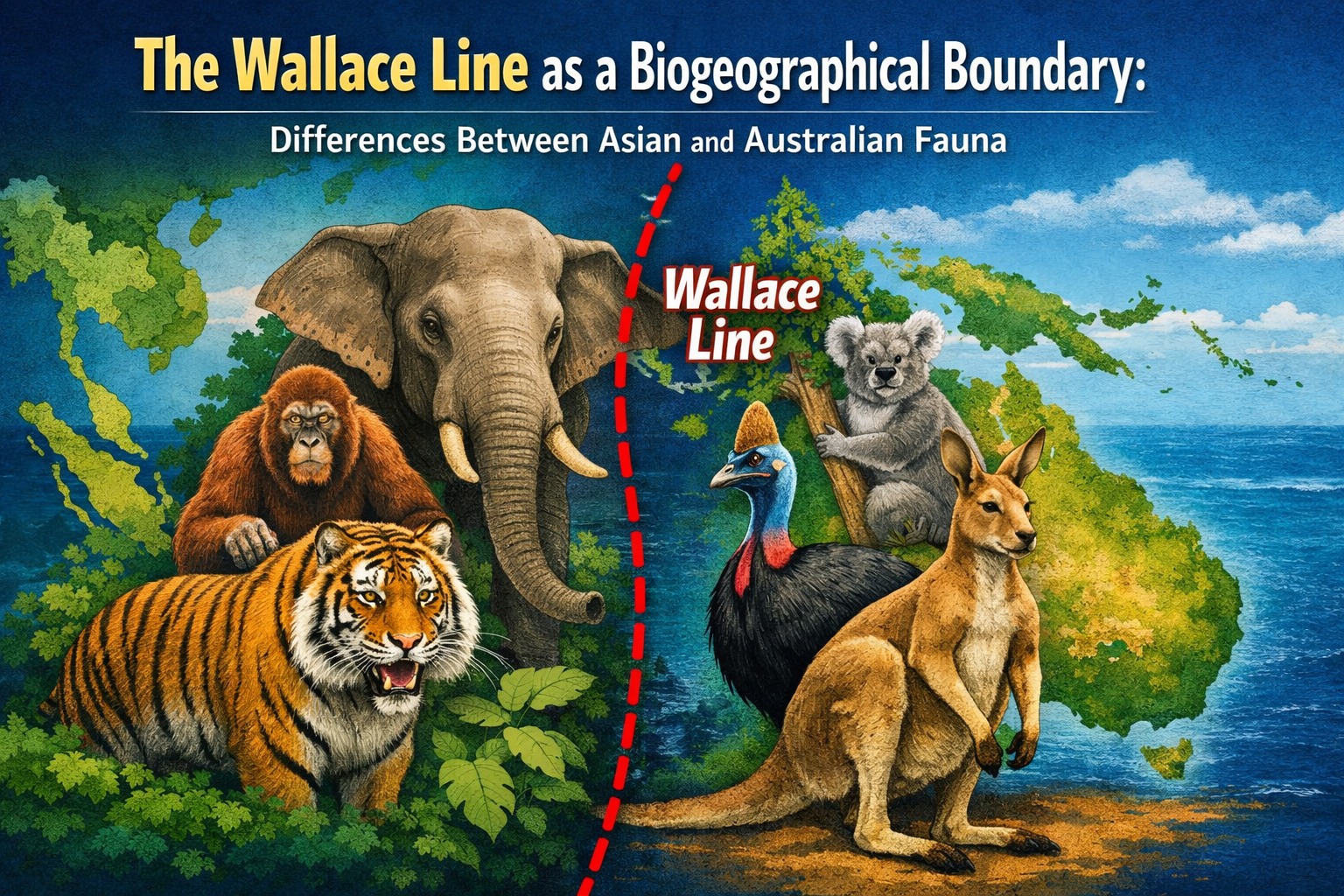
Indonesia is known as a region with extremely high biodiversity. One of the main factors influencing this uniqueness is the presence of the Wallace Line, an imaginary line that serves as a biogeographical boundary between Asian and Australian fauna. This line is not merely a geographical divider, but an important marker for understanding differences in animal species, evolutionary processes, and natural history across Southeast Asia and Australia.
DEFINITION OF THE WALLACE LINE
The Wallace Line was first proposed by Alfred Russel Wallace, a British naturalist in the 19th century. The line stretches between Borneo and Sulawesi, as well as between Bali and Lombok. Although the distance between these islands is relatively short, the differences in fauna found on either side of the line are striking.
From a biogeographical perspective, regions west of the Wallace Line are influenced by the Asian continent, while regions to the east exhibit fauna characteristics closer to those of Australia.
ASIAN FAUNA WEST OF THE WALLACE LINE
The western region of the Wallace Line, including Sumatra, Java, Borneo, and Bali, is dominated by typical Asian fauna. The main characteristic of Asian fauna is the presence of large placental mammals.
Examples of Asian fauna in this region include the Sumatran elephant, tigers, rhinoceroses, orangutans, and tapirs. This diversity developed because these areas were once connected to the Asian mainland, allowing animals to migrate and spread naturally.
AUSTRALIAN FAUNA EAST OF THE WALLACE LINE
In contrast, regions east of the Wallace Line such as Sulawesi, Maluku, Papua, and Australia are dominated by Australian fauna. The most distinctive feature of Australian fauna is the abundance of marsupials.
Common examples include kangaroos, wallabies, cuscuses, and cassowaries. Fauna in this region evolved separately for a very long time due to deep ocean barriers that prevented animal migration from Asia.
FACTORS CAUSING FAUNAL DIFFERENCES
The differences between Asian and Australian fauna are influenced by several key factors, including geological history, tectonic plate movement, and climatic and environmental conditions. During the ice ages, sea levels did drop, but the deep seas around the Wallace Line remained a natural barrier to animal migration.
As a result, evolutionary processes in the two regions occurred separately, producing distinct faunal characteristics that persist to this day.
THE ROLE OF THE WALLACE LINE IN SCIENCE
The Wallace Line plays a crucial role in the development of biogeography and evolutionary theory. This concept helps scientists understand patterns of species distribution and the relationship between environment, geography, and evolution.
Moreover, understanding the Wallace Line is essential for conservation efforts, as each region has unique faunal characteristics that require different preservation strategies.
CONCLUSION
The Wallace Line is a biogeographical boundary that separates Asian and Australian fauna with very distinct characteristics. Its existence demonstrates how geographical factors and natural history strongly influence the distribution and evolution of fauna. By understanding the Wallace Line, we can better appreciate Indonesia’s biodiversity and the importance of conserving it.
Keywords:
Tentang Penulis
Gusti Ayu Tita
Penulis — Universitas STEKOM
Penulis aktif yang berfokus pada isu-isu akademik, teknologi pendidikan, dan pengembangan sumber daya manusia di lingkungan kampus.