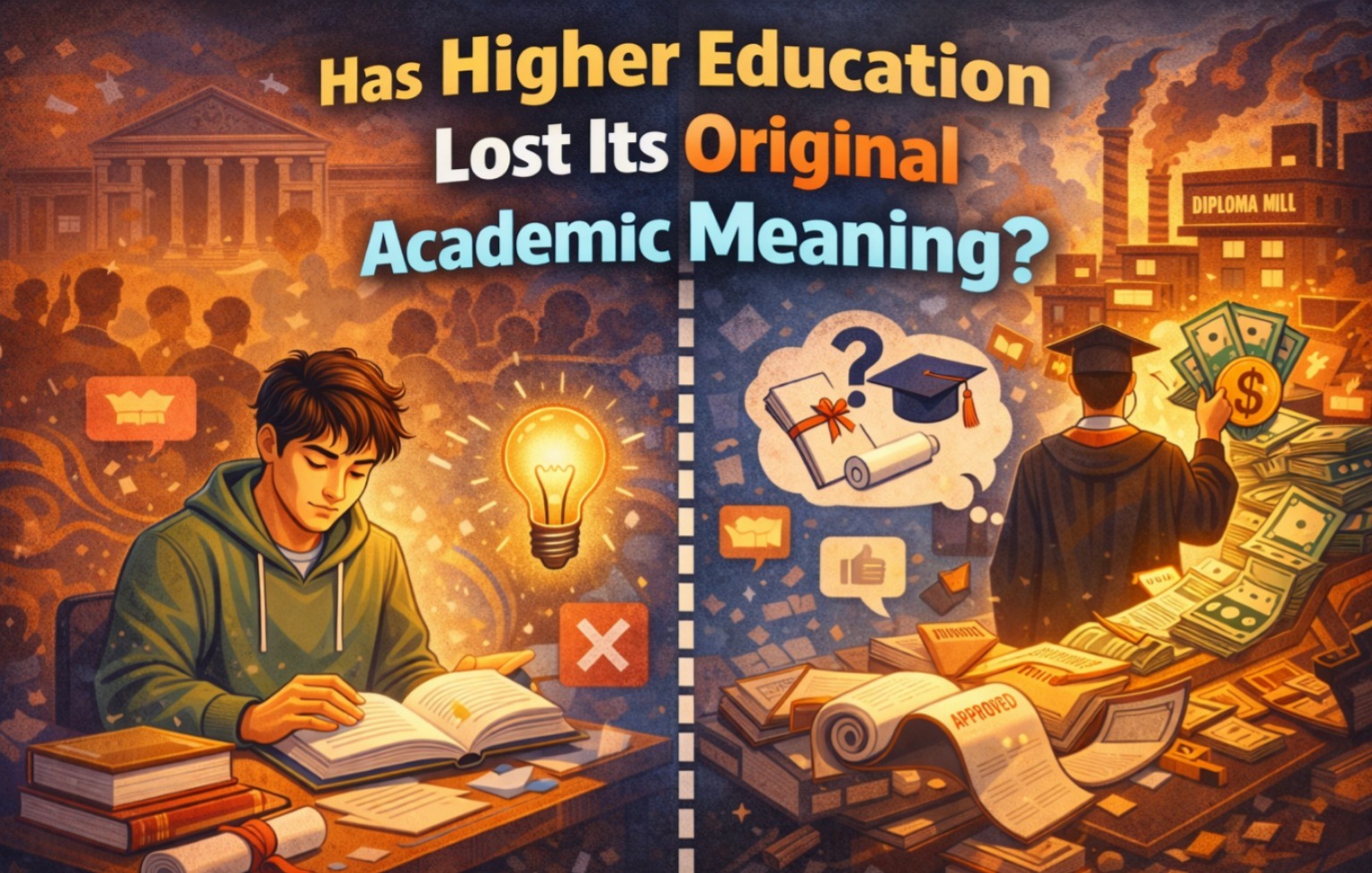
Questions about the true purpose of higher education are increasingly relevant in today’s evolving academic landscape. Many argue that universities are no longer fully focused on the pursuit of knowledge, but rather on achieving academic status in the form of degrees and social recognition. Has higher education truly lost its original academic meaning?
In an era of intense job market competition, a bachelor’s degree is often viewed as a ticket into the professional world. But is higher education merely a symbol of status, or does it still serve as a space for intellectual growth and character development?
THE TRANSFORMATION OF HIGHER EDUCATION
Over time, higher education has undergone significant transformation. In the past, attending university was closely associated with deep intellectual exploration. Today, many students see it as a strategic step toward improving career prospects.
Employers frequently require diplomas as administrative qualifications, which encourages students to prioritize graduating on time rather than mastering their field of study. As a result, the learning process can sometimes be treated as a formality rather than a meaningful journey.
However, not all students adopt this pragmatic view. Many still use their academic years to engage in research, intellectual discussions, and personal development.
ACADEMIC STATUS AS A SOCIAL SYMBOL
In many societies, educational degrees carry strong symbolic value. Individuals with academic titles are often perceived as more competent and prestigious. This social perception influences how students approach their studies.
For some, success in college is measured by the degree earned rather than the quality of understanding achieved. Yet academic status should ideally be the outcome of meaningful learning, not the primary goal in itself.
When status becomes more important than knowledge, the essence of education risks being reduced to administrative achievement.
KNOWLEDGE AS THE IRREPLACEABLE FOUNDATION
Despite shifting perspectives, knowledge remains fundamental. The modern workplace increasingly demands real competence, critical thinking, and adaptability.
Students who rely solely on academic status without developing relevant expertise may struggle to compete. In contrast, those who use college as an opportunity to deeply understand their field gain long-term advantages.
Knowledge not only helps individuals secure employment but also shapes their mindset, professional ethics, and decision-making abilities.
PRESERVING THE ESSENCE OF HIGHER EDUCATION
Maintaining the true essence of higher education requires awareness from both students and institutions. Students must actively explore their subjects, engage in discussions, and participate in enriching academic experiences.
At the same time, universities should offer learning approaches that align with industry needs and technological developments. Practice-oriented and project-based learning can bridge the gap between theory and real-world application.
In this way, academic status can still be achieved without compromising the depth and quality of understanding.
CONCLUSION
Has higher education lost its original academic meaning? While perspectives may have shifted due to career demands and social expectations, the core purpose of higher education should remain rooted in the pursuit and development of knowledge.
Academic status should be the result of meaningful learning, not its sole objective. When knowledge and recognition are balanced, higher education continues to serve as a valuable investment for both intellectual and professional growth.
Tentang Penulis
Gusti Ayu Tita
Penulis — Universitas STEKOM
Penulis aktif yang berfokus pada isu-isu akademik, teknologi pendidikan, dan pengembangan sumber daya manusia di lingkungan kampus.