Higher Education Relevance Amid Student Economic Pressure
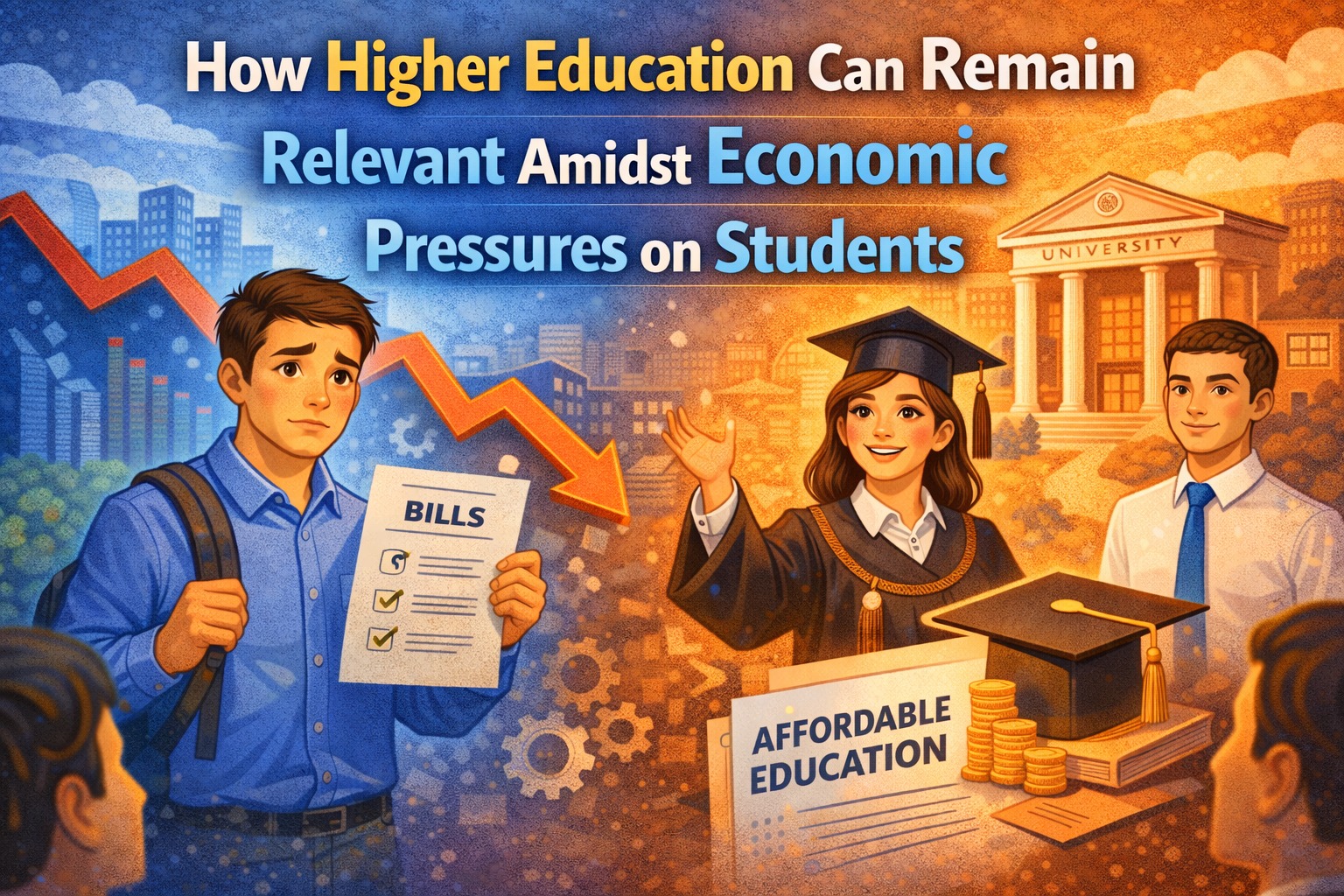
Economic pressure on students is not a new phenomenon. For decades, many students have had to live frugally, work while studying, or survive with limited financial resources. What makes today different is the speed, scale, and intensity of these pressures. Living costs continue to rise, the job market demands early work experience, while higher education systems often move at a much slower pace. In this context, a critical question emerges: How can higher education remain relevant when students are busy struggling to survive? If universities fail to address this reality, the relevance of higher education will continue to be questioned.
Economic Pressure Is Not a Disruption, but a Core Reality
Many education systems still treat economic pressure as a “personal problem” of students. In reality, for a large number of students, economic conditions form the primary context in which their academic lives unfold.
Economic pressure is an essential part of the student experience, not an external disturbance.
Today’s students must constantly consider:
* Food and housing expenses
* Transportation and daily necessities
* Family financial responsibilities
* Additional income to sustain their studies
Ignoring these realities means educating students as if they live outside real life.
Education that overlooks students’ economic realities fails to address the whole individual.
Educational Relevance Is Measured by Usefulness, Not Ideals
Throughout history, education that endures is education that is useful. It is not defined by how idealistic its concepts are, but by how applicable it is in real life.
The lasting value of education lies in its practical relevance.
Higher education remains relevant when:
* Knowledge is connected to real-life conditions
* Learning processes help students cope with pressure rather than increase it
* Universities acknowledge that students live in the real world, not in isolation
Without this alignment, higher education risks being seen merely as a formality for obtaining a degree.
Relevance comes from usefulness, not from abstract ideals.
Restoring the Connection Between Knowledge and Life
One of the major challenges in higher education today is the disconnect between academic knowledge and everyday life. Course content often feels distant from the realities faced by students under economic pressure.
The gap between theory and lived experience weakens educational relevance.
Relevance emerges when:
* Knowledge is explained through real-world contexts
* Students understand the function of knowledge in everyday life
* Education addresses not only theory, but also survival and growth
Historically, knowledge has never been born in sterile spaces, but from human needs and lived experiences.
Knowledge gains meaning when it is rooted in real life.
Conclusion
Higher education can remain relevant amid student economic pressure only if it dares to stand on reality rather than illusion. Life pressure is not a disruption to the learning process, but a context that must be understood and addressed.
Economic struggle is part of the learning environment, not an obstacle to it.
The most meaningful education has never been one that distances itself from life, but one that grows within it. If higher education seeks to remain meaningful, it must return to this fundamental principle: educating people to live, not merely to graduate.
Tentang Penulis
Gusti Ayu Tita
Penulis — Universitas STEKOM
Penulis aktif yang berfokus pada isu-isu akademik, teknologi pendidikan, dan pengembangan sumber daya manusia di lingkungan kampus.