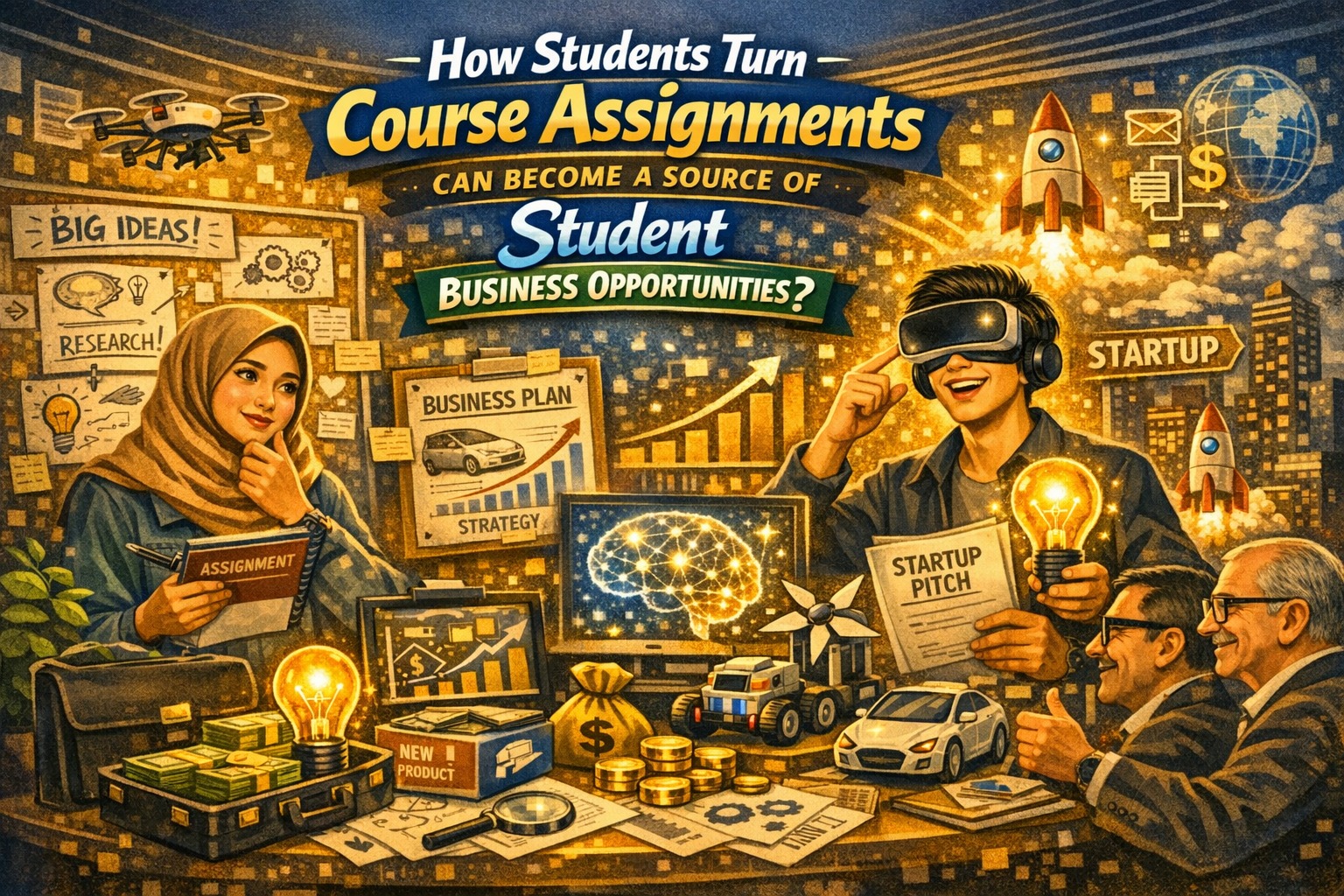
Course assignments are a common part of academic life, designed to help students understand theories, develop analytical skills, and apply knowledge to specific topics. Most students focus on completing these assignments to achieve good grades and meet academic requirements. However, with the right perspective and creativity, course assignments can offer much more than academic evaluation. They can become the starting point for real business opportunities. In many cases, business ideas originate from simple observations, research projects, or problem-solving activities. University assignments often require students to analyze real-world problems and propose solutions. This process can naturally lead to innovative ideas that have practical value outside the classroom. When students recognize the potential within their assignments and take steps to develop their ideas further, they can transform academic work into promising entrepreneurial opportunities.
IDENTIFYING BUSINESS POTENTIAL IN ACADEMIC PROJECTS
The first step in turning course assignments into business opportunities is recognizing the potential within the ideas developed during academic work. Many assignments require students to analyze problems, conduct research, and design solutions. These elements are very similar to the early stages of creating a business concept.
Students who pay close attention to the problems they study may discover opportunities to create products or services that address real needs. For example, a project about improving student productivity could inspire the development of a digital tool or application. Similarly, research about sustainable practices might lead to the creation of eco-friendly products or services.
Recognizing this potential requires students to think beyond academic evaluation. Instead of seeing assignments as temporary tasks, they can view them as opportunities to explore ideas that might have value in real-world markets or communities.
DEVELOPING ASSIGNMENT IDEAS INTO PRACTICAL SOLUTIONS
Once students identify a promising idea within their assignments, the next step is to develop it into a practical solution. This process often begins with refining the concept and exploring how the idea could work in real situations. Students may expand their initial proposal by adding new features or improving the original design.
Creating a simple prototype or demonstration can help transform an academic idea into something more tangible. Prototypes allow students to test whether their ideas are functional and useful. Even simple prototypes provide valuable insights about what works and what needs improvement.
This development process also helps students understand the challenges involved in turning ideas into real products or services. By experimenting and refining their concepts, they gradually move closer to creating something that has genuine business potential.
THE IMPORTANCE OF MARKET AWARENESS AND USER NEEDS
For an assignment idea to become a successful business opportunity, it must address the needs of real users. Understanding the target audience is therefore a crucial part of the process. Students should consider who might benefit from their idea and how their solution solves a specific problem.
Basic research can help students gain insight into potential users and market conditions. By gathering feedback from classmates, lecturers, or potential customers, students can improve their ideas and make them more relevant. This feedback often reveals important details that may not have been considered during the initial assignment.
Market awareness also helps students focus on developing practical and realistic solutions. Instead of creating overly complex concepts, they can concentrate on building ideas that provide clear benefits to users. This approach increases the chances that their academic projects can evolve into viable business opportunities.
CONCLUSION
Course assignments can become valuable business opportunities when students approach them with creativity, curiosity, and strategic thinking. By identifying real problems, developing practical solutions, and understanding the needs of potential users, students can transform academic ideas into entrepreneurial ventures.
Universities provide a supportive environment for this process, offering access to knowledge, research resources, and collaborative learning experiences. These factors make it possible for students to experiment with ideas and refine them into meaningful projects.
Ultimately, the ability to turn course assignments into business opportunities demonstrates how academic learning can inspire innovation and entrepreneurship. Students who embrace this approach not only gain deeper educational experiences but also develop skills that prepare them for future careers in a competitive and dynamic world.
Tentang Penulis
Gusti Ayu Tita
Penulis — Universitas STEKOM
Penulis aktif yang berfokus pada isu-isu akademik, teknologi pendidikan, dan pengembangan sumber daya manusia di lingkungan kampus.