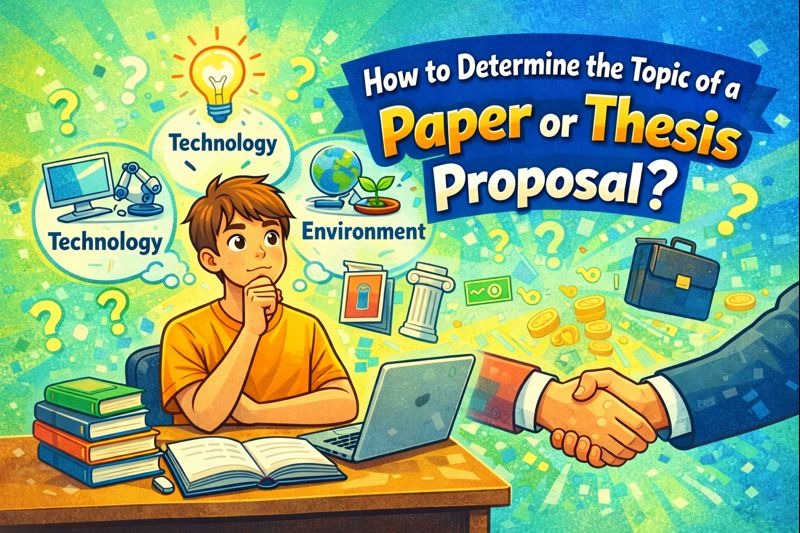
Choosing a topic for a paper or thesis proposal is often an initial challenge for students. Many feel confused due to too many options or fear that the chosen topic may not be relevant. In fact, the right topic will simplify the writing process, research, and completion of studies. Therefore, it is important for students to understand the steps to select a topic in a focused and strategic manner.
THE IMPORTANCE OF CHOOSING THE RIGHT TOPIC FROM THE START
The topic serves as the main foundation in writing a paper or thesis. A clear and interesting topic helps students stay focused, consistent, and motivated throughout the research process. Additionally, a relevant topic facilitates finding references and gaining approval from supervisors.
A well-chosen topic ensures focus, motivation, and academic relevance.
ALIGN THE TOPIC WITH PERSONAL INTERESTS AND FIELD OF STUDY
The first step in selecting a topic is understanding personal interests and the field of study. Students should choose a topic that genuinely interests them so that the writing process does not feel burdensome. Strong interest encourages deeper investigation and maximum problem-solving.
Interest-driven topics increase engagement and research quality.
IDENTIFY RELEVANT AND CURRENT ISSUES
A good topic usually arises from real and relevant problems. Students can observe phenomena in their surroundings, current issues in their field, or problems frequently discussed in class. Current topics carry higher academic and practical value.
Relevance and timeliness enhance the academic and practical value of research.
CONDUCT PRELIMINARY LITERATURE STUDY
Before finalizing a topic, students need to review references such as journals, books, or previous studies. Literature study ensures that the chosen topic is still viable and not overly explored. It can also help identify research gaps for further exploration.
Literature review validates topic feasibility and uncovers research opportunities.
MATCH THE TOPIC WITH ABILITIES AND RESOURCES
An ideal topic aligns with the student’s abilities and available data and time. Avoid topics that are too broad or complex. A realistic topic makes it easier to create a research framework and complete it on schedule.
Feasible topics facilitate structured research and timely completion.
CONSULT WITH SUPERVISORS
Discussion with a supervisor is crucial in the topic selection process. Supervisors can provide input on the topic’s feasibility, research direction, and appropriate methodology. Early consultation also reduces the risk of repeated revisions later.
Supervisor guidance improves topic relevance and research planning.
NARROW AND FOCUS THE TOPIC
After identifying a general topic, students need to narrow the scope to make it more specific. A focused topic simplifies the formulation of research questions, objectives, and data analysis.
Focused topics enhance clarity and depth in research design.
CONCLUSION
Choosing a paper or thesis proposal topic requires careful planning. By aligning with personal interests, observing relevant problems, conducting literature studies, and consulting supervisors, students can select the right and high-quality topic. A good topic not only eases the writing process but also increases the chances of overall research success.
Tentang Penulis
Gusti Ayu Tita
Penulis — Universitas STEKOM
Penulis aktif yang berfokus pada isu-isu akademik, teknologi pendidikan, dan pengembangan sumber daya manusia di lingkungan kampus.