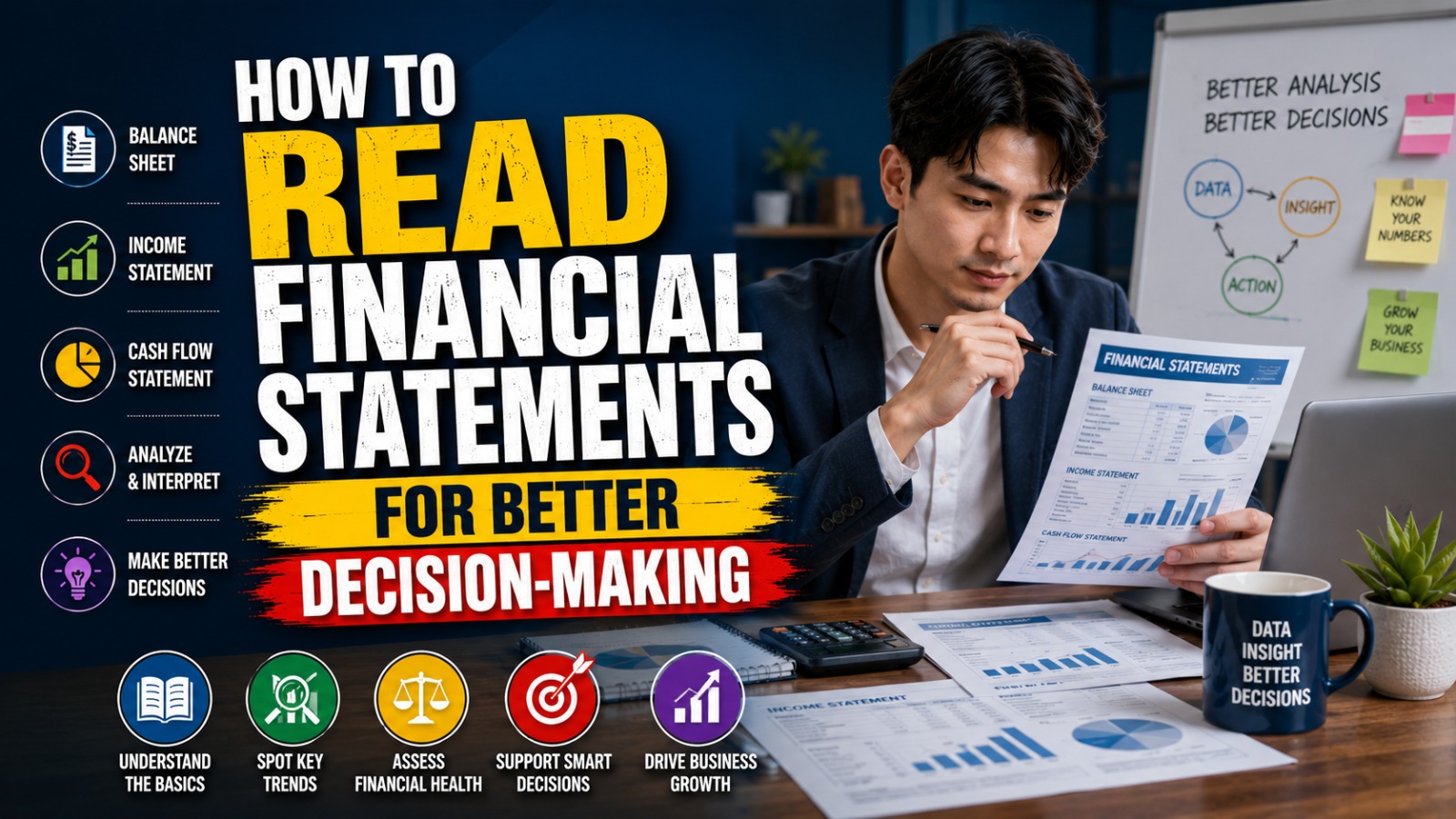
Financial statements are essential tools that help business owners understand the financial health of their companies. Without knowing how to read and analyze these reports, it becomes difficult to make informed decisions about budgeting, investments, expansion, and daily operations.
For small business owners, learning how to interpret financial statements can improve profitability, strengthen cash flow management, and reduce financial risks. Understanding the numbers behind the business allows leaders to identify opportunities, solve financial problems early, and create smarter long-term strategies.
WHAT ARE FINANCIAL STATEMENTS?
Financial statements are formal records that summarize a company’s financial activities over a specific period. These reports provide valuable insights into revenue, expenses, assets, liabilities, and overall profitability.
The three main financial statements are:
- Income Statement
- Balance Sheet
- Cash Flow Statement
Each report serves a different purpose and offers important information for business decision-making.
UNDERSTANDING THE INCOME STATEMENT
The income statement, also known as the profit and loss statement, shows how much revenue a business earns and how much it spends during a certain period.
The main components include:
Revenue
Revenue represents the total income generated from sales of products or services before expenses are deducted.
Cost of Goods Sold (COGS)
COGS includes the direct costs associated with producing goods or delivering services.
Gross Profit
Gross profit is calculated by subtracting COGS from revenue. It reflects how efficiently the business produces its products or services.
Operating Expenses
These are the costs required to run the business, such as salaries, rent, marketing, utilities, and insurance.
Net Profit
Net profit is the final amount remaining after all expenses, taxes, and interest payments are deducted from revenue.
A healthy income statement helps business owners evaluate profitability and identify areas where costs can be reduced.
HOW TO READ A BALANCE SHEET
A balance sheet provides a snapshot of a company’s financial position at a specific point in time. It shows what the business owns and what it owes.
The balance sheet consists of three key sections:
Assets
Assets are resources owned by the business, including:
- Cash
- Inventory
- Equipment
- Accounts receivable
- Property
Assets are usually divided into current assets and long-term assets.
Liabilities
Liabilities represent debts and financial obligations, such as:
- Loans
- Accounts payable
- Taxes owed
- Credit card balances
Current liabilities are short-term obligations, while long-term liabilities are paid over several years.
Owner’s Equity
Owner’s equity represents the remaining value after liabilities are subtracted from assets. It reflects the owner’s financial interest in the business.
The balance sheet follows this basic formula:
Assets=Liabilities+Owner’s Equity\text{Assets} = \text{Liabilities} + \text{Owner's Equity}Assets=Liabilities+Owner’s Equity
A strong balance sheet typically shows healthy asset growth and manageable debt levels.
ANALYZING THE CASH FLOW STATEMENT
The cash flow statement tracks how money moves into and out of the business. Unlike the income statement, which focuses on profitability, the cash flow statement measures liquidity.
It is divided into three sections:
Operating Activities
This section shows cash generated from normal business operations.
Investing Activities
Investing activities include purchasing equipment, property, or other long-term investments.
Financing Activities
This area tracks loans, debt repayments, and owner investments.
Positive cash flow is essential because it allows businesses to pay bills, salaries, and operational expenses on time.
KEY FINANCIAL RATIOS TO MONITOR
Financial ratios help business owners evaluate company performance more effectively.
Important ratios include:
Profit Margin
This ratio measures how much profit the company generates from sales.
Profit Margin=Net ProfitRevenue×100%\text{Profit Margin} = \frac{\text{Net Profit}}{\text{Revenue}} \times 100\%Profit Margin=RevenueNet Profit×100%
Higher profit margins usually indicate stronger financial performance.
Current Ratio
The current ratio measures the company’s ability to pay short-term obligations.
Current Ratio=Current AssetsCurrent Liabilities\text{Current Ratio} = \frac{\text{Current Assets}}{\text{Current Liabilities}}Current Ratio=Current LiabilitiesCurrent Assets
A ratio above 1 generally indicates good short-term financial stability.
Debt-to-Equity Ratio
This ratio evaluates how much debt the business uses compared to owner investment.
Debt-to-Equity Ratio=Total LiabilitiesOwner’s Equity\text{Debt-to-Equity Ratio} = \frac{\text{Total Liabilities}}{\text{Owner's Equity}}Debt-to-Equity Ratio=Owner’s EquityTotal Liabilities
Lower debt levels often reduce financial risk.
COMMON MISTAKES WHEN READING FINANCIAL STATEMENTS
Many business owners misunderstand financial reports because they focus only on revenue or profit. Common mistakes include:
- Ignoring cash flow problems
- Overlooking rising operational costs
- Failing to compare financial data over time
- Misinterpreting debt levels
- Not reviewing financial reports regularly
Accurate analysis requires looking at all financial statements together rather than separately.
HOW FINANCIAL STATEMENTS SUPPORT BETTER DECISIONS
Financial statements help business owners make more informed decisions in areas such as:
- Budget planning
- Pricing strategies
- Cost reduction
- Business expansion
- Loan applications
- Investment opportunities
Businesses that regularly analyze financial data are often better prepared to adapt to changing market conditions.
CONCLUSION
Understanding how to read financial statements is essential for making smarter business decisions. Income statements, balance sheets, and cash flow statements each provide valuable insights into profitability, liquidity, and overall financial health.
By learning how to interpret these reports and monitor important financial ratios, business owners can improve financial management, reduce risks, and create stronger long-term growth strategies. Strong financial analysis is not only useful for solving problems but also for identifying opportunities that support future business success.
Tentang Penulis
Gusti Ayu Tita
Penulis — Universitas STEKOM
Penulis aktif yang berfokus pada isu-isu akademik, teknologi pendidikan, dan pengembangan sumber daya manusia di lingkungan kampus.