Autonomous vehicles have become one of the most groundbreaking innovations in modern transportation. By combining artificial intelligence, machine learning, advanced sensors, and real-time data processing, self-driving technology is transforming how people and goods move across the world. As governments and automotive companies continue investing in research and development, autonomous vehicles are expected to redefine mobility, improve road safety, and reshape urban infrastructure.
THE EVOLUTION OF AUTONOMOUS VEHICLE TECHNOLOGY
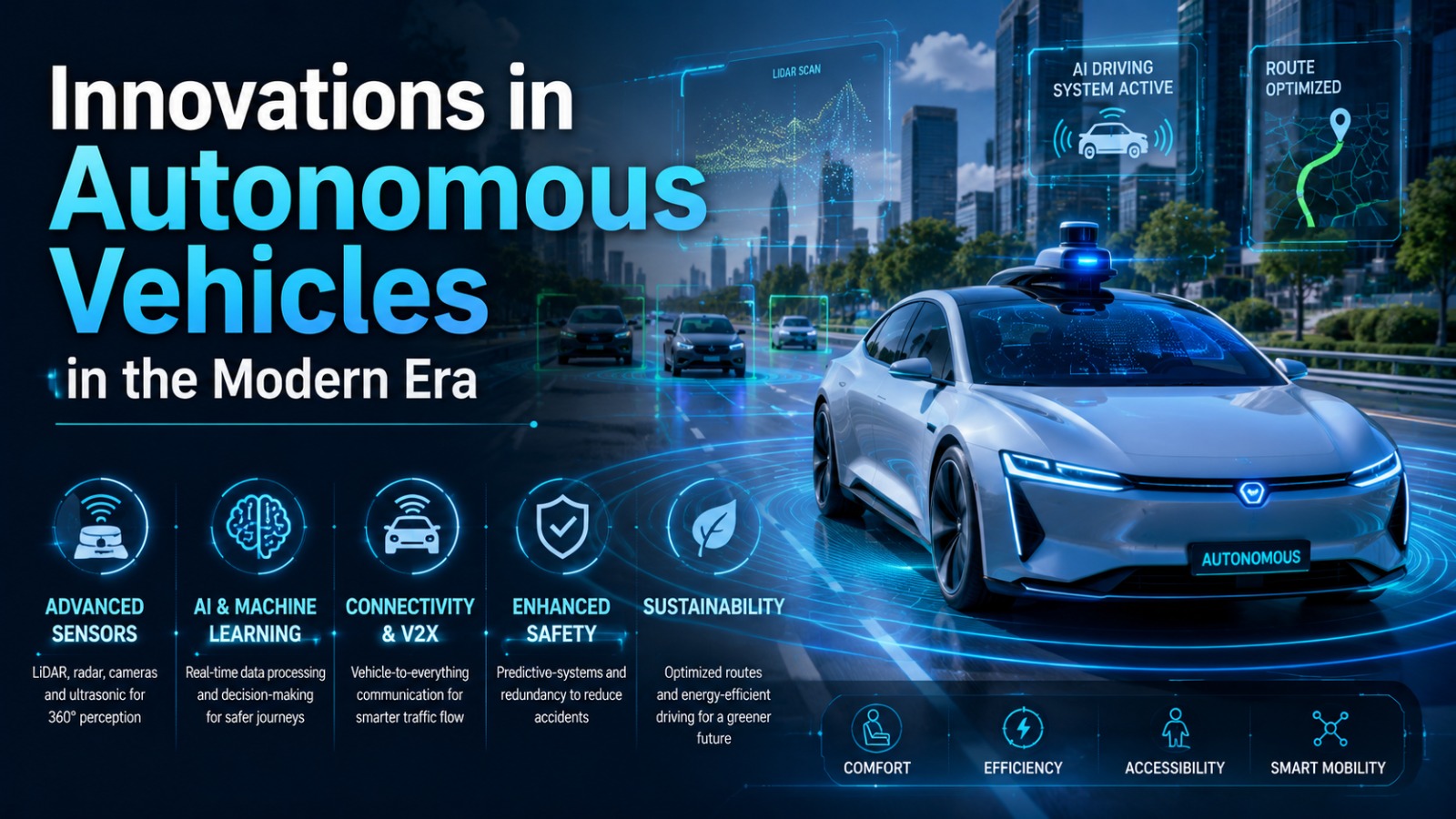
The development of autonomous vehicles has accelerated significantly over the last decade. Early driver-assistance systems such as adaptive cruise control and lane-keeping assistance laid the foundation for fully autonomous driving technologies. Today, advanced autonomous vehicles use a combination of cameras, radar, LiDAR, GPS, and onboard computing systems to perceive their surroundings and make driving decisions in real time.
Major automotive manufacturers and technology companies are actively testing autonomous systems in controlled and public environments. These efforts continue to push the boundaries of what self-driving technology can achieve in modern transportation.
KEY INNOVATIONS DRIVING AUTONOMOUS VEHICLES
Artificial intelligence is at the core of autonomous vehicle innovation. AI enables vehicles to process large amounts of environmental data, recognize objects, predict movement patterns, and make split-second driving decisions.
Sensor fusion technology is another critical advancement. By combining data from multiple sensors, autonomous vehicles can create highly accurate representations of their surroundings, improving navigation and obstacle detection.
Vehicle-to-everything communication is also enhancing autonomous driving capabilities. This technology allows vehicles to communicate with traffic systems, infrastructure, and other vehicles to improve traffic flow and reduce accident risks.
BENEFITS OF AUTONOMOUS VEHICLES
One of the most significant advantages of autonomous vehicles is improved road safety. Since human error contributes to the majority of traffic accidents, reducing driver involvement could substantially decrease collisions.
Autonomous vehicles may also improve transportation efficiency. Self-driving systems can optimize routes, reduce traffic congestion, and lower fuel consumption through smoother driving behavior.
Additionally, autonomous transportation can increase mobility for elderly individuals, people with disabilities, and those unable to drive independently.
CHALLENGES FACING AUTONOMOUS VEHICLE ADOPTION
Despite rapid innovation, autonomous vehicles still face several challenges. Safety remains the most critical concern, as developers must ensure vehicles can handle complex and unpredictable road conditions reliably.
Legal and regulatory frameworks also remain underdeveloped in many countries. Policymakers must establish standards for liability, insurance, testing, and public deployment.
Cybersecurity is another growing issue. Because autonomous vehicles rely heavily on software and connectivity, they may become targets for hacking or malicious interference if security measures are inadequate.
THE FUTURE OF SELF-DRIVING TRANSPORTATION
The future of autonomous vehicles is expected to include greater integration with smart city infrastructure, electric vehicle systems, and shared mobility services. Fully autonomous ride-hailing fleets and driverless delivery vehicles may become common in urban areas.
Continued improvements in AI, sensor technology, and regulatory support will likely accelerate adoption over the coming years. Although widespread implementation may take time, autonomous vehicles are positioned to become a defining element of future transportation systems.
CONCLUSION
Innovations in autonomous vehicles in the modern era are revolutionizing the transportation industry. Through advancements in artificial intelligence, sensor systems, and connectivity, self-driving vehicles offer the potential for safer roads, greater mobility, and more efficient transportation networks. While technical and regulatory challenges remain, autonomous vehicles are steadily moving from experimental prototypes to practical real-world solutions.
Tentang Penulis
Gusti Ayu Tita
Penulis — Universitas STEKOM
Penulis aktif yang berfokus pada isu-isu akademik, teknologi pendidikan, dan pengembangan sumber daya manusia di lingkungan kampus.