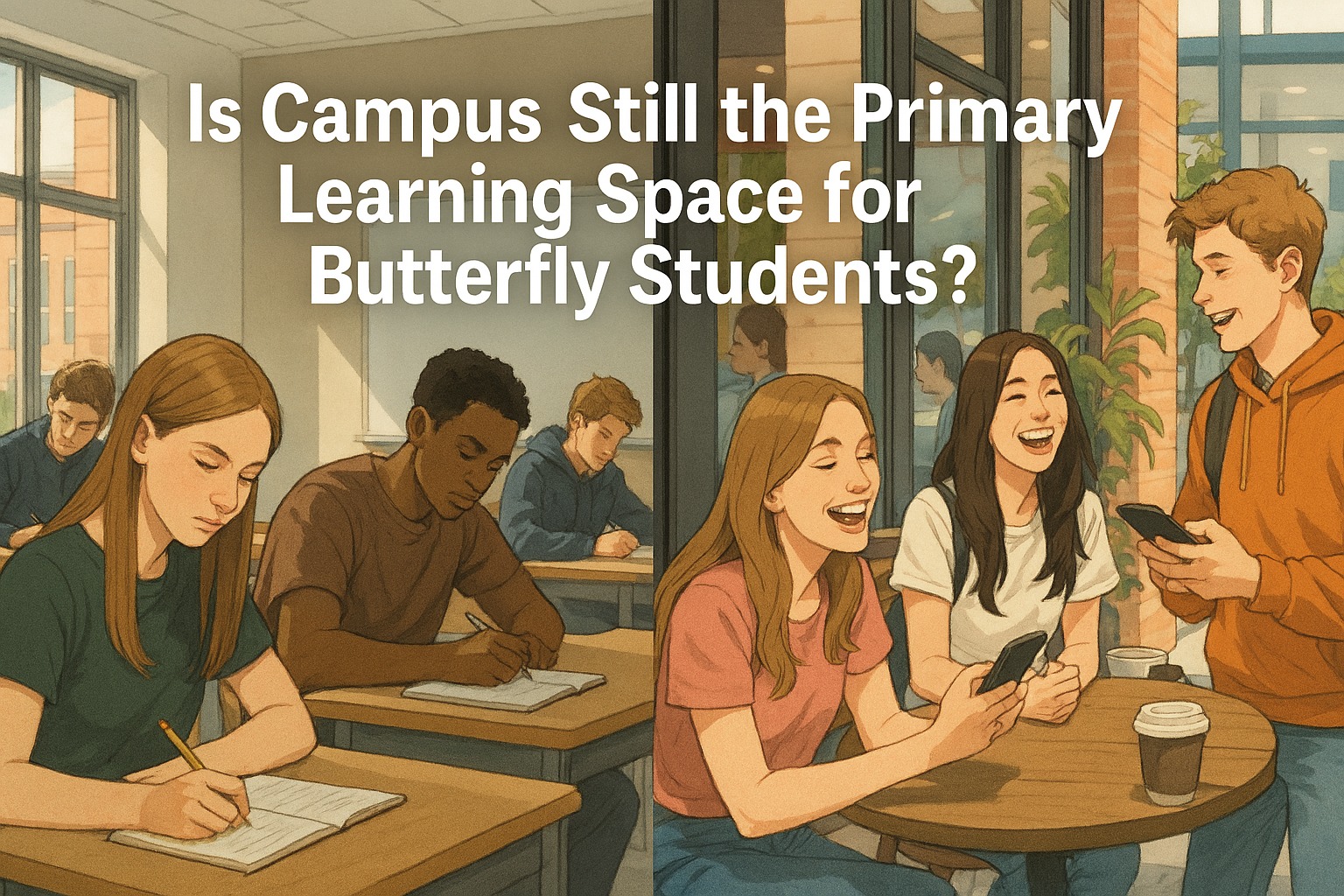
The idea of a “butterfly student” has become increasingly familiar in modern higher education. These are students who rarely stay in one place. They move between classrooms, organizations, online platforms, internships, competitions, and communities. Their learning journey is dynamic, colorful, and often unpredictable.
In the past, campus was clearly the primary learning space. Lecture halls, libraries, laboratories, and academic discussions defined student growth. Today, however, digital platforms, industry partnerships, and community-based learning are reshaping how knowledge is acquired and applied.
This shift raises an important question: Is campus still the main learning environment for butterfly students? Or has it become just one of many learning ecosystems they navigate? To answer this, we need to examine how learning spaces have evolved and how student identity continues to transform in the digital era.
THE RISE OF BUTTERFLY STUDENTS
The term butterfly students refers to individuals who do not limit themselves to formal lectures. They actively participate in student organizations, volunteer programs, entrepreneurial projects, online certifications, and collaborative communities. Their learning experience is fluid rather than fixed.
This phenomenon is closely tied to the rapid development of technology. Online courses, webinars, professional workshops, and global communities allow students to access knowledge beyond campus boundaries. Learning is no longer confined to physical classrooms.
In addition, the competitive job market encourages students to diversify their skills. Employers increasingly value adaptability, leadership, and real-world experience. As a result, students spread their wings across multiple environments to build comprehensive competence.
Butterfly students represent a generation that values flexibility. They are not abandoning campus entirely, but they are redefining how they use it. Campus becomes one stop in a larger learning journey rather than the sole destination.
CAMPUS AS A TRADITIONAL CENTER OF KNOWLEDGE
Historically, universities have been the heart of intellectual development. Structured curricula, academic mentorship, and research facilities provide systematic knowledge that is difficult to replace entirely.
On campus, students gain theoretical foundations. Concepts, frameworks, and critical thinking skills are cultivated through guided instruction. These structured learning experiences create academic depth and discipline.
Furthermore, campus offers a social learning environment. Face-to-face discussions, debates, and collaborative projects foster interpersonal growth. These interactions build communication skills that are essential in professional life.
Despite digital transformation, the campus still plays a central role in shaping academic identity. It provides credibility, certification, and structured evaluation that external learning spaces may not consistently offer.
DIGITAL PLATFORMS AS NEW LEARNING ECOSYSTEMS
The digital era has significantly expanded learning opportunities. Massive open online courses, professional certifications, and interactive platforms allow students to study at their own pace and according to their interests.
Online learning environments also provide global exposure. Students can interact with peers and experts from different countries without leaving their homes. This broadens perspectives and enhances cross-cultural understanding.
Another advantage of digital platforms is practical relevance. Many online programs focus on industry needs, equipping students with specific technical skills. This aligns closely with current workforce demands.
For butterfly students, digital ecosystems complement campus education. Instead of replacing campus, online spaces serve as extensions where curiosity can grow beyond formal academic boundaries.
INDUSTRY AND COMMUNITY AS REAL-WORLD CLASSROOMS
Learning does not stop at textbooks. Internships, part-time jobs, and community projects function as real-world classrooms where students apply theory into practice.
Industry exposure allows students to understand professional standards, teamwork dynamics, and problem-solving in real situations. These experiences often teach lessons that cannot be fully captured in lectures.
Community engagement also strengthens empathy and social awareness. By working directly with diverse groups, students learn responsibility, collaboration, and adaptability.
For butterfly students, these environments provide transformative learning. Campus may introduce concepts, but real-world spaces test and refine them.
CHALLENGES OF MULTIPLE LEARNING SPACES
While diverse learning spaces offer opportunities, they also present challenges. Balancing academic responsibilities with external commitments can be overwhelming.
There is also the risk of fragmented focus. Moving between multiple activities may reduce depth in certain areas. Without clear priorities, students might experience burnout.
Moreover, not all external learning experiences are structured or guided. Without proper reflection, practical activities may lack academic integration.
Therefore, butterfly students must develop time management, self-regulation, and intentional planning to ensure their diverse experiences remain meaningful and coherent.
REDEFINING THE ROLE OF CAMPUS
Rather than losing relevance, campus is evolving. It is no longer the only source of knowledge, but it remains a foundational anchor.
Campus can function as a hub that connects theory with practice. Universities increasingly integrate internships, project-based learning, and digital collaboration into curricula.
For butterfly students, campus serves as a stabilizing core. It provides academic structure, mentorship, and certification while allowing exploration beyond its walls.
Ultimately, campus is still a primary learning space—but not in isolation. It is part of a broader ecosystem where learning is continuous, interconnected, and multidimensional.
Tentang Penulis
Gusti Ayu Tita
Penulis — Universitas STEKOM
Penulis aktif yang berfokus pada isu-isu akademik, teknologi pendidikan, dan pengembangan sumber daya manusia di lingkungan kampus.