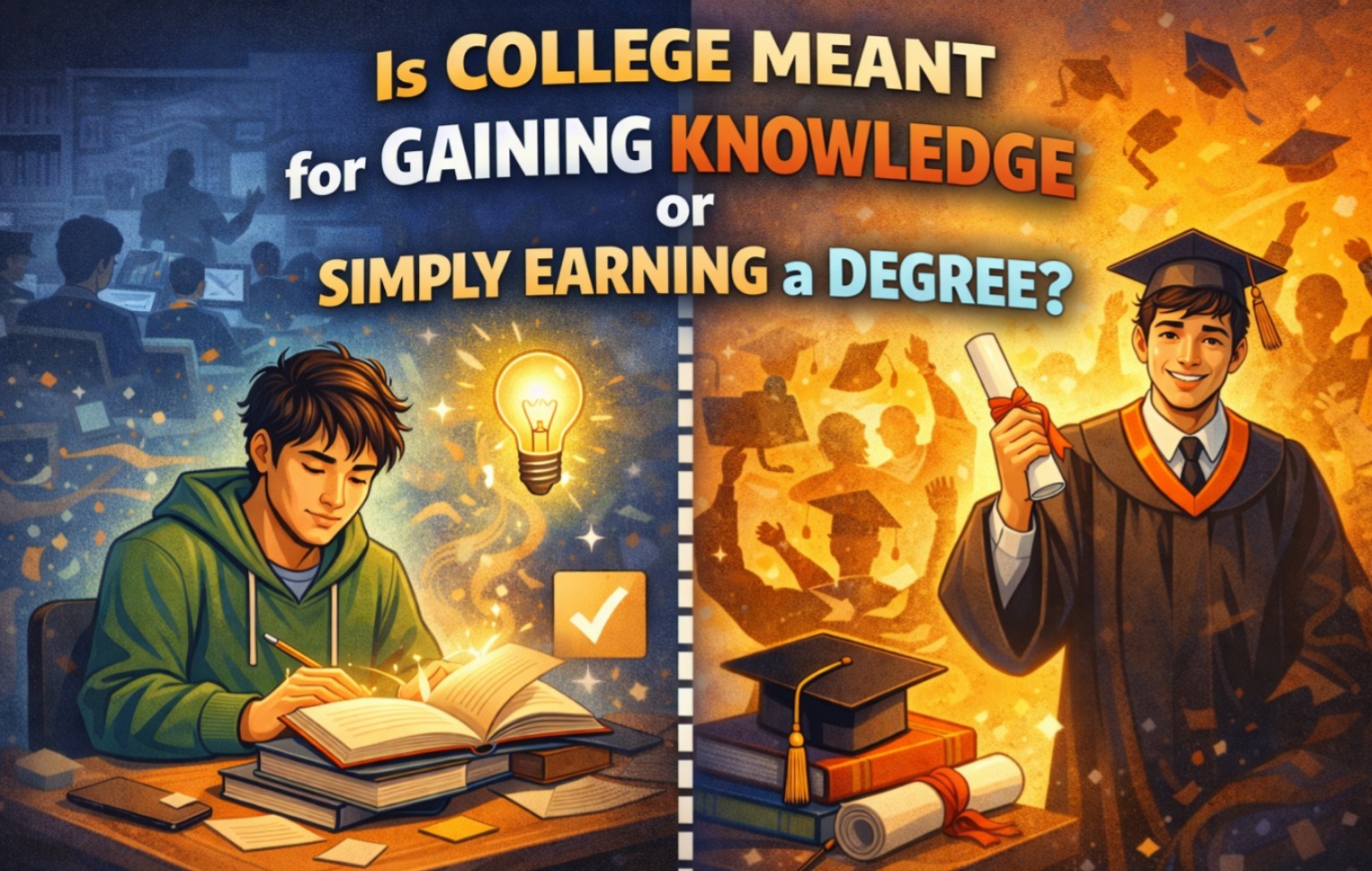
Amid the increasingly competitive job market, a frequently discussed question arises: is college still truly about gaining knowledge, or has it become merely a formality to obtain a degree? This question feels especially relevant in an era when many companies prioritize practical skills over academic background alone.
This phenomenon has led many students to question their primary purpose for attending college. Is it to broaden their perspectives, build character, and enhance competence? Or is it simply to meet social expectations and administrative requirements in the professional world?
THE SHIFTING MEANING OF COLLEGE IN THE MODERN ERA
In the past, college was seen as the main gateway to knowledge and upward mobility. Universities were spaces for discussion, research, and personal development. Today, however, some view college as nothing more than a minimum requirement in the recruitment process.
Many students focus on achieving high GPAs without truly understanding the material they study. An education system that heavily emphasizes grades further reinforces the mindset that graduating quickly and earning a degree is what matters most.
At the same time, changes in industry demands play a significant role. The job market increasingly values technical skills, internship experience, and soft skills such as communication and problem-solving. A bachelor’s degree alone is no longer sufficient without real, applicable abilities.
THE STUDENT’S ROLE IN DEFINING THE VALUE OF COLLEGE
Ultimately, the meaning of college depends on how students choose to experience it. Universities provide facilities and opportunities, but it is up to students to decide whether to take full advantage of them.
Students who actively participate in organizations, seminars, research projects, or internships tend to gain more comprehensive experiences. They acquire not only theoretical knowledge but also practical skills and professional networks.
On the other hand, if college is approached merely as attending classes and aiming for graduation, the experience may feel superficial. The degree is earned, but competence may not be fully developed.
CURRENT CHALLENGES IN HIGHER EDUCATION
One major challenge in higher education today is aligning curricula with industry needs. Many graduates struggle to adapt because what they learned in college does not always match workplace realities.
Moreover, with the widespread access to information through the internet, learning is no longer limited to campus. Online courses, digital training programs, and professional certifications have become attractive alternatives for younger generations.
This raises a new question: if knowledge is accessible everywhere, what makes college remain relevant? The answer lies in structured learning experiences, academic mentorship, and an environment that supports character development and critical thinking.
COLLEGE AS A LONG-TERM INVESTMENT
Despite ongoing debates, college still holds strategic value when viewed as a long-term investment. Higher education is not only about securing a first job but also about building a foundation for critical thinking, professional ethics, and adaptability.
A degree is important as formal proof of academic achievement. However, the true value of college lies in the learning process—discussions, idea exploration, intellectual growth, and the development of resilience.
With the right mindset, college can become a combination of knowledge-seeking and career preparation. The degree itself is not the final goal, but rather part of a continuous journey of self-development.
CONCLUSION
Is college meant for gaining knowledge or simply earning a degree? The answer depends on how we define it. When pursued with the intention to grow, college remains a valuable space for learning. But when focused solely on obtaining a degree, the true essence of education can easily be lost.
In today’s modern era, students are expected to be more proactive, adaptive, and strategic in making the most of their college years. A degree matters—but competence and character ultimately shape the future.
Tentang Penulis
Gusti Ayu Tita
Penulis — Universitas STEKOM
Penulis aktif yang berfokus pada isu-isu akademik, teknologi pendidikan, dan pengembangan sumber daya manusia di lingkungan kampus.