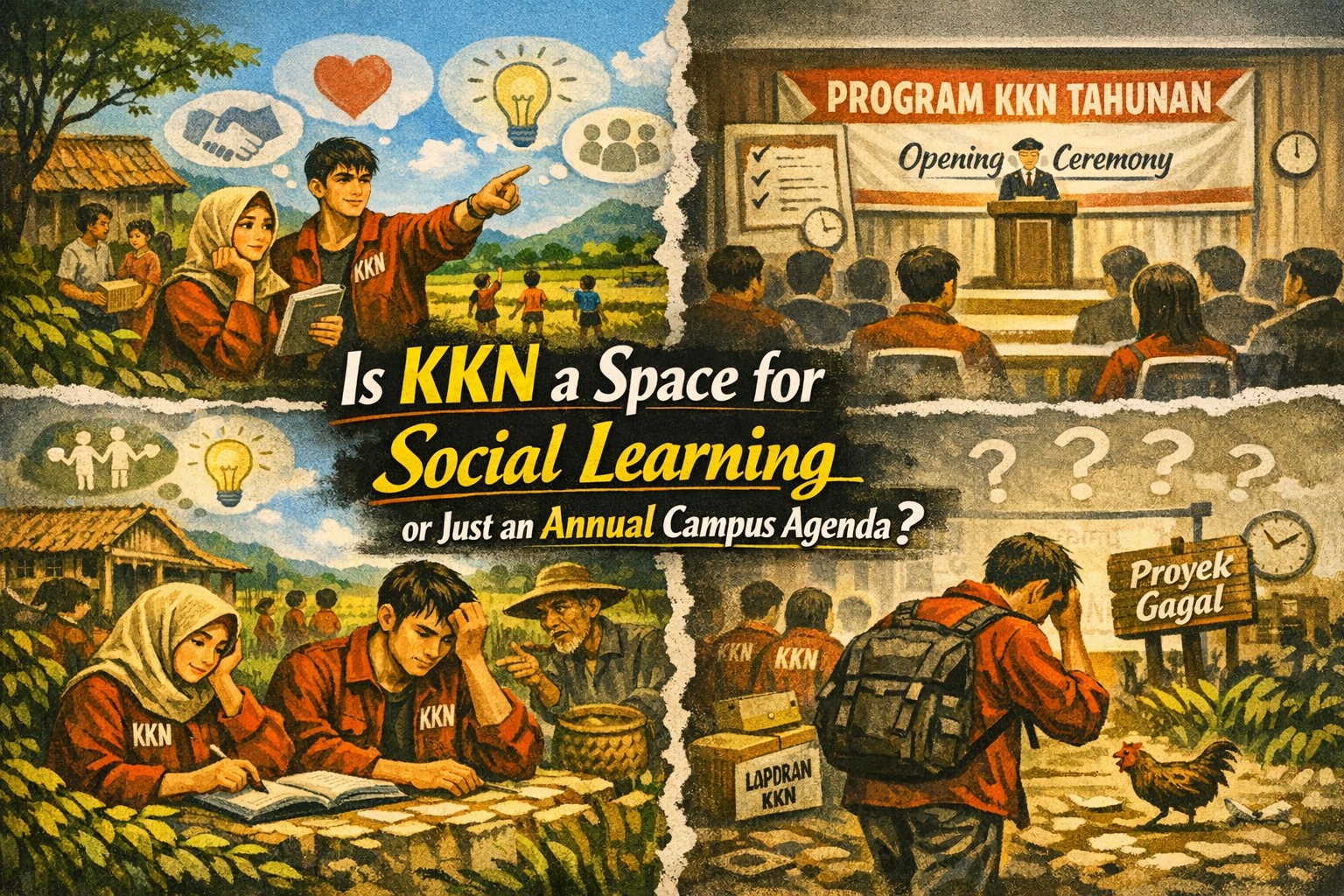
For decades, KKN (Kuliah Kerja Nyata) has been a mandatory program for many university students in Indonesia. Officially, it is designed as a form of community engagement and experiential learning. Yet, among students, a recurring question continues to surface: is KKN truly a space for social learning, or has it become merely an annual campus agenda?
This article examines the dual identity of KKN and evaluates its relevance in today’s academic landscape.
THE CONCEPT OF KKN AS SOCIAL LEARNING
At its core, KKN is meant to expose students to social realities beyond the classroom. By living and working within communities, students are expected to learn directly from real-life situations—understanding cultural values, local problems, and social dynamics.
This process turns society into a learning space. Students develop empathy, communication skills, and problem-solving abilities that cannot be fully taught through lectures or textbooks.
WHEN KKN FEELS LIKE A ROUTINE CAMPUS AGENDA
Despite its learning potential, KKN is often perceived as a routine academic requirement. For some students, it becomes a yearly agenda repeated without significant innovation.
Several factors contribute to this perception:
- Standardized programs applied to diverse communities
- Emphasis on schedules, reports, and formal completion
- Limited flexibility for creative or context-based initiatives
- Focus on fulfilling academic credits rather than learning depth
When these elements dominate, KKN risks losing its educational essence.
THE ROLE OF STUDENT ENGAGEMENT
Whether KKN becomes meaningful or merely procedural largely depends on student involvement. Active participation, curiosity, and openness to learning play a crucial role.
Students who interact deeply with communities often gain valuable insights, while those who treat KKN as a task to finish may miss its learning opportunities. Social learning requires presence, listening, and reflection—not just physical attendance.
COMMUNITY AS A LEARNING PARTNER
KKN can only function as social learning when communities are seen as partners, not objects of intervention. Mutual respect and collaboration allow students to learn local knowledge while contributing appropriately.
Without this partnership, activities may feel superficial, reinforcing the idea that KKN is just an annual agenda with limited relevance.
REDEFINING THE PURPOSE OF KKN
To strengthen its role as a learning space, KKN needs a shift in focus:
- From output-based evaluation to reflection-based learning
- From short-term activities to sustainable engagement
- From uniform programs to context-sensitive approaches
This shift requires commitment from universities, supervisors, and students alike.
WHY KKN STILL MATTERS
Even with its challenges, KKN remains one of the few academic programs that directly connects students with social reality. It provides exposure to inequality, diversity, and real-life problem solving.
When approached thoughtfully, KKN offers lessons that shape students into socially aware graduates—far beyond what a campus agenda alone can achieve.
CONCLUSION
So, is KKN a space for social learning or just an annual campus agenda? The answer depends on how it is implemented and experienced.
KKN becomes social learning when reflection, engagement, and collaboration are prioritized. Without these elements, it risks becoming a repetitive academic routine. Ultimately, the true value of KKN lies in its ability to transform experiences into understanding.
Tentang Penulis
Gusti Ayu Tita
Penulis — Universitas STEKOM
Penulis aktif yang berfokus pada isu-isu akademik, teknologi pendidikan, dan pengembangan sumber daya manusia di lingkungan kampus.