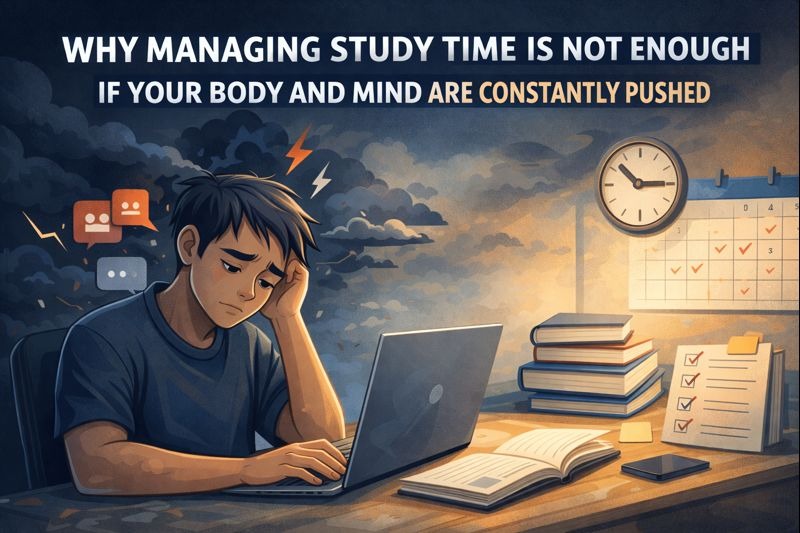
Many students believe that the main problem in college life is poor time management. A well-organized schedule is often seen as the solution to piled-up assignments, consecutive deadlines, and academic pressure. However, in reality, time management alone is often not enough—especially when the body and mind are continuously pushed without rest.
A NEAT SCHEDULE DOES NOT ALWAYS GUARANTEE SUSTAINABILITY
Creating schedules for classes, studying, and organizational activities is indeed important. However, an overly packed schedule can become a new source of stress. When every moment is filled with obligations, students lose the space to breathe and recover their energy.
Healthy time management should offer flexibility, not merely cram activities into a single day. Without flexibility, schedules become tools for forcing oneself to keep going even when exhaustion sets in.
THE BODY AND MIND HAVE LIMITS
Academic productivity often demands students to stay active, focused, and ready to face challenges. Unfortunately, the human body and mind have natural limits. Lack of sleep, irregular eating habits, and continuous mental pressure negatively affect learning ability.
Ignoring these signs of fatigue does not only reduce performance but can also lead to mental exhaustion that is difficult to recover from quickly.
THE CULTURE OF BUSYNESS ON CAMPUS
Campus environments often normalize excessive busyness. Students who are constantly active are seen as more accomplished, while those who take breaks are considered less dedicated. This culture pushes many students to keep forcing themselves just to avoid falling behind.
As a result, managing study time turns into a competition of who is the busiest, rather than who can maintain balance.
SELF-MANAGEMENT GOES BEYOND TIME MANAGEMENT
Managing college life should be accompanied by the ability to manage energy, emotions, and self-expectations. Students need to learn when to focus, when to rest, and when to say “enough.”
Self-management helps students realize that productivity is not about doing everything, but about choosing what truly matters and aligns with personal capacity.
BUILDING A MORE HUMANE LEARNING PATTERN
A healthy learning pattern allows the body and mind to recover. Adequate rest, guilt-free leisure time, and non-academic activities help maintain mental balance. With more stable conditions, students are actually better prepared to face academic demands.
Learning does not always have to feel overwhelming. When done with a humane rhythm, the college experience becomes more meaningful and sustainable.
CONCLUSION: TIME ALONE IS NOT ENOUGH WITHOUT BALANCE
Managing study time is important, but it will not be effective if the body and mind are constantly pushed beyond their limits. Healthy time management must go hand in hand with awareness of physical and mental needs.
Students who maintain personal balance do not only survive college life but grow holistically without sacrificing their well-being.
**Keywords:**
Tentang Penulis
Gusti Ayu Tita
Penulis — Universitas STEKOM
Penulis aktif yang berfokus pada isu-isu akademik, teknologi pendidikan, dan pengembangan sumber daya manusia di lingkungan kampus.