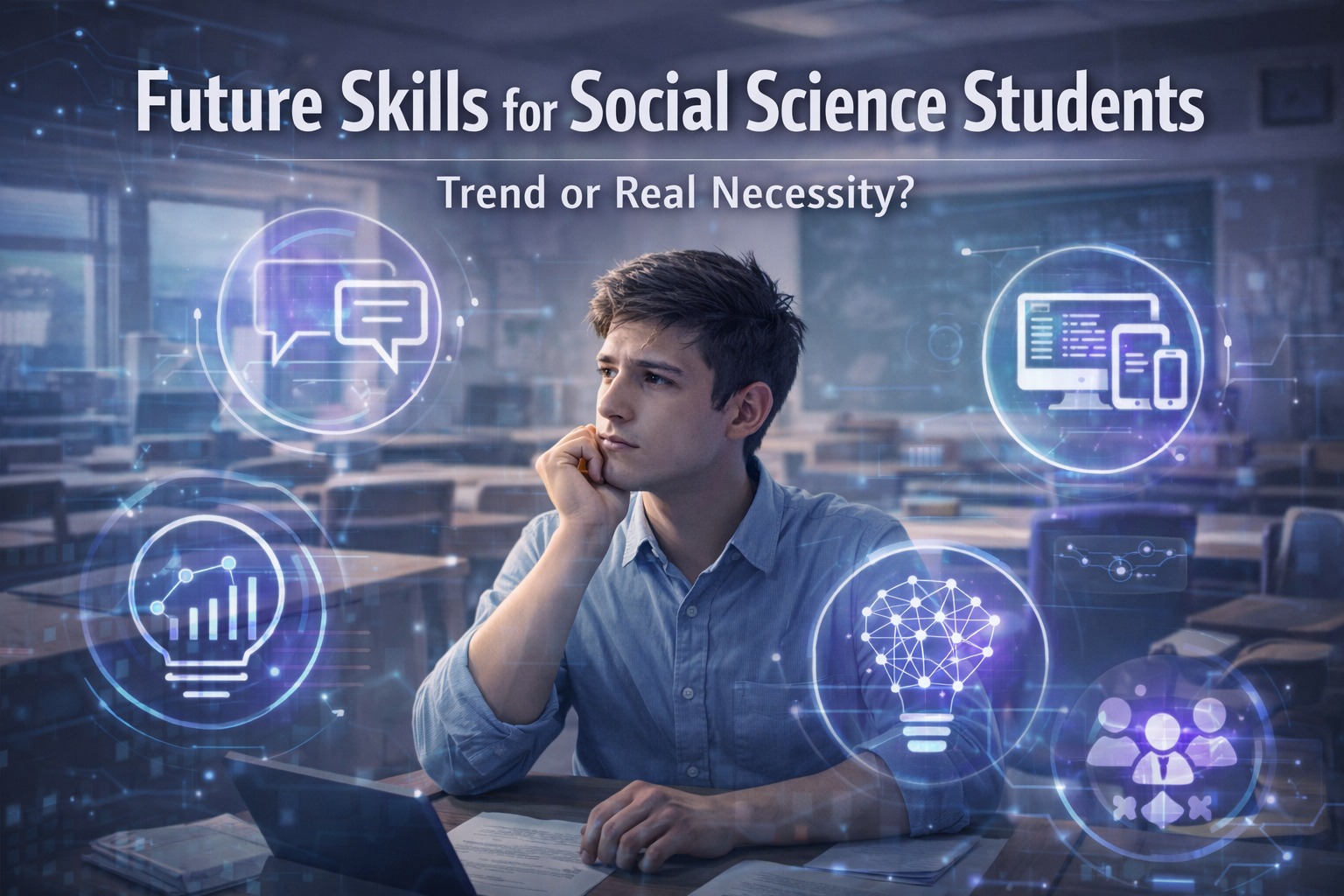
In an era of rapid globalization, the education sector faces major challenges in preparing future generations. For students in the Social Sciences and Humanities (Soshum), the skills required to compete in an evolving job market are often debated. Are these skills merely trends, or are they genuine necessities? This article examines the relevance of future skills for social science students in the context of a changing world.
A FUTURE FULL OF CHALLENGES
Technological advancement and the Fourth Industrial Revolution have significantly transformed the labor market. Digitalization and automation dominate many sectors, replacing certain human roles while simultaneously creating new opportunities that demand new skills. Abilities such as data analysis, digital literacy, and high-level creativity are increasingly viewed as essential for survival in a dynamic workforce.
This raises an important question: what does this mean for social science students? Are technical skills the only requirement, or are there other equally important competencies?
ESSENTIAL SKILLS FOR SOCIAL SCIENCE STUDENTS
Social science students typically focus on disciplines such as sociology, psychology, economics, law, and political science. Although these fields may appear non-technical, the skills required for future success are diverse.
1. Analytical and Problem-Solving Skills
The ability to analyze data and solve problems creatively is essential. Policy analysts and socio-economic researchers, for example, must interpret data accurately and propose applicable solutions. Critical thinking is particularly important in an era of information overload.
2. Effective Communication Skills
Communication is fundamental for social science students who frequently engage in human interaction across business, political, and social contexts. The ability to articulate ideas clearly and persuasively—both orally and in writing—is indispensable.
3. Digital Literacy
Digital skills are increasingly required across all sectors. For social science students, digital literacy extends beyond basic tool usage to include efficient information management, data security awareness, and the use of digital platforms to enhance performance.
4. Creativity and Innovation
Creativity is crucial in policymaking, research design, and academic writing. The ability to think beyond conventional approaches and offer innovative solutions provides a significant competitive advantage.
BETWEEN TRENDS AND REAL NEEDS
Some skills gain popularity due to industry trends rather than genuine necessity. For instance, data science and artificial intelligence are often promoted as universally essential. However, their relevance varies depending on specialization.
For social science students, core skills such as analytical thinking, communication, and creativity remain fundamental. At the same time, technology-based skills—such as using big data or machine learning for social research—are becoming increasingly relevant and, in some cases, indispensable.
CONCLUSION
Future skills for social science students should not be viewed merely as trends. While adapting to technological developments is important, foundational skills such as critical analysis, communication, and creativity remain central to professional success.
By balancing technological competencies with social and humanistic skills, social science students can better prepare themselves for an evolving labor market while maintaining the core values of their disciplines.
Tentang Penulis
Gusti Ayu Tita
Penulis — Universitas STEKOM
Penulis aktif yang berfokus pada isu-isu akademik, teknologi pendidikan, dan pengembangan sumber daya manusia di lingkungan kampus.