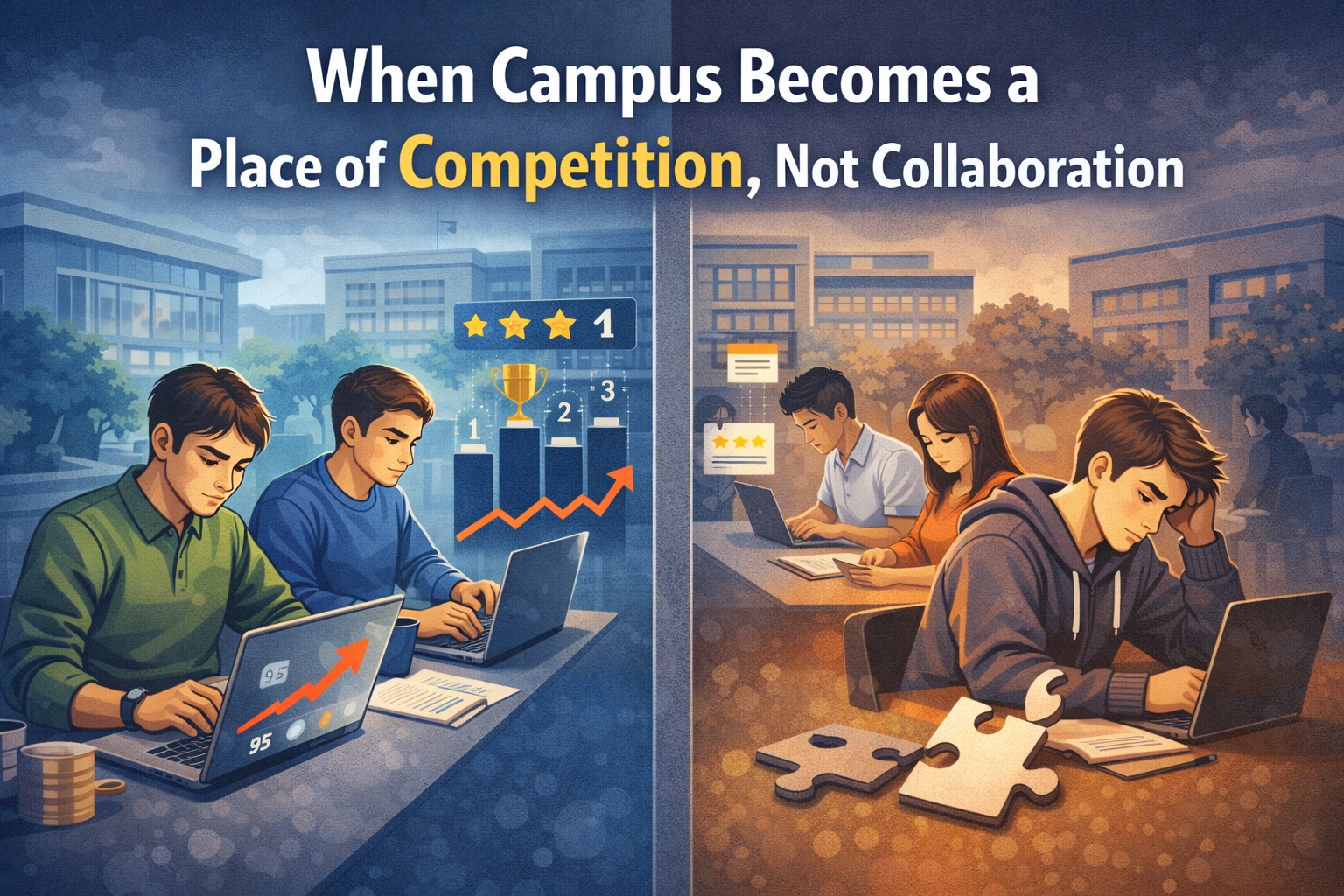
Ideally, a campus should be a learning space that encourages collaboration, exchange of ideas, and shared growth. However, in reality, many students feel that campus life resembles a competition arena. The race for grades, achievements, and recognition often pushes students to compete, sometimes at the expense of cooperation and solidarity. This phenomenon is a modern student reality that is rarely discussed in depth. When competition dominates over collaboration, the learning process risks losing its human values.
THE CULTURE OF COMPETITION ON CAMPUS
Higher education systems that emphasize individual achievement often trigger a culture of competition. Academic grades, rankings, and personal awards become the main indicators of success.
In this situation, students are encouraged to constantly compare themselves with others. The focus shifts from understanding the material to outperforming peers. Competition without balanced collaboration can create distance between students.
THE IMPACT OF COMPETITION ON MENTAL HEALTH
An overly competitive campus environment can trigger psychological pressure. Students feel they must always excel, fear falling behind, and worry about not meeting existing standards.
This pressure can lead to stress, mental exhaustion, and decreased self-confidence. Instead of supporting one another, students may feel alone in facing academic demands.
COLLABORATION THAT IS SLOWLY FADING
Collaboration should be at the heart of the learning process in higher education. Discussions, group work, and exchanging perspectives help students develop critical thinking and empathy.
However, when competition becomes dominant, collaboration may be seen as a threat. Information is kept to oneself, group work becomes a formality, and creating trust among students becomes more difficult.
THE ROLE OF SYSTEMS AND CAMPUS ENVIRONMENT
The campus environment plays a major role in shaping student interactions. Assessment systems, teaching methods, and how lecturers build classroom dynamics determine whether students are encouraged to compete or collaborate.
Campuses that promote open discussion, collaborative projects, and process-based evaluation are more likely to create a healthy and inclusive learning atmosphere.
REBUILDING THE VALUE OF COLLABORATION
Restoring collaboration does not mean eliminating competition entirely. Healthy competition is still needed to encourage self-development. However, it must be directed in a way that does not damage social relationships or student mental health.
Students need to understand that success is not always individual. The ability to work together, share roles, and support each other is an essential skill in both the workplace and society.
TOWARD A MORE HUMAN-CENTERED CAMPUS
An ideal campus is a place where students grow together, not bring each other down. Creating a balance between competition and collaboration is an important step toward a more humane educational environment.
By placing collaboration as a core value, campuses can become safe spaces for students to learn, grow, and support one another in facing academic and life challenges.
Tentang Penulis
Gusti Ayu Tita
Penulis — Universitas STEKOM
Penulis aktif yang berfokus pada isu-isu akademik, teknologi pendidikan, dan pengembangan sumber daya manusia di lingkungan kampus.