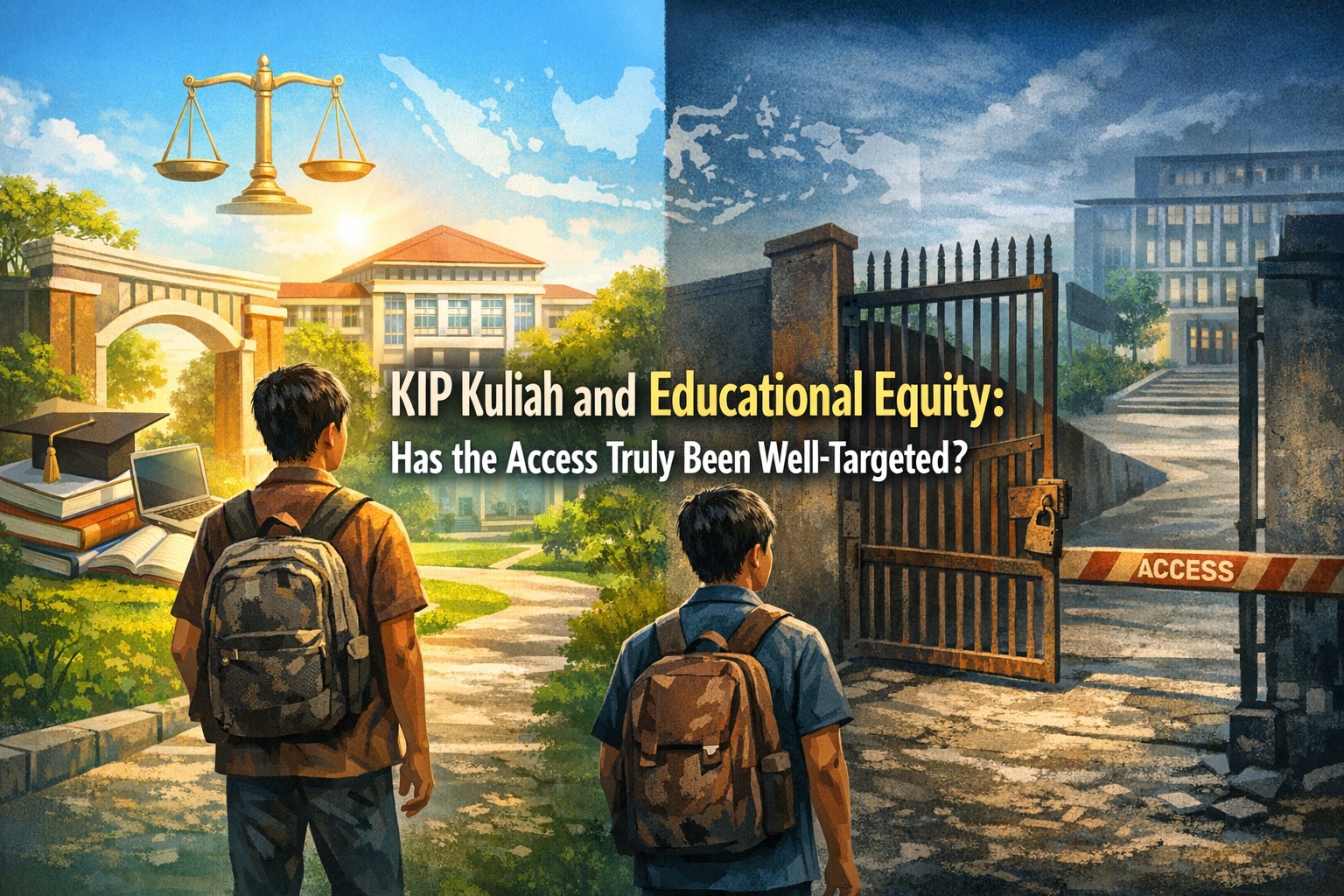
Education is a fundamental right of every citizen without exception. However, in Indonesia, economic inequality remains a major barrier preventing many students from continuing their education to a higher level. To address this challenge, the government launched **Kartu Indonesia Pintar Kuliah (KIP Kuliah)**—a program aimed at expanding access to higher education for students from underprivileged families.
Nevertheless, an important question arises: Has KIP Kuliah truly been well-targeted in supporting educational equity, or does inequality still persist in practice?
AN OVERVIEW OF KIP KULIAH
KIP Kuliah is a higher-education financial assistance program for students from low-income families who wish to pursue university studies.
The program includes:
- Full tuition fee exemption,
- Monthly living cost assistance,
- Financial support throughout the study period until on-time graduation.
The primary goal of KIP Kuliah is to achieve equal access to higher education so that all Indonesian students have the same opportunity to attend university, regardless of their economic background.
KIP KULIAH AS A TOOL FOR EDUCATIONAL EQUITY
Since its launch, KIP Kuliah has supported hundreds of thousands of students across Indonesia. Several positive impacts have been observed, including:
1. Increased participation in higher education among students from low-income families.
2. A decline in university dropout rates caused by financial constraints.
3. Growing academic motivation among disadvantaged students to pursue their aspirations through education.
4. An increase in the number of students from 3T regions (frontier, outermost, and underdeveloped areas) enrolled in both public and private universities.
Overall, the program has served as a bridge between opportunity and economic limitation—an important step toward social justice in education.
ONGOING CHALLENGES IN TARGETING ACCURACY
Despite its noble objectives, the implementation of KIP Kuliah has not always been smooth. Several recurring issues include:
- Inaccurate beneficiary data, resulting in some financially capable students receiving assistance.
- Limited outreach in remote areas, leaving many disadvantaged students unaware of how to apply.
- Restricted recipient quotas, preventing all eligible students from receiving support despite meeting economic criteria.
- Insufficient inter-agency integration, particularly in verifying household welfare data.
These challenges raise serious concerns about how accurately KIP Kuliah targets its intended beneficiaries in promoting educational equity.
IMPROVEMENT EFFORTS TO ENSURE BETTER TARGETING
To ensure that fair access to education is genuinely achieved, several strategic measures should be implemented:
1. Improving the national data system to ensure greater accuracy and stronger integration with the Integrated Social Welfare Data (DTKS).
2. Enhancing transparency and public oversight in the selection and aid distribution processes.
3. Expanding and equalizing outreach efforts, particularly in schools located in remote regions.
4. Conducting regular evaluations and involving universities to ensure that beneficiaries truly come from families in need.
Through these measures, KIP Kuliah can operate more effectively and truly function as a national instrument for educational equity.
CONCLUSION
KIP Kuliah is one of Indonesia’s most strategic educational programs in promoting social justice. It has provided new hope for thousands of underprivileged students to pursue higher education.
However, to achieve genuine educational equity, accurate targeting must remain a top priority. Without reliable data, equal outreach, and transparent oversight, the full potential of KIP Kuliah as a driver of educational equity will not be fully realized.
Tentang Penulis
Gusti Ayu Tita
Penulis — Universitas STEKOM
Penulis aktif yang berfokus pada isu-isu akademik, teknologi pendidikan, dan pengembangan sumber daya manusia di lingkungan kampus.