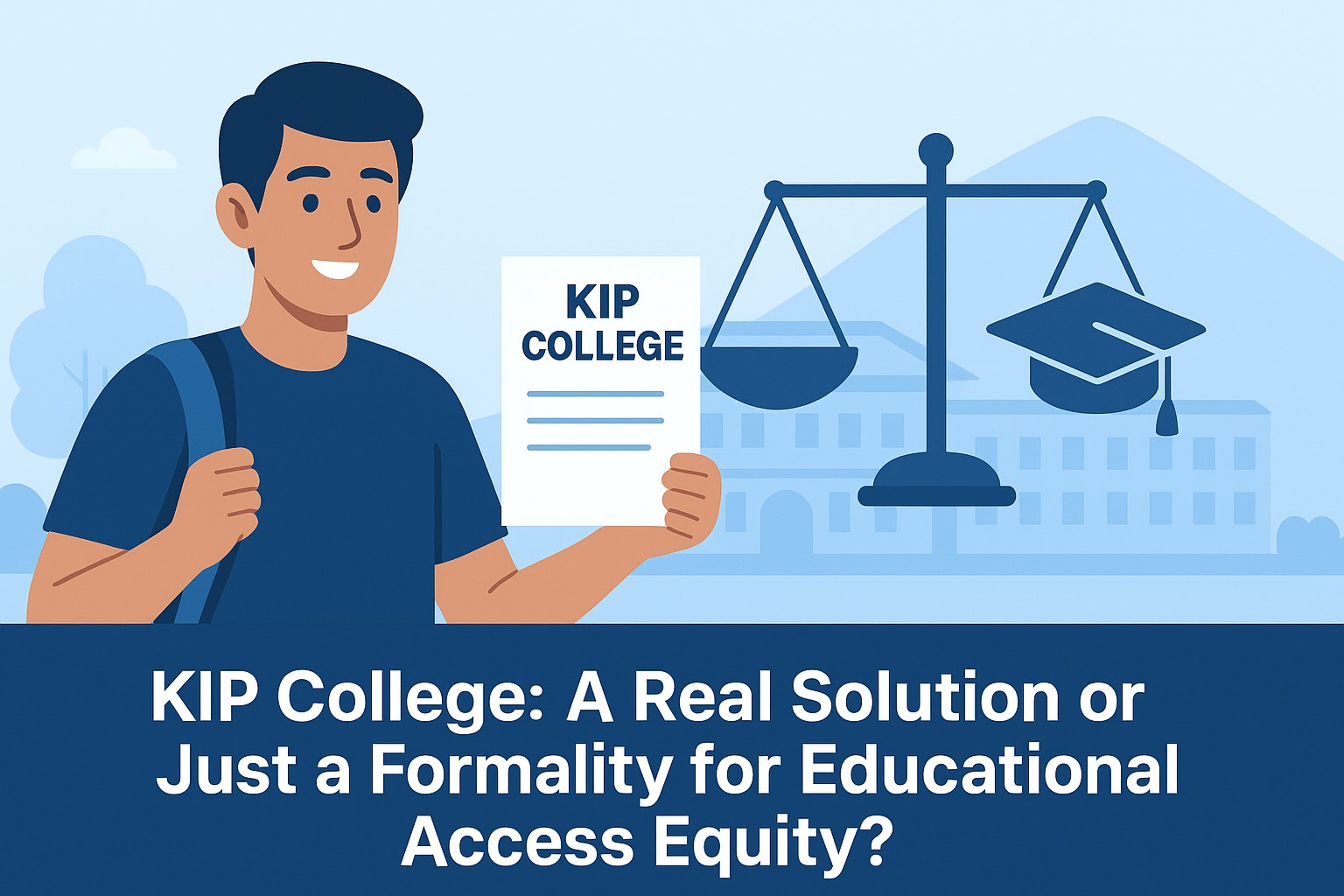
Higher education should be a right for every citizen, regardless of economic background. However, in reality, many students in Indonesia are still forced to bury their dreams of going to college due to financial limitations. To address this issue, the government introduced the Kartu Indonesia Pintar Kuliah (KIP Kuliah) as financial support for underprivileged students.
This leads to an important question — is KIP Kuliah truly an effective solution for ensuring equitable access to education, or is it merely an administrative formality with limited real impact?
WHAT IS KIP KULIAH AND ITS PURPOSE?
KIP Kuliah is a government assistance program that provides educational support for prospective students who come from economically disadvantaged families but demonstrate strong academic performance. This assistance includes:
- Full tuition fees for public or private universities,
- Monthly living allowance,
- Support for students from their first year until graduation, provided they complete their studies on time
The main goal of this program is to create equal opportunities in education and ensure that financial hardship does not prevent anyone from pursuing higher education.
KIP KULIAH AS A REAL SOLUTION: IMPACT AND BENEFITS
Undeniably, since its launch, KIP Kuliah has opened opportunities for thousands of young people across Indonesia. Some of its proven benefits include:
- Increasing participation in higher education among low-income families,
- Reducing dropout rates caused by financial barriers,
- Promoting equal access to education between urban areas and remote regions,
- Encouraging academic motivation among underprivileged students who now see college as an attainable dream.
The success stories of many KIP Kuliah recipients—who have gone on to become young professionals—demonstrate that this program has enabled fairer social mobility.
BUT IS KIP KULIAH TRULY WELL-TARGETED?
Despite its positive impact, several challenges still hinder the effectiveness of the program. Some of these include:
- Inaccurate recipient data, causing eligible students to miss out on assistance,
- Limited outreach in remote areas, leaving many potential beneficiaries unaware of the registration process,
- Slow and bureaucratic verification procedures, leading to delayed disbursement of funds,
- The perception that the program is merely administrative, functioning but not fully eliminating educational inequality.
In other words, although KIP Kuliah is beneficial, there is still a gap between policy expectations and on-the-ground realities.
STEPS TOWARD TRUE EDUCATION ACCESS EQUITY
To ensure that KIP Kuliah becomes more than a formality, several important steps need attention:
- Improving the national data system to ensure recipients truly come from underprivileged families,
- Increasing transparency and public oversight of fund distribution,
- Expanding outreach in underserved areas so that information about KIP Kuliah reaches everyone,
- Strengthening collaboration with universities and local governments to support recipients throughout their study period.
With these systemic improvements, KIP Kuliah can become a genuine tool for educational equity, not just a symbolic policy.
CONCLUSION
KIP Kuliah is a significant government initiative aimed at opening access to higher education for all segments of society. The program has helped many students pursue their dreams of attending college without financial burden.
However, to make it a truly impactful solution—and not merely a formality—greater transparency, equitable information distribution, and strong oversight are essential to ensure the assistance reaches the right people.
Tentang Penulis
Gusti Ayu Tita
Penulis — Universitas STEKOM
Penulis aktif yang berfokus pada isu-isu akademik, teknologi pendidikan, dan pengembangan sumber daya manusia di lingkungan kampus.